

u D
ð Þ= 0,
w D
ð Þ= 0,
w 0
ð Þ
u 0
ð Þ
= h
′ x
ð Þ.
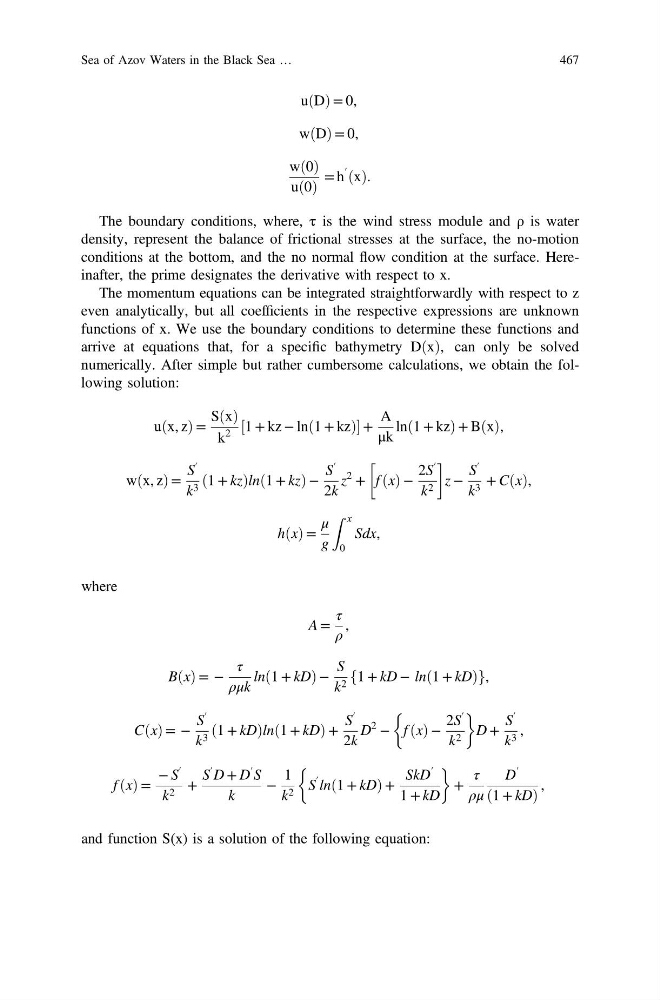
The boundary conditions, where, τ is the wind stress module and ρ is water
density, represent the balance of frictional stresses at the surface, the no-motion
conditions at the bottom, and the no normal flow condition at the surface. Hereinafter, the prime designates the derivative with respect to x.
The momentum equations can be integrated straightforwardly with respect to z
even analytically, but all coefficients in the respective expressions are unknown
functions of x. We use the boundary conditions to determine these functions and
arrive at equations that, for a specific bathymetry D x
ð Þ, can only be solved
numerically. After simple but rather cumbersome calculations, we obtain the following solution:
u x, z
ð Þ=
S x
ð Þ
k
2
1 + kz − ln 1 + kz
ð
Þ
½
+
A
μk
ln 1 + kz
ð
Þ+ B x
ð Þ,
w x, z
ð Þ=
S
′
k 3 1 + kz
ð
Þln 1 + kz
ð
Þ−
S
′
2k
z
2 + f x
ð Þ −
2S
′
k 2
!
z −
S
′
k 3 + C x
ð Þ,
h x
ð Þ =
μ
g
Z x
0
Sdx,
where
A =
τ
ρ
,
B x
ð Þ = −
τ
ρμk
ln 1 + kD
ð
Þ−
S
k 2 1 + kD − ln 1 + kD
ð
Þ
f
g ,
C x
ð Þ = −
S
′
k 3 1 + kD
ð
Þln 1 + kD
ð
Þ+
S
′
2k
D
2
− f x
ð Þ −
2S
′
k 2
&
'
D +
S
′
k 3 ,
f x
ð Þ =
− S
′
k 2 +
S
′ D + D
′ S
k
−
1
k 2 S
′ ln 1 + kD
ð
Þ+
SkD
′
1 + kD
&
'
+
τ
ρμ
D
′
1 + kD
ð
Þ
,
and function S(x) is a solution of the following equation:
Sea of Azov Waters in the Black Sea …
467
ð Þ= 0,
w D
ð Þ= 0,
w 0
ð Þ
u 0
ð Þ
= h
′ x
ð Þ.
The boundary conditions, where, τ is the wind stress module and ρ is water
density, represent the balance of frictional stresses at the surface, the no-motion
conditions at the bottom, and the no normal flow condition at the surface. Hereinafter, the prime designates the derivative with respect to x.
The momentum equations can be integrated straightforwardly with respect to z
even analytically, but all coefficients in the respective expressions are unknown
functions of x. We use the boundary conditions to determine these functions and
arrive at equations that, for a specific bathymetry D x
ð Þ, can only be solved
numerically. After simple but rather cumbersome calculations, we obtain the following solution:
u x, z
ð Þ=
S x
ð Þ
k
2
1 + kz − ln 1 + kz
ð
Þ
½
+
A
μk
ln 1 + kz
ð
Þ+ B x
ð Þ,
w x, z
ð Þ=
S
′
k 3 1 + kz
ð
Þln 1 + kz
ð
Þ−
S
′
2k
z
2 + f x
ð Þ −
2S
′
k 2
!
z −
S
′
k 3 + C x
ð Þ,
h x
ð Þ =
μ
g
Z x
0
Sdx,
where
A =
τ
ρ
,
B x
ð Þ = −
τ
ρμk
ln 1 + kD
ð
Þ−
S
k 2 1 + kD − ln 1 + kD
ð
Þ
f
g ,
C x
ð Þ = −
S
′
k 3 1 + kD
ð
Þln 1 + kD
ð
Þ+
S
′
2k
D
2
− f x
ð Þ −
2S
′
k 2
&
'
D +
S
′
k 3 ,
f x
ð Þ =
− S
′
k 2 +
S
′ D + D
′ S
k
−
1
k 2 S
′ ln 1 + kD
ð
Þ+
SkD
′
1 + kD
&
'
+
τ
ρμ
D
′
1 + kD
ð
Þ
,
and function S(x) is a solution of the following equation:
Sea of Azov Waters in the Black Sea …
467