

S
′ = −
S
2 kμ
g ln 1 + kD
ð
Þ− kD
ð
Þ
n
o
− S k
2 DD
′ +
k
2 DD
′
1 + kD −
τk
2
gρ ln 1 + kD
ð
Þ
h
i
+
k
3 τDD
′
ρμ 1 + kD
ð
Þ
1 + kD
ð
Þln 1 + kD
ð
Þ+
k 2 D 2
2 − kD 1 + ln 1 + kD
ð
Þ
ð
Þ
.
We obtain S(x) by integrating the latter equation numerically, starting from the
coast where we set S(0) = 0 and then obtain all other unknown functions, which
fully determine the solutions for u(x, z), w(x, z), and h(x).
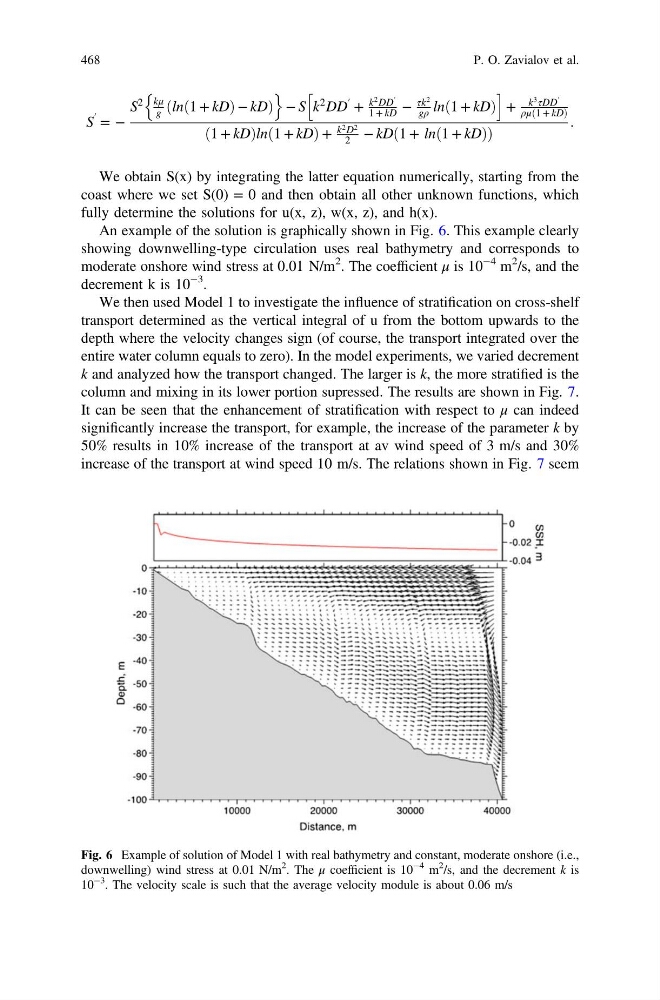
An example of the solution is graphically shown in Fig. 6. This example clearly
showing downwelling-type circulation uses real bathymetry and corresponds to
moderate onshore wind stress at 0.01 N/m
2 . The coefficient μ is 10
−4 m
2 /s, and the
decrement k is 10
−3 .
We then used Model 1 to investigate the influence of stratification on cross-shelf
transport determined as the vertical integral of u from the bottom upwards to the
depth where the velocity changes sign (of course, the transport integrated over the
entire water column equals to zero). In the model experiments, we varied decrement
k and analyzed how the transport changed. The larger is k, the more stratified is the
column and mixing in its lower portion supressed. The results are shown in Fig. 7.
It can be seen that the enhancement of stratification with respect to μ can indeed
significantly increase the transport, for example, the increase of the parameter k by
50% results in 10% increase of the transport at av wind speed of 3 m/s and 30%
increase of the transport at wind speed 10 m/s. The relations shown in Fig. 7 seem
Fig. 6 Example of solution of Model 1 with real bathymetry and constant, moderate onshore (i.e.,
downwelling) wind stress at 0.01 N/m
2
. The μ coefficient is 10
−4 m
2
/s, and the decrement k is
10
−3
. The velocity scale is such that the average velocity module is about 0.06 m/s
468
P. O. Zavialov et al.
′ = −
S
2 kμ
g ln 1 + kD
ð
Þ− kD
ð
Þ
n
o
− S k
2 DD
′ +
k
2 DD
′
1 + kD −
τk
2
gρ ln 1 + kD
ð
Þ
h
i
+
k
3 τDD
′
ρμ 1 + kD
ð
Þ
1 + kD
ð
Þln 1 + kD
ð
Þ+
k 2 D 2
2 − kD 1 + ln 1 + kD
ð
Þ
ð
Þ
.
We obtain S(x) by integrating the latter equation numerically, starting from the
coast where we set S(0) = 0 and then obtain all other unknown functions, which
fully determine the solutions for u(x, z), w(x, z), and h(x).
An example of the solution is graphically shown in Fig. 6. This example clearly
showing downwelling-type circulation uses real bathymetry and corresponds to
moderate onshore wind stress at 0.01 N/m
2 . The coefficient μ is 10
−4 m
2 /s, and the
decrement k is 10
−3 .
We then used Model 1 to investigate the influence of stratification on cross-shelf
transport determined as the vertical integral of u from the bottom upwards to the
depth where the velocity changes sign (of course, the transport integrated over the
entire water column equals to zero). In the model experiments, we varied decrement
k and analyzed how the transport changed. The larger is k, the more stratified is the
column and mixing in its lower portion supressed. The results are shown in Fig. 7.
It can be seen that the enhancement of stratification with respect to μ can indeed
significantly increase the transport, for example, the increase of the parameter k by
50% results in 10% increase of the transport at av wind speed of 3 m/s and 30%
increase of the transport at wind speed 10 m/s. The relations shown in Fig. 7 seem
Fig. 6 Example of solution of Model 1 with real bathymetry and constant, moderate onshore (i.e.,
downwelling) wind stress at 0.01 N/m
2
. The μ coefficient is 10
−4 m
2
/s, and the decrement k is
10
−3
. The velocity scale is such that the average velocity module is about 0.06 m/s
468
P. O. Zavialov et al.