

Simple Mathematical Models
It is our objective to reproduce and quantify the effect of the flow intensification by
means of the simplest models possible. We will consider the stationary state,
2-dimensional setting (i.e., conditions uniform in along-shore direction), and no
Coriolis force as commented above. On the other hand, we retain the “real” bottom
topography in the cross-shore direction.
Model 1: Density is uniform, eddy viscosity linearly decreases with depth
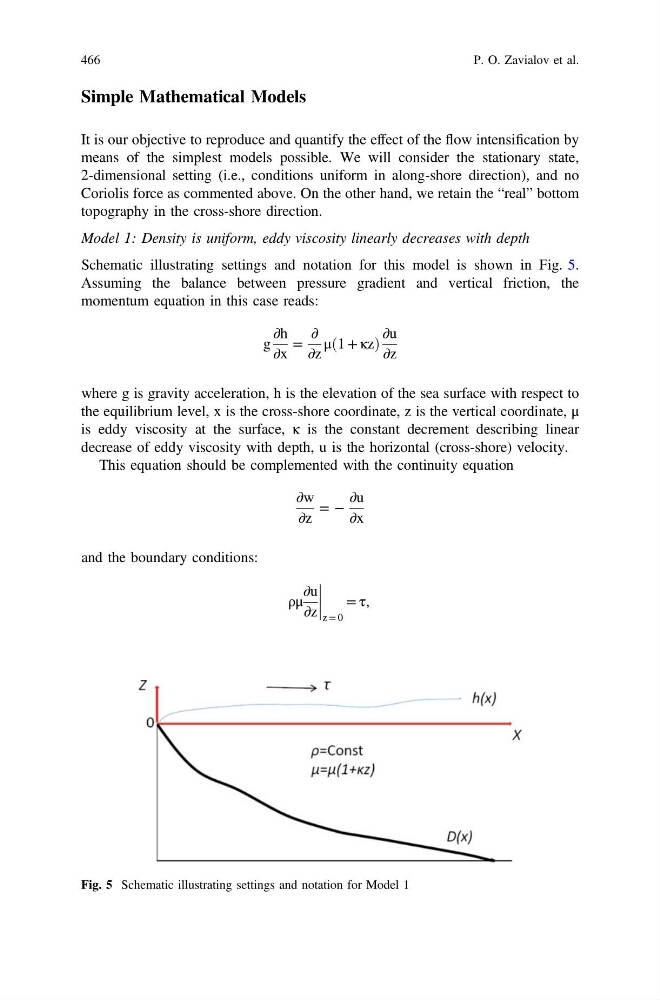
Schematic illustrating settings and notation for this model is shown in Fig. 5.
Assuming the balance between pressure gradient and vertical friction, the
momentum equation in this case reads:
g
∂h
∂x
=
∂
∂z
μ 1 + κz
ð
Þ
∂u
∂z
where g is gravity acceleration, h is the elevation of the sea surface with respect to
the equilibrium level, x is the cross-shore coordinate, z is the vertical coordinate, μ
is eddy viscosity at the surface, κ is the constant decrement describing linear
decrease of eddy viscosity with depth, u is the horizontal (cross-shore) velocity.
This equation should be complemented with the continuity equation
∂w
∂z
= −
∂u
∂x
and the boundary conditions:
ρμ
∂u
∂z
z = 0
= τ,
Fig. 5 Schematic illustrating settings and notation for Model 1
466
P. O. Zavialov et al.
It is our objective to reproduce and quantify the effect of the flow intensification by
means of the simplest models possible. We will consider the stationary state,
2-dimensional setting (i.e., conditions uniform in along-shore direction), and no
Coriolis force as commented above. On the other hand, we retain the “real” bottom
topography in the cross-shore direction.
Model 1: Density is uniform, eddy viscosity linearly decreases with depth
Schematic illustrating settings and notation for this model is shown in Fig. 5.
Assuming the balance between pressure gradient and vertical friction, the
momentum equation in this case reads:
g
∂h
∂x
=
∂
∂z
μ 1 + κz
ð
Þ
∂u
∂z
where g is gravity acceleration, h is the elevation of the sea surface with respect to
the equilibrium level, x is the cross-shore coordinate, z is the vertical coordinate, μ
is eddy viscosity at the surface, κ is the constant decrement describing linear
decrease of eddy viscosity with depth, u is the horizontal (cross-shore) velocity.
This equation should be complemented with the continuity equation
∂w
∂z
= −
∂u
∂x
and the boundary conditions:
ρμ
∂u
∂z
z = 0
= τ,
Fig. 5 Schematic illustrating settings and notation for Model 1
466
P. O. Zavialov et al.