

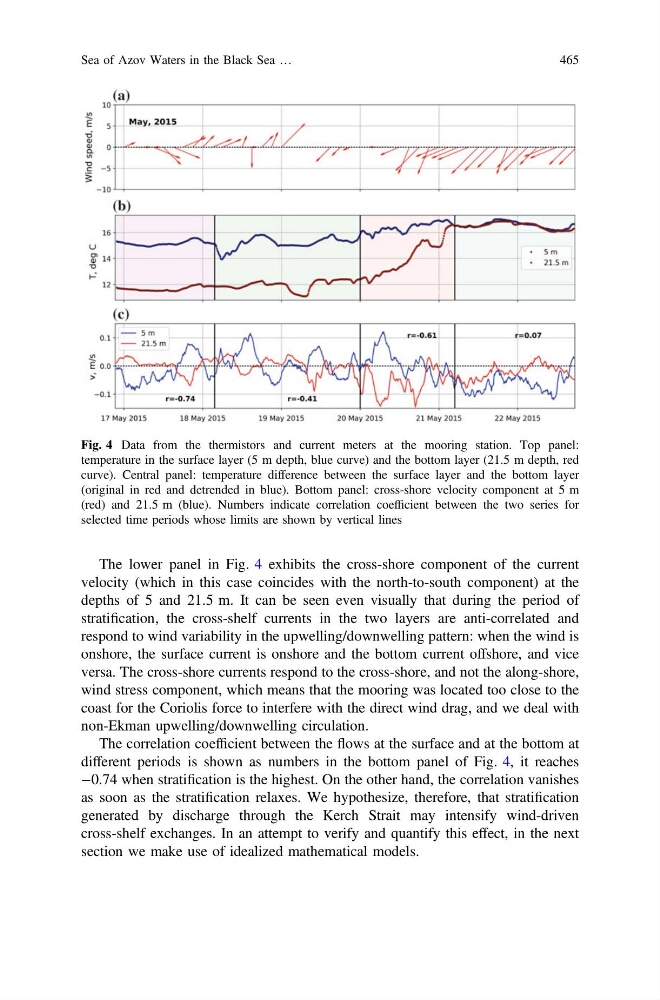
The lower panel in Fig. 4 exhibits the cross-shore component of the current
velocity (which in this case coincides with the north-to-south component) at the
depths of 5 and 21.5 m. It can be seen even visually that during the period of
stratification, the cross-shelf currents in the two layers are anti-correlated and
respond to wind variability in the upwelling/downwelling pattern: when the wind is
onshore, the surface current is onshore and the bottom current offshore, and vice
versa. The cross-shore currents respond to the cross-shore, and not the along-shore,
wind stress component, which means that the mooring was located too close to the
coast for the Coriolis force to interfere with the direct wind drag, and we deal with
non-Ekman upwelling/downwelling circulation.
The correlation coefficient between the flows at the surface and at the bottom at
different periods is shown as numbers in the bottom panel of Fig. 4, it reaches
−0.74 when stratification is the highest. On the other hand, the correlation vanishes
as soon as the stratification relaxes. We hypothesize, therefore, that stratification
generated by discharge through the Kerch Strait may intensify wind-driven
cross-shelf exchanges. In an attempt to verify and quantify this effect, in the next
section we make use of idealized mathematical models.
Fig. 4 Data from the thermistors and current meters at the mooring station. Top panel:
temperature in the surface layer (5 m depth, blue curve) and the bottom layer (21.5 m depth, red
curve). Central panel: temperature difference between the surface layer and the bottom layer
(original in red and detrended in blue). Bottom panel: cross-shore velocity component at 5 m
(red) and 21.5 m (blue). Numbers indicate correlation coefficient between the two series for
selected time periods whose limits are shown by vertical lines
Sea of Azov Waters in the Black Sea …
465
velocity (which in this case coincides with the north-to-south component) at the
depths of 5 and 21.5 m. It can be seen even visually that during the period of
stratification, the cross-shelf currents in the two layers are anti-correlated and
respond to wind variability in the upwelling/downwelling pattern: when the wind is
onshore, the surface current is onshore and the bottom current offshore, and vice
versa. The cross-shore currents respond to the cross-shore, and not the along-shore,
wind stress component, which means that the mooring was located too close to the
coast for the Coriolis force to interfere with the direct wind drag, and we deal with
non-Ekman upwelling/downwelling circulation.
The correlation coefficient between the flows at the surface and at the bottom at
different periods is shown as numbers in the bottom panel of Fig. 4, it reaches
−0.74 when stratification is the highest. On the other hand, the correlation vanishes
as soon as the stratification relaxes. We hypothesize, therefore, that stratification
generated by discharge through the Kerch Strait may intensify wind-driven
cross-shelf exchanges. In an attempt to verify and quantify this effect, in the next
section we make use of idealized mathematical models.
Fig. 4 Data from the thermistors and current meters at the mooring station. Top panel:
temperature in the surface layer (5 m depth, blue curve) and the bottom layer (21.5 m depth, red
curve). Central panel: temperature difference between the surface layer and the bottom layer
(original in red and detrended in blue). Bottom panel: cross-shore velocity component at 5 m
(red) and 21.5 m (blue). Numbers indicate correlation coefficient between the two series for
selected time periods whose limits are shown by vertical lines
Sea of Azov Waters in the Black Sea …
465