

space. Inter-basin and diapycnal volume fluxes in between the 59.5° N section and
the Greenland-Scotland Ridge were then estimated from a box model.
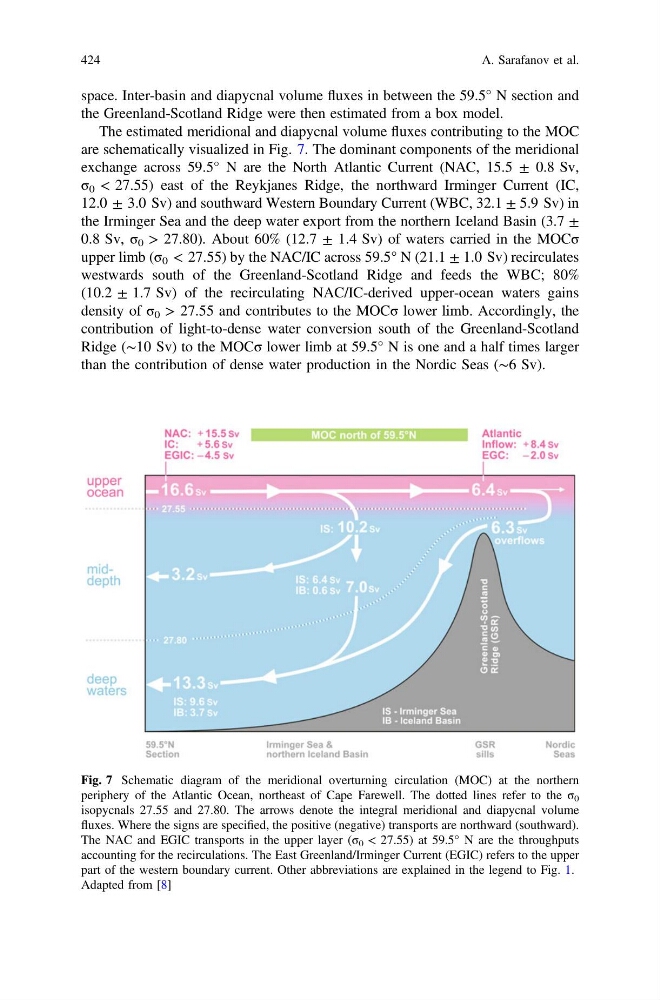
The estimated meridional and diapycnal volume fluxes contributing to the MOC
are schematically visualized in Fig. 7. The dominant components of the meridional
exchange across 59.5° N are the North Atlantic Current (NAC, 15.5 ± 0.8 Sv,
σ 0 < 27.55) east of the Reykjanes Ridge, the northward Irminger Current (IC,
12.0 ± 3.0 Sv) and southward Western Boundary Current (WBC, 32.1 ± 5.9 Sv) in
the Irminger Sea and the deep water export from the northern Iceland Basin (3.7 ±
0.8 Sv, σ 0 > 27.80). About 60% (12.7 ± 1.4 Sv) of waters carried in the MOCσ
upper limb (σ 0 < 27.55) by the NAC/IC across 59.5° N (21.1 ± 1.0 Sv) recirculates
westwards south of the Greenland-Scotland Ridge and feeds the WBC; 80%
(10.2 ± 1.7 Sv) of the recirculating NAC/IC-derived upper-ocean waters gains
density of σ 0 > 27.55 and contributes to the MOCσ lower limb. Accordingly, the
contribution of light-to-dense water conversion south of the Greenland-Scotland
Ridge (∼10 Sv) to the MOCσ lower limb at 59.5° N is one and a half times larger
than the contribution of dense water production in the Nordic Seas (∼6 Sv).
Fig. 7 Schematic diagram of the meridional overturning circulation (MOC) at the northern
periphery of the Atlantic Ocean, northeast of Cape Farewell. The dotted lines refer to the σ 0
isopycnals 27.55 and 27.80. The arrows denote the integral meridional and diapycnal volume
fluxes. Where the signs are specified, the positive (negative) transports are northward (southward).
The NAC and EGIC transports in the upper layer (σ 0 < 27.55) at 59.5° N are the throughputs
accounting for the recirculations. The East Greenland/Irminger Current (EGIC) refers to the upper
part of the western boundary current. Other abbreviations are explained in the legend to Fig. 1.
Adapted from [8]
424
A. Sarafanov et al.
the Greenland-Scotland Ridge were then estimated from a box model.
The estimated meridional and diapycnal volume fluxes contributing to the MOC
are schematically visualized in Fig. 7. The dominant components of the meridional
exchange across 59.5° N are the North Atlantic Current (NAC, 15.5 ± 0.8 Sv,
σ 0 < 27.55) east of the Reykjanes Ridge, the northward Irminger Current (IC,
12.0 ± 3.0 Sv) and southward Western Boundary Current (WBC, 32.1 ± 5.9 Sv) in
the Irminger Sea and the deep water export from the northern Iceland Basin (3.7 ±
0.8 Sv, σ 0 > 27.80). About 60% (12.7 ± 1.4 Sv) of waters carried in the MOCσ
upper limb (σ 0 < 27.55) by the NAC/IC across 59.5° N (21.1 ± 1.0 Sv) recirculates
westwards south of the Greenland-Scotland Ridge and feeds the WBC; 80%
(10.2 ± 1.7 Sv) of the recirculating NAC/IC-derived upper-ocean waters gains
density of σ 0 > 27.55 and contributes to the MOCσ lower limb. Accordingly, the
contribution of light-to-dense water conversion south of the Greenland-Scotland
Ridge (∼10 Sv) to the MOCσ lower limb at 59.5° N is one and a half times larger
than the contribution of dense water production in the Nordic Seas (∼6 Sv).
Fig. 7 Schematic diagram of the meridional overturning circulation (MOC) at the northern
periphery of the Atlantic Ocean, northeast of Cape Farewell. The dotted lines refer to the σ 0
isopycnals 27.55 and 27.80. The arrows denote the integral meridional and diapycnal volume
fluxes. Where the signs are specified, the positive (negative) transports are northward (southward).
The NAC and EGIC transports in the upper layer (σ 0 < 27.55) at 59.5° N are the throughputs
accounting for the recirculations. The East Greenland/Irminger Current (EGIC) refers to the upper
part of the western boundary current. Other abbreviations are explained in the legend to Fig. 1.
Adapted from [8]
424
A. Sarafanov et al.