

Cascading of Dense Shelf Waters in the Irminger Sea
Based on the hydrographic data collected at 59.5° N, 64.3° N and 65–66° N in the
western Irminger Sea in the 1990s–2000s, an observational evidence for the
deep-reaching cascading of dense shelf waters south of the Denmark Strait was
found [14]. The data collected in the northwestern Irminger Sea (65–66° N) indicate
that the East Greenland Current ∼200 km south of the Denmark Strait occasionally
carries shelf waters as dense as the overflow-derived deep waters transported by the
DWBC (σ 0 > 27.80). Hydrographic traces of cascading of dense shelf waters down
the East Greenland slope were found from repeat measurements at 64.3° N, where
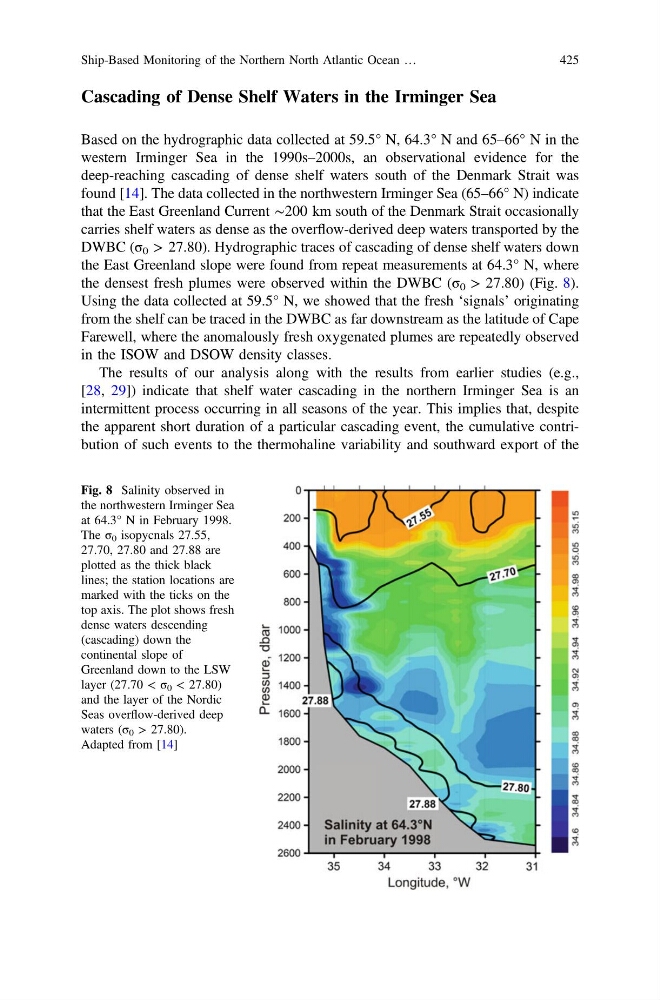
the densest fresh plumes were observed within the DWBC (σ 0 > 27.80) (Fig. 8).
Using the data collected at 59.5° N, we showed that the fresh ‘signals’ originating
from the shelf can be traced in the DWBC as far downstream as the latitude of Cape
Farewell, where the anomalously fresh oxygenated plumes are repeatedly observed
in the ISOW and DSOW density classes.
The results of our analysis along with the results from earlier studies (e.g.,
[28, 29]) indicate that shelf water cascading in the northern Irminger Sea is an
intermittent process occurring in all seasons of the year. This implies that, despite
the apparent short duration of a particular cascading event, the cumulative contribution of such events to the thermohaline variability and southward export of the
Fig. 8 Salinity observed in
the northwestern Irminger Sea
at 64.3° N in February 1998.
The σ 0 isopycnals 27.55,
27.70, 27.80 and 27.88 are
plotted as the thick black
lines; the station locations are
marked with the ticks on the
top axis. The plot shows fresh
dense waters descending
(cascading) down the
continental slope of
Greenland down to the LSW
layer (27.70 < σ 0 < 27.80)
and the layer of the Nordic
Seas overflow-derived deep
waters (σ 0 > 27.80).
Adapted from [14]
Ship-Based Monitoring of the Northern North Atlantic Ocean …
425
Based on the hydrographic data collected at 59.5° N, 64.3° N and 65–66° N in the
western Irminger Sea in the 1990s–2000s, an observational evidence for the
deep-reaching cascading of dense shelf waters south of the Denmark Strait was
found [14]. The data collected in the northwestern Irminger Sea (65–66° N) indicate
that the East Greenland Current ∼200 km south of the Denmark Strait occasionally
carries shelf waters as dense as the overflow-derived deep waters transported by the
DWBC (σ 0 > 27.80). Hydrographic traces of cascading of dense shelf waters down
the East Greenland slope were found from repeat measurements at 64.3° N, where
the densest fresh plumes were observed within the DWBC (σ 0 > 27.80) (Fig. 8).
Using the data collected at 59.5° N, we showed that the fresh ‘signals’ originating
from the shelf can be traced in the DWBC as far downstream as the latitude of Cape
Farewell, where the anomalously fresh oxygenated plumes are repeatedly observed
in the ISOW and DSOW density classes.
The results of our analysis along with the results from earlier studies (e.g.,
[28, 29]) indicate that shelf water cascading in the northern Irminger Sea is an
intermittent process occurring in all seasons of the year. This implies that, despite
the apparent short duration of a particular cascading event, the cumulative contribution of such events to the thermohaline variability and southward export of the
Fig. 8 Salinity observed in
the northwestern Irminger Sea
at 64.3° N in February 1998.
The σ 0 isopycnals 27.55,
27.70, 27.80 and 27.88 are
plotted as the thick black
lines; the station locations are
marked with the ticks on the
top axis. The plot shows fresh
dense waters descending
(cascading) down the
continental slope of
Greenland down to the LSW
layer (27.70 < σ 0 < 27.80)
and the layer of the Nordic
Seas overflow-derived deep
waters (σ 0 > 27.80).
Adapted from [14]
Ship-Based Monitoring of the Northern North Atlantic Ocean …
425