

intensity of the anticyclone (panels “a” and “b”), one can speak about the qualitative agreement with Fig. 2, identifying the bundle of isolines, located to the right
from the separatrix loop, with the eastern stream NwAC, and the one to the left with
the west side. The same can be said about the phase portraits in Fig. 3.
The resulting velocity distributions will now be used as “external fields” for the
anticyclonic lens, localized in the pycnocline [6, 7, 23]. Hereinafter, we will consider processes that take place only in the corresponding middle layer.
Without resting on the problem of the anticyclonic lens in the vicinity of a
topographic vortex (these questions are discussed in detail in Ivanov and Korablev
[6, 7]), we consider several versions of the different behavior of the lens depending
on its initial location.
Let us consider separately cases (I) without taking into account the vortex
(A = 0), and (II) taking into account the effect of anticyclonic rotation on the
external flow (A < 0).
Case (I). At the initial time moment, we assume that the lens has a circular shape
with dimensionless radius r lens = 0.6, which corresponds to 60 km, and represents a
vortex patch belonging to the middle layer, which is a region with a constant value
of potential vorticity (PV). In this case, the initial PV value determines the time
scale. Assuming the azimuthal velocity at the outer edge of the lens to be 20 cm/s,
we will choose PV such that the rotation period of its liquid particles is equal to
20 days. This period will correspond to a unit of dimensionless time in numerical
experiments.
In the presence of a lens, the phase portrait is constructed taking into account its
effect on the current function field using the Contour Dynamics Method developed
for the three-layer rotating liquid [20].
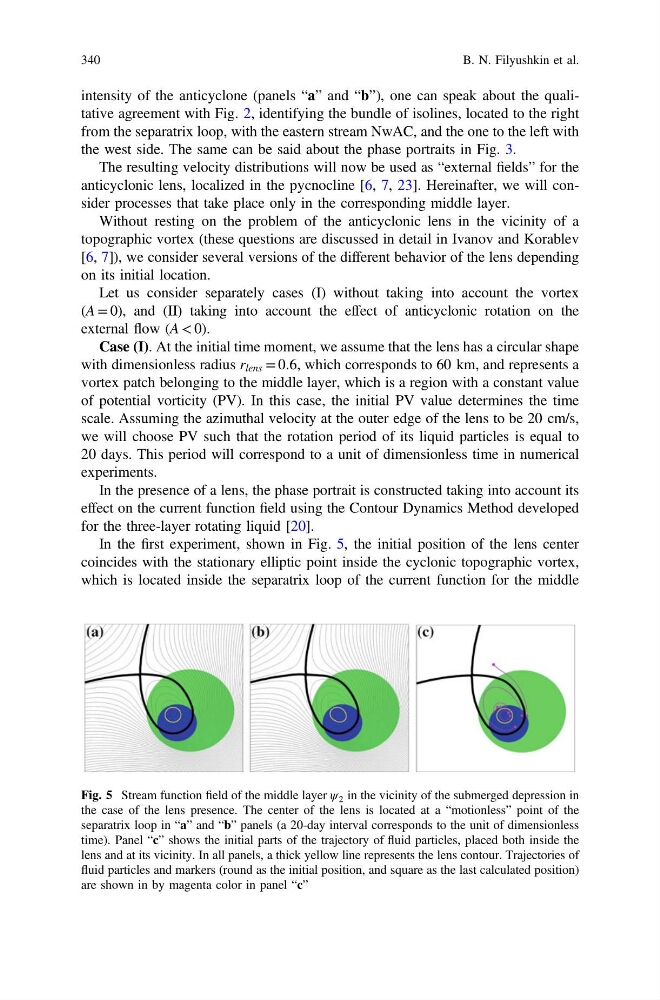
In the first experiment, shown in Fig. 5, the initial position of the lens center
coincides with the stationary elliptic point inside the cyclonic topographic vortex,
which is located inside the separatrix loop of the current function for the middle
Fig. 5 Stream function field of the middle layer ψ 2 in the vicinity of the submerged depression in
the case of the lens presence. The center of the lens is located at a “motionless” point of the
separatrix loop in “a” and “b” panels (a 20-day interval corresponds to the unit of dimensionless
time). Panel “c” shows the initial parts of the trajectory of fluid particles, placed both inside the
lens and at its vicinity. In all panels, a thick yellow line represents the lens contour. Trajectories of
fluid particles and markers (round as the initial position, and square as the last calculated position)
are shown in by magenta color in panel “c”
340
B. N. Filyushkin et al.
from the separatrix loop, with the eastern stream NwAC, and the one to the left with
the west side. The same can be said about the phase portraits in Fig. 3.
The resulting velocity distributions will now be used as “external fields” for the
anticyclonic lens, localized in the pycnocline [6, 7, 23]. Hereinafter, we will consider processes that take place only in the corresponding middle layer.
Without resting on the problem of the anticyclonic lens in the vicinity of a
topographic vortex (these questions are discussed in detail in Ivanov and Korablev
[6, 7]), we consider several versions of the different behavior of the lens depending
on its initial location.
Let us consider separately cases (I) without taking into account the vortex
(A = 0), and (II) taking into account the effect of anticyclonic rotation on the
external flow (A < 0).
Case (I). At the initial time moment, we assume that the lens has a circular shape
with dimensionless radius r lens = 0.6, which corresponds to 60 km, and represents a
vortex patch belonging to the middle layer, which is a region with a constant value
of potential vorticity (PV). In this case, the initial PV value determines the time
scale. Assuming the azimuthal velocity at the outer edge of the lens to be 20 cm/s,
we will choose PV such that the rotation period of its liquid particles is equal to
20 days. This period will correspond to a unit of dimensionless time in numerical
experiments.
In the presence of a lens, the phase portrait is constructed taking into account its
effect on the current function field using the Contour Dynamics Method developed
for the three-layer rotating liquid [20].
In the first experiment, shown in Fig. 5, the initial position of the lens center
coincides with the stationary elliptic point inside the cyclonic topographic vortex,
which is located inside the separatrix loop of the current function for the middle
Fig. 5 Stream function field of the middle layer ψ 2 in the vicinity of the submerged depression in
the case of the lens presence. The center of the lens is located at a “motionless” point of the
separatrix loop in “a” and “b” panels (a 20-day interval corresponds to the unit of dimensionless
time). Panel “c” shows the initial parts of the trajectory of fluid particles, placed both inside the
lens and at its vicinity. In all panels, a thick yellow line represents the lens contour. Trajectories of
fluid particles and markers (round as the initial position, and square as the last calculated position)
are shown in by magenta color in panel “c”
340
B. N. Filyushkin et al.