

layer. Assuming the selected external parameters, this point has coordinates
(−1.3098; −0.3511). Panel “a” shows that, in this case, the lens does not virtually
affect the kinematic characteristics of the flow outside the topographic vortex.
Changes are observed only in the inner part of the separatrix loop. Panel “b” shows
that the position of the lens can be considered almost quasistationary. Indeed, when
t = 10, i.e., more than 6 months after the beginning of motion, the lens center
remains in its initial position. Of course, the lens does not retain a circular shape,
since the external field is not axisymmetric, but the position of its center stably
holds almost the same place. Panel “c” shows the behavior of several liquid particles inside and outside the lens. Three of the four selected material points are
initially located at the latitude of the lens center and move as follows: (1) the
particle inside the lens rotates along a closed circular path in the anticyclonic
direction, (2) the particle between the lens and the boundary of the separatrix loop
rotates along the cyclonic path, remaining inside the topographic cyclone, (3) the
particle located outside the separatrix loop is carried away by the current beyond the
depression. Finally, the particle, initially located north of the lens boundary, moves
along a hole-shaped path reminding the configuration of the corresponding isoline
of the current function.
This experiment suggests that the region of the capture of an anticyclonic lens by
a cyclonic topographic vortex cannot only be confined to a motionless elliptic point
but may have finite dimensions.
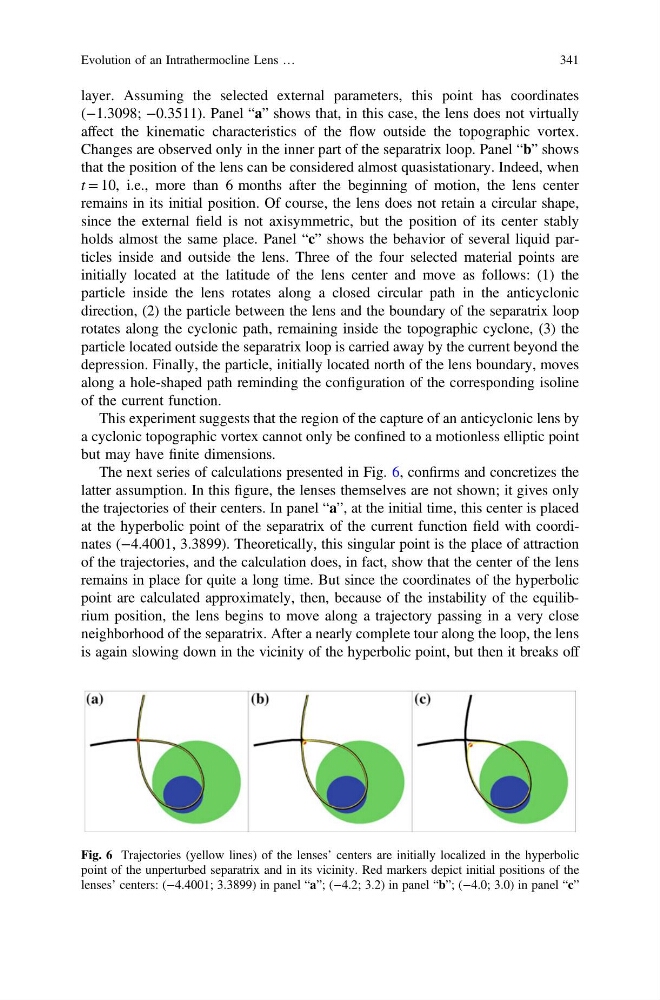
The next series of calculations presented in Fig. 6, confirms and concretizes the
latter assumption. In this figure, the lenses themselves are not shown; it gives only
the trajectories of their centers. In panel “a”, at the initial time, this center is placed
at the hyperbolic point of the separatrix of the current function field with coordinates (−4.4001, 3.3899). Theoretically, this singular point is the place of attraction
of the trajectories, and the calculation does, in fact, show that the center of the lens
remains in place for quite a long time. But since the coordinates of the hyperbolic
point are calculated approximately, then, because of the instability of the equilibrium position, the lens begins to move along a trajectory passing in a very close
neighborhood of the separatrix. After a nearly complete tour along the loop, the lens
is again slowing down in the vicinity of the hyperbolic point, but then it breaks off
Fig. 6 Trajectories (yellow lines) of the lenses’ centers are initially localized in the hyperbolic
point of the unperturbed separatrix and in its vicinity. Red markers depict initial positions of the
lenses’ centers: (−4.4001; 3.3899) in panel “a”; (−4.2; 3.2) in panel “b”; (−4.0; 3.0) in panel “c”
Evolution of an Intrathermocline Lens …
341
(−1.3098; −0.3511). Panel “a” shows that, in this case, the lens does not virtually
affect the kinematic characteristics of the flow outside the topographic vortex.
Changes are observed only in the inner part of the separatrix loop. Panel “b” shows
that the position of the lens can be considered almost quasistationary. Indeed, when
t = 10, i.e., more than 6 months after the beginning of motion, the lens center
remains in its initial position. Of course, the lens does not retain a circular shape,
since the external field is not axisymmetric, but the position of its center stably
holds almost the same place. Panel “c” shows the behavior of several liquid particles inside and outside the lens. Three of the four selected material points are
initially located at the latitude of the lens center and move as follows: (1) the
particle inside the lens rotates along a closed circular path in the anticyclonic
direction, (2) the particle between the lens and the boundary of the separatrix loop
rotates along the cyclonic path, remaining inside the topographic cyclone, (3) the
particle located outside the separatrix loop is carried away by the current beyond the
depression. Finally, the particle, initially located north of the lens boundary, moves
along a hole-shaped path reminding the configuration of the corresponding isoline
of the current function.
This experiment suggests that the region of the capture of an anticyclonic lens by
a cyclonic topographic vortex cannot only be confined to a motionless elliptic point
but may have finite dimensions.
The next series of calculations presented in Fig. 6, confirms and concretizes the
latter assumption. In this figure, the lenses themselves are not shown; it gives only
the trajectories of their centers. In panel “a”, at the initial time, this center is placed
at the hyperbolic point of the separatrix of the current function field with coordinates (−4.4001, 3.3899). Theoretically, this singular point is the place of attraction
of the trajectories, and the calculation does, in fact, show that the center of the lens
remains in place for quite a long time. But since the coordinates of the hyperbolic
point are calculated approximately, then, because of the instability of the equilibrium position, the lens begins to move along a trajectory passing in a very close
neighborhood of the separatrix. After a nearly complete tour along the loop, the lens
is again slowing down in the vicinity of the hyperbolic point, but then it breaks off
Fig. 6 Trajectories (yellow lines) of the lenses’ centers are initially localized in the hyperbolic
point of the unperturbed separatrix and in its vicinity. Red markers depict initial positions of the
lenses’ centers: (−4.4001; 3.3899) in panel “a”; (−4.2; 3.2) in panel “b”; (−4.0; 3.0) in panel “c”
Evolution of an Intrathermocline Lens …
341