

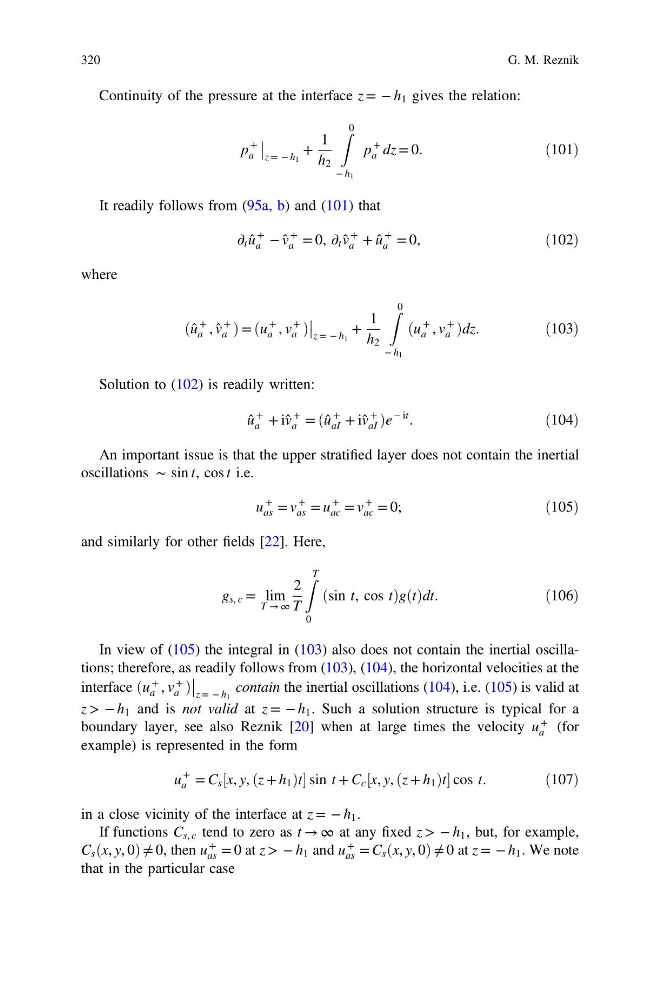
Continuity of the pressure at the interface z = − h 1 gives the relation:
p
+
a
z = − h 1
+
1
h 2
Z 0
− h 1
p
+
a dz = 0.
ð101Þ
It readily follows from (95a, b) and (101) that
∂ t û
+
a − v̂
+
a = 0, ∂ t v̂
+
a + û
+
a = 0,
ð102Þ
where
ðû
+
a , v̂
+
a Þ = ðu
+
a , v
+
a Þ
z = − h 1
+
1
h 2
Z 0
− h 1
ðu
+
a , v
+
a Þdz.
ð103Þ
Solution to (102) is readily written:
û
+
a + iv̂
+
a = ðû
+
aI + iv̂
+
aI Þe
− it .
ð104Þ
An important issue is that the upper stratified layer does not contain the inertial
oscillations ∼ sin t, cos t i.e.
u
+
as = v
+
as = u
+
ac = v
+
ac = 0;
ð105Þ
and similarly for other fields [22]. Here,
g s, c = lim
T → ∞
2
T
Z T
0
ðsin t, cos tÞgðtÞdt.
ð106Þ
In view of (105) the integral in (103) also does not contain the inertial oscillations; therefore, as readily follows from (103), (104), the horizontal velocities at the
interface ðu
+
a , v
+
a Þ
z = − h 1
contain the inertial oscillations (104), i.e. (105) is valid at
z > − h 1 and is not valid at z = − h 1 . Such a solution structure is typical for a
boundary layer, see also Reznik [20] when at large times the velocity u
+
a (for
example) is represented in the form
u
+
a = C s ½x, y, ðz + h 1 Þt sin t + C c ½x, y, ðz + h 1 Þt cos t.
ð107Þ
in a close vicinity of the interface at z = − h 1 .
If functions C s, c tend to zero as t → ∞ at any fixed z > − h 1 , but, for example,
C s ðx, y, 0Þ ≠ 0, then u
+
as = 0 at z > − h 1 and u
+
as = C s ðx, y, 0Þ ≠ 0 at z = − h 1 . We note
that in the particular case
320
G. M. Reznik
p
+
a
z = − h 1
+
1
h 2
Z 0
− h 1
p
+
a dz = 0.
ð101Þ
It readily follows from (95a, b) and (101) that
∂ t û
+
a − v̂
+
a = 0, ∂ t v̂
+
a + û
+
a = 0,
ð102Þ
where
ðû
+
a , v̂
+
a Þ = ðu
+
a , v
+
a Þ
z = − h 1
+
1
h 2
Z 0
− h 1
ðu
+
a , v
+
a Þdz.
ð103Þ
Solution to (102) is readily written:
û
+
a + iv̂
+
a = ðû
+
aI + iv̂
+
aI Þe
− it .
ð104Þ
An important issue is that the upper stratified layer does not contain the inertial
oscillations ∼ sin t, cos t i.e.
u
+
as = v
+
as = u
+
ac = v
+
ac = 0;
ð105Þ
and similarly for other fields [22]. Here,
g s, c = lim
T → ∞
2
T
Z T
0
ðsin t, cos tÞgðtÞdt.
ð106Þ
In view of (105) the integral in (103) also does not contain the inertial oscillations; therefore, as readily follows from (103), (104), the horizontal velocities at the
interface ðu
+
a , v
+
a Þ
z = − h 1
contain the inertial oscillations (104), i.e. (105) is valid at
z > − h 1 and is not valid at z = − h 1 . Such a solution structure is typical for a
boundary layer, see also Reznik [20] when at large times the velocity u
+
a (for
example) is represented in the form
u
+
a = C s ½x, y, ðz + h 1 Þt sin t + C c ½x, y, ðz + h 1 Þt cos t.
ð107Þ
in a close vicinity of the interface at z = − h 1 .
If functions C s, c tend to zero as t → ∞ at any fixed z > − h 1 , but, for example,
C s ðx, y, 0Þ ≠ 0, then u
+
as = 0 at z > − h 1 and u
+
as = C s ðx, y, 0Þ ≠ 0 at z = − h 1 . We note
that in the particular case
320
G. M. Reznik