

Ageostrophic Component
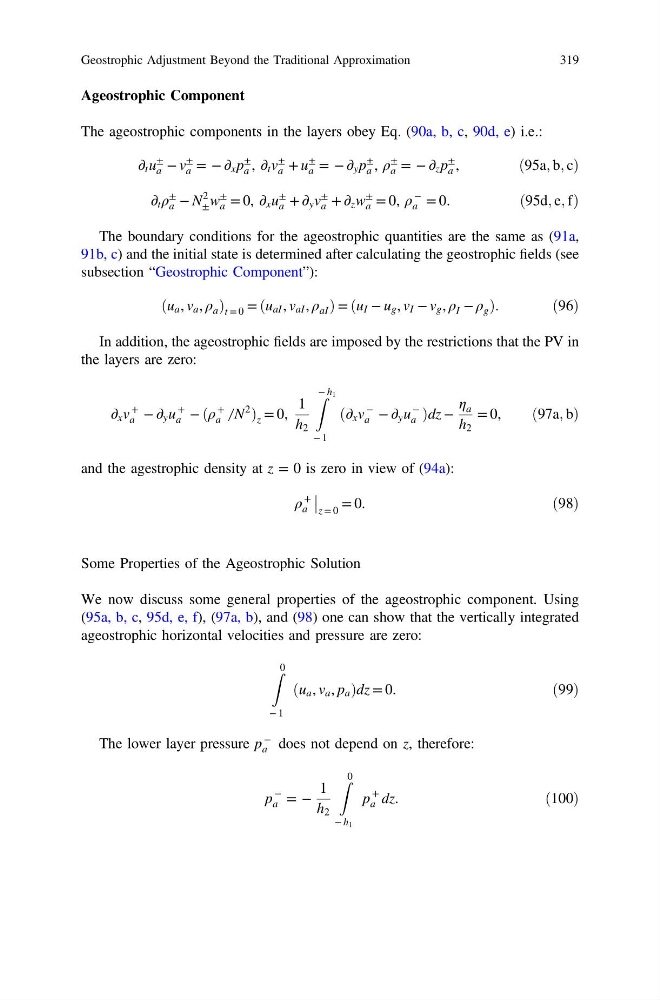
The ageostrophic components in the layers obey Eq. (90a, b, c, 90d, e) i.e.:
∂ t u
±
a − v
±
a = − ∂ x p
±
a , ∂ t v
±
a + u
±
a = − ∂ y p
±
a , ρ
±
a = − ∂ z p
±
a ,
ð95a; b; cÞ
∂ t ρ
±
a − N
2
± w
±
a = 0, ∂ x u
±
a + ∂ y v
±
a + ∂ z w
±
a = 0, ρ
−
a = 0.
ð95d; e; fÞ
The boundary conditions for the ageostrophic quantities are the same as (91a,
91b, c) and the initial state is determined after calculating the geostrophic fields (see
subsection “Geostrophic Component”):
ðu a , v a , ρ a Þ t = 0 = ðu aI , v aI , ρ aI Þ = ðu I − u g , v I − v g , ρ I − ρ g Þ.
ð96Þ
In addition, the ageostrophic fields are imposed by the restrictions that the PV in
the layers are zero:
∂ x v
+
a − ∂ y u
+
a − ðρ
+
a ̸ N
2
Þ z = 0,
1
h 2
Z − h 1
− 1
ð∂ x v
−
a − ∂ y u
−
a Þdz −
η a
h 2
= 0,
ð97a; bÞ
and the agestrophic density at z = 0 is zero in view of (94a):
ρ
+
a
z = 0
= 0.
ð98Þ
Some Properties of the Ageostrophic Solution
We now discuss some general properties of the ageostrophic component. Using
(95a, b, c, 95d, e, f), (97a, b), and (98) one can show that the vertically integrated
ageostrophic horizontal velocities and pressure are zero:
Z 0
− 1
ðu a , v a , p a Þdz = 0.
ð99Þ
The lower layer pressure p
−
a does not depend on z, therefore:
p
−
a = −
1
h 2
Z 0
− h 1
p
+
a dz.
ð100Þ
Geostrophic Adjustment Beyond the Traditional Approximation
319
The ageostrophic components in the layers obey Eq. (90a, b, c, 90d, e) i.e.:
∂ t u
±
a − v
±
a = − ∂ x p
±
a , ∂ t v
±
a + u
±
a = − ∂ y p
±
a , ρ
±
a = − ∂ z p
±
a ,
ð95a; b; cÞ
∂ t ρ
±
a − N
2
± w
±
a = 0, ∂ x u
±
a + ∂ y v
±
a + ∂ z w
±
a = 0, ρ
−
a = 0.
ð95d; e; fÞ
The boundary conditions for the ageostrophic quantities are the same as (91a,
91b, c) and the initial state is determined after calculating the geostrophic fields (see
subsection “Geostrophic Component”):
ðu a , v a , ρ a Þ t = 0 = ðu aI , v aI , ρ aI Þ = ðu I − u g , v I − v g , ρ I − ρ g Þ.
ð96Þ
In addition, the ageostrophic fields are imposed by the restrictions that the PV in
the layers are zero:
∂ x v
+
a − ∂ y u
+
a − ðρ
+
a ̸ N
2
Þ z = 0,
1
h 2
Z − h 1
− 1
ð∂ x v
−
a − ∂ y u
−
a Þdz −
η a
h 2
= 0,
ð97a; bÞ
and the agestrophic density at z = 0 is zero in view of (94a):
ρ
+
a
z = 0
= 0.
ð98Þ
Some Properties of the Ageostrophic Solution
We now discuss some general properties of the ageostrophic component. Using
(95a, b, c, 95d, e, f), (97a, b), and (98) one can show that the vertically integrated
ageostrophic horizontal velocities and pressure are zero:
Z 0
− 1
ðu a , v a , p a Þdz = 0.
ð99Þ
The lower layer pressure p
−
a does not depend on z, therefore:
p
−
a = −
1
h 2
Z 0
− h 1
p
+
a dz.
ð100Þ
Geostrophic Adjustment Beyond the Traditional Approximation
319