

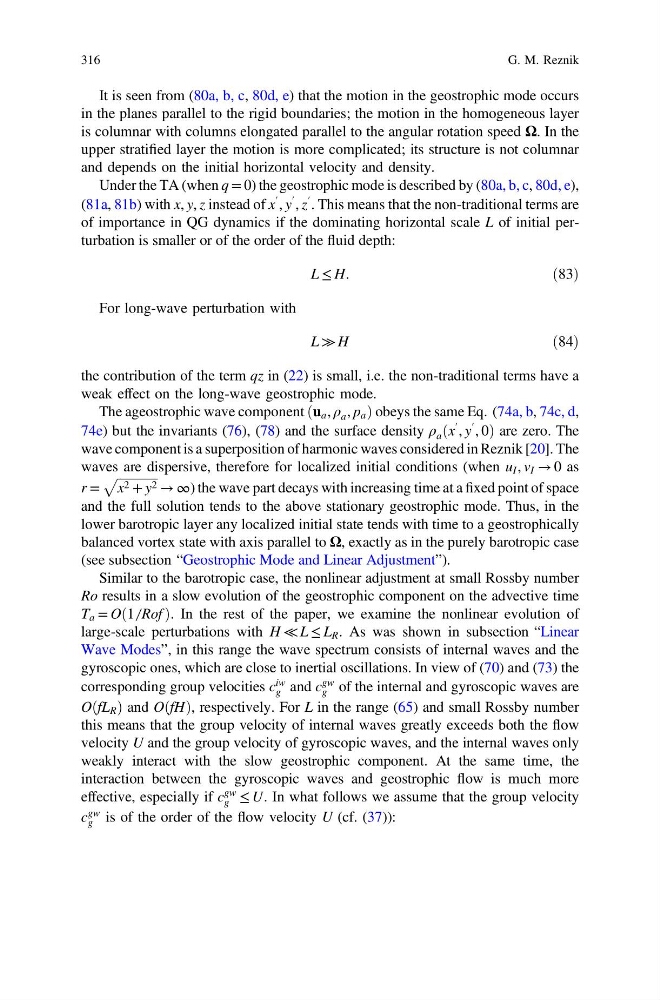
It is seen from (80a, b, c, 80d, e) that the motion in the geostrophic mode occurs
in the planes parallel to the rigid boundaries; the motion in the homogeneous layer
is columnar with columns elongated parallel to the angular rotation speed Ω. In the
upper stratified layer the motion is more complicated; its structure is not columnar
and depends on the initial horizontal velocity and density.
Under the TA (when q = 0) the geostrophic mode is described by (80a, b, c, 80d, e),
(81a, 81b) with x, y, z instead of x
′ , y
′ , z
′ . This means that the non-traditional terms are
of importance in QG dynamics if the dominating horizontal scale L of initial perturbation is smaller or of the order of the fluid depth:
L ≤ H.
ð83Þ
For long-wave perturbation with
L ≫ H
ð84Þ
the contribution of the term qz in (22) is small, i.e. the non-traditional terms have a
weak effect on the long-wave geostrophic mode.
The ageostrophic wave component ðu a , ρ a , p a Þ obeys the same Eq. (74a, b, 74c, d,
74e) but the invariants (76), (78) and the surface density ρ a ðx
′ , y
′ , 0Þ are zero. The
wave component is a superposition of harmonic waves considered in Reznik [20]. The
waves are dispersive, therefore for localized initial conditions (when u I , v I → 0 as
r =
ffiffiffiffiffiffiffiffiffiffiffiffiffi
x 2 + y 2
p
→ ∞) the wave part decays with increasing time at a fixed point of space
and the full solution tends to the above stationary geostrophic mode. Thus, in the
lower barotropic layer any localized initial state tends with time to a geostrophically
balanced vortex state with axis parallel to Ω, exactly as in the purely barotropic case
(see subsection “Geostrophic Mode and Linear Adjustment”).
Similar to the barotropic case, the nonlinear adjustment at small Rossby number
Ro results in a slow evolution of the geostrophic component on the advective time
T a = Oð1 ̸ Rof Þ. In the rest of the paper, we examine the nonlinear evolution of
large-scale perturbations with H ≪ L ≤ L R . As was shown in subsection “Linear
Wave Modes”, in this range the wave spectrum consists of internal waves and the
gyroscopic ones, which are close to inertial oscillations. In view of (70) and (73) the
corresponding group velocities c
iw
g and c
gw
g of the internal and gyroscopic waves are
OðfL R Þ and OðfHÞ, respectively. For L in the range (65) and small Rossby number
this means that the group velocity of internal waves greatly exceeds both the flow
velocity U and the group velocity of gyroscopic waves, and the internal waves only
weakly interact with the slow geostrophic component. At the same time, the
interaction between the gyroscopic waves and geostrophic flow is much more
effective, especially if c
gw
g ≤ U. In what follows we assume that the group velocity
c
gw
g is of the order of the flow velocity U (cf. (37)):
316
G. M. Reznik
in the planes parallel to the rigid boundaries; the motion in the homogeneous layer
is columnar with columns elongated parallel to the angular rotation speed Ω. In the
upper stratified layer the motion is more complicated; its structure is not columnar
and depends on the initial horizontal velocity and density.
Under the TA (when q = 0) the geostrophic mode is described by (80a, b, c, 80d, e),
(81a, 81b) with x, y, z instead of x
′ , y
′ , z
′ . This means that the non-traditional terms are
of importance in QG dynamics if the dominating horizontal scale L of initial perturbation is smaller or of the order of the fluid depth:
L ≤ H.
ð83Þ
For long-wave perturbation with
L ≫ H
ð84Þ
the contribution of the term qz in (22) is small, i.e. the non-traditional terms have a
weak effect on the long-wave geostrophic mode.
The ageostrophic wave component ðu a , ρ a , p a Þ obeys the same Eq. (74a, b, 74c, d,
74e) but the invariants (76), (78) and the surface density ρ a ðx
′ , y
′ , 0Þ are zero. The
wave component is a superposition of harmonic waves considered in Reznik [20]. The
waves are dispersive, therefore for localized initial conditions (when u I , v I → 0 as
r =
ffiffiffiffiffiffiffiffiffiffiffiffiffi
x 2 + y 2
p
→ ∞) the wave part decays with increasing time at a fixed point of space
and the full solution tends to the above stationary geostrophic mode. Thus, in the
lower barotropic layer any localized initial state tends with time to a geostrophically
balanced vortex state with axis parallel to Ω, exactly as in the purely barotropic case
(see subsection “Geostrophic Mode and Linear Adjustment”).
Similar to the barotropic case, the nonlinear adjustment at small Rossby number
Ro results in a slow evolution of the geostrophic component on the advective time
T a = Oð1 ̸ Rof Þ. In the rest of the paper, we examine the nonlinear evolution of
large-scale perturbations with H ≪ L ≤ L R . As was shown in subsection “Linear
Wave Modes”, in this range the wave spectrum consists of internal waves and the
gyroscopic ones, which are close to inertial oscillations. In view of (70) and (73) the
corresponding group velocities c
iw
g and c
gw
g of the internal and gyroscopic waves are
OðfL R Þ and OðfHÞ, respectively. For L in the range (65) and small Rossby number
this means that the group velocity of internal waves greatly exceeds both the flow
velocity U and the group velocity of gyroscopic waves, and the internal waves only
weakly interact with the slow geostrophic component. At the same time, the
interaction between the gyroscopic waves and geostrophic flow is much more
effective, especially if c
gw
g ≤ U. In what follows we assume that the group velocity
c
gw
g is of the order of the flow velocity U (cf. (37)):
316
G. M. Reznik