

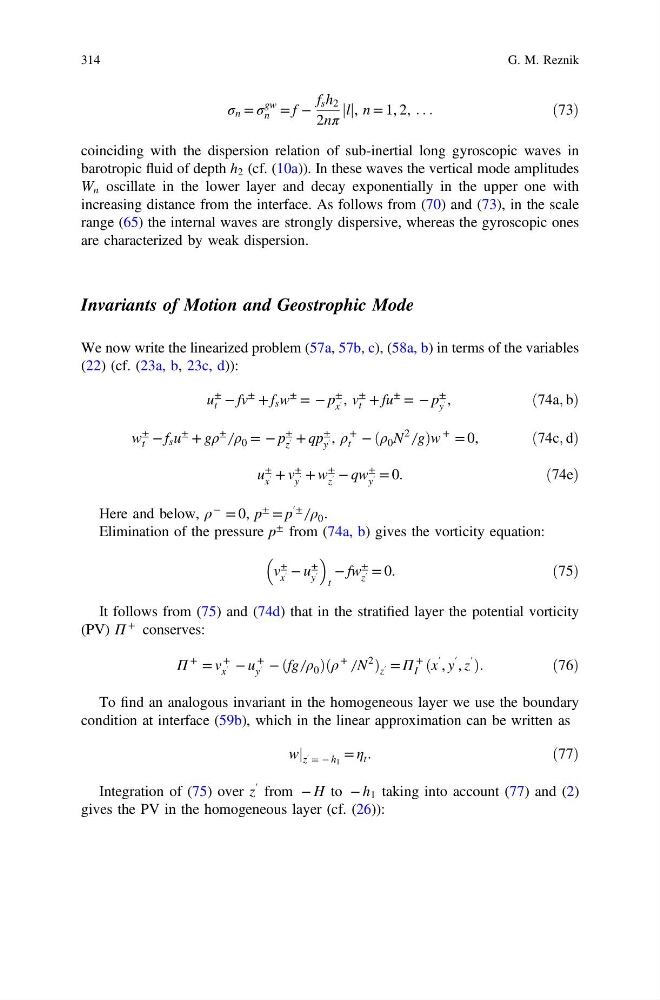
σ n = σ
gw
n = f −
f s h 2
2nπ
l
j j, n = 1, 2, . . .
ð73Þ
coinciding with the dispersion relation of sub-inertial long gyroscopic waves in
barotropic fluid of depth h 2 (cf. (10a)). In these waves the vertical mode amplitudes
W n oscillate in the lower layer and decay exponentially in the upper one with
increasing distance from the interface. As follows from (70) and (73), in the scale
range (65) the internal waves are strongly dispersive, whereas the gyroscopic ones
are characterized by weak dispersion.
Invariants of Motion and Geostrophic Mode
We now write the linearized problem (57a, 57b, c), (58a, b) in terms of the variables
(22) (cf. (23a, b, 23c, d)):
u
±
t − fv
± + f s w
± = − p
±
x ′ , v
±
t + fu
± = − p
±
y ′ ,
ð74a; bÞ
w
±
t − f s u
± + gρ
±
̸ ρ 0 = − p
±
z ′ + qp
±
y ′ , ρ
+
t − ðρ 0 N
2
̸ gÞw
+ = 0,
ð74c; dÞ
u
±
x ′ + v
±
y ′ + w
±
z ′ − qw
±
y ′ = 0.
ð74eÞ
Here and below, ρ
− = 0, p
± = p
′±
̸ ρ 0 .
Elimination of the pressure p
± from (74a, b) gives the vorticity equation:
v
±
x ′ − u
±
y ′
t
− fw
±
z ′ = 0.
ð75Þ
It follows from (75) and (74d) that in the stratified layer the potential vorticity
(PV) Π
+ conserves:
Π
+ = v
+
x ′ − u
+
y ′ − ðfg ̸ ρ 0 Þðρ
+
̸ N
2
Þ z ′ = Π
+
I ðx
′ , y
′ , z
′
Þ.
ð76Þ
To find an analogous invariant in the homogeneous layer we use the boundary
condition at interface (59b), which in the linear approximation can be written as
wj z ′ = − h 1 = η t .
ð77Þ
Integration of (75) over z
′ from − H to − h 1 taking into account (77) and (2)
gives the PV in the homogeneous layer (cf. (26)):
314
G. M. Reznik
gw
n = f −
f s h 2
2nπ
l
j j, n = 1, 2, . . .
ð73Þ
coinciding with the dispersion relation of sub-inertial long gyroscopic waves in
barotropic fluid of depth h 2 (cf. (10a)). In these waves the vertical mode amplitudes
W n oscillate in the lower layer and decay exponentially in the upper one with
increasing distance from the interface. As follows from (70) and (73), in the scale
range (65) the internal waves are strongly dispersive, whereas the gyroscopic ones
are characterized by weak dispersion.
Invariants of Motion and Geostrophic Mode
We now write the linearized problem (57a, 57b, c), (58a, b) in terms of the variables
(22) (cf. (23a, b, 23c, d)):
u
±
t − fv
± + f s w
± = − p
±
x ′ , v
±
t + fu
± = − p
±
y ′ ,
ð74a; bÞ
w
±
t − f s u
± + gρ
±
̸ ρ 0 = − p
±
z ′ + qp
±
y ′ , ρ
+
t − ðρ 0 N
2
̸ gÞw
+ = 0,
ð74c; dÞ
u
±
x ′ + v
±
y ′ + w
±
z ′ − qw
±
y ′ = 0.
ð74eÞ
Here and below, ρ
− = 0, p
± = p
′±
̸ ρ 0 .
Elimination of the pressure p
± from (74a, b) gives the vorticity equation:
v
±
x ′ − u
±
y ′
t
− fw
±
z ′ = 0.
ð75Þ
It follows from (75) and (74d) that in the stratified layer the potential vorticity
(PV) Π
+ conserves:
Π
+ = v
+
x ′ − u
+
y ′ − ðfg ̸ ρ 0 Þðρ
+
̸ N
2
Þ z ′ = Π
+
I ðx
′ , y
′ , z
′
Þ.
ð76Þ
To find an analogous invariant in the homogeneous layer we use the boundary
condition at interface (59b), which in the linear approximation can be written as
wj z ′ = − h 1 = η t .
ð77Þ
Integration of (75) over z
′ from − H to − h 1 taking into account (77) and (2)
gives the PV in the homogeneous layer (cf. (26)):
314
G. M. Reznik