

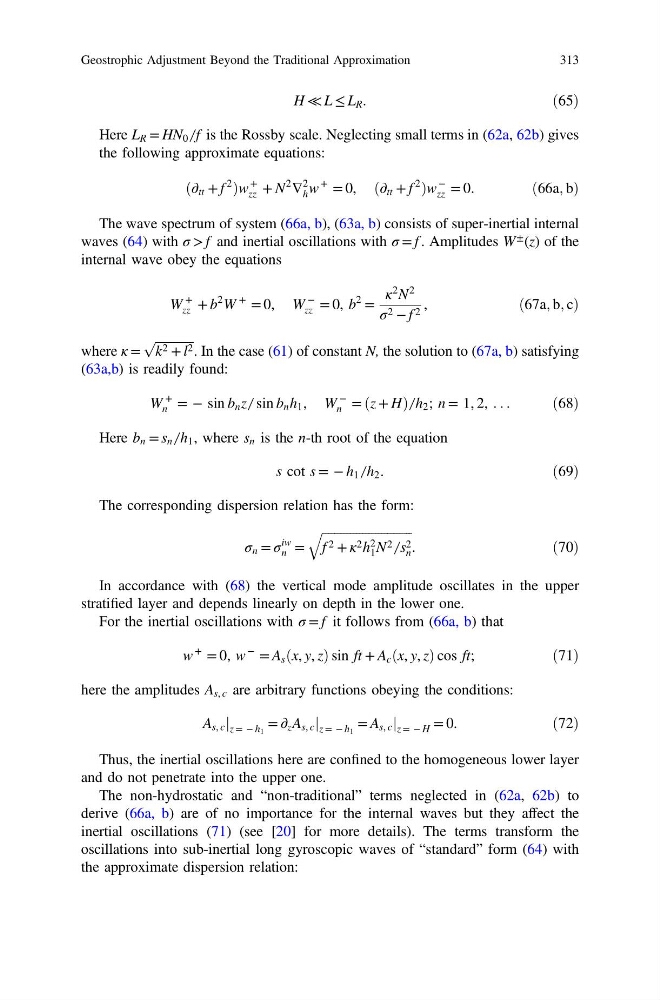
H ≪ L ≤ L R .
ð65Þ
Here L R = HN 0 ̸ f is the Rossby scale. Neglecting small terms in (62a, 62b) gives
the following approximate equations:
ð∂ tt + f
2
Þw
+
zz + N
2
∇
2
h w
+ = 0, ð∂ tt + f
2
Þw
−
zz = 0.
ð66a; bÞ
The wave spectrum of system (66a, b), (63a, b) consists of super-inertial internal
waves (64) with σ > f and inertial oscillations with σ = f . Amplitudes W
± (z) of the
internal wave obey the equations
W
+
zz + b
2 W
+ = 0, W
−
zz = 0, b
2 =
κ
2 N
2
σ 2 − f 2 ,
ð67a; b; cÞ
where κ =
ffiffiffiffiffiffiffiffiffiffiffiffi ffi
k 2 + l 2
p
. In the case (61) of constant N, the solution to (67a, b) satisfying
(63a,b) is readily found:
W
+
n = − sin b n z ̸ sin b n h 1 , W
−
n = ðz + HÞ ̸ h 2 ; n = 1, 2, . . .
ð68Þ
Here b n = s n ̸ h 1 , where s n is the n-th root of the equation
s cot s = − h 1 ̸ h 2 .
ð69Þ
The corresponding dispersion relation has the form:
σ n = σ
iw
n =
ffiffiffiffiffiffiffiffiffiffiffiffiffiffiffiffiffiffiffiffiffiffiffiffiffiffiffiffiffi
f 2 + κ 2 h 2
1 N 2 ̸ s 2
n
q
.
ð70Þ
In accordance with (68) the vertical mode amplitude oscillates in the upper
stratified layer and depends linearly on depth in the lower one.
For the inertial oscillations with σ = f it follows from (66a, b) that
w
+ = 0, w
− = A s ðx, y, zÞ sin ft + A c ðx, y, zÞ cos ft;
ð71Þ
here the amplitudes A s, c are arbitrary functions obeying the conditions:
A s, c j z = − h 1 = ∂ z A s, c j z = − h 1 = A s, c j z = − H = 0.
ð72Þ
Thus, the inertial oscillations here are confined to the homogeneous lower layer
and do not penetrate into the upper one.
The non-hydrostatic and “non-traditional” terms neglected in (62a, 62b) to
derive (66a, b) are of no importance for the internal waves but they affect the
inertial oscillations (71) (see [20] for more details). The terms transform the
oscillations into sub-inertial long gyroscopic waves of “standard” form (64) with
the approximate dispersion relation:
Geostrophic Adjustment Beyond the Traditional Approximation
313
ð65Þ
Here L R = HN 0 ̸ f is the Rossby scale. Neglecting small terms in (62a, 62b) gives
the following approximate equations:
ð∂ tt + f
2
Þw
+
zz + N
2
∇
2
h w
+ = 0, ð∂ tt + f
2
Þw
−
zz = 0.
ð66a; bÞ
The wave spectrum of system (66a, b), (63a, b) consists of super-inertial internal
waves (64) with σ > f and inertial oscillations with σ = f . Amplitudes W
± (z) of the
internal wave obey the equations
W
+
zz + b
2 W
+ = 0, W
−
zz = 0, b
2 =
κ
2 N
2
σ 2 − f 2 ,
ð67a; b; cÞ
where κ =
ffiffiffiffiffiffiffiffiffiffiffiffi ffi
k 2 + l 2
p
. In the case (61) of constant N, the solution to (67a, b) satisfying
(63a,b) is readily found:
W
+
n = − sin b n z ̸ sin b n h 1 , W
−
n = ðz + HÞ ̸ h 2 ; n = 1, 2, . . .
ð68Þ
Here b n = s n ̸ h 1 , where s n is the n-th root of the equation
s cot s = − h 1 ̸ h 2 .
ð69Þ
The corresponding dispersion relation has the form:
σ n = σ
iw
n =
ffiffiffiffiffiffiffiffiffiffiffiffiffiffiffiffiffiffiffiffiffiffiffiffiffiffiffiffiffi
f 2 + κ 2 h 2
1 N 2 ̸ s 2
n
q
.
ð70Þ
In accordance with (68) the vertical mode amplitude oscillates in the upper
stratified layer and depends linearly on depth in the lower one.
For the inertial oscillations with σ = f it follows from (66a, b) that
w
+ = 0, w
− = A s ðx, y, zÞ sin ft + A c ðx, y, zÞ cos ft;
ð71Þ
here the amplitudes A s, c are arbitrary functions obeying the conditions:
A s, c j z = − h 1 = ∂ z A s, c j z = − h 1 = A s, c j z = − H = 0.
ð72Þ
Thus, the inertial oscillations here are confined to the homogeneous lower layer
and do not penetrate into the upper one.
The non-hydrostatic and “non-traditional” terms neglected in (62a, 62b) to
derive (66a, b) are of no importance for the internal waves but they affect the
inertial oscillations (71) (see [20] for more details). The terms transform the
oscillations into sub-inertial long gyroscopic waves of “standard” form (64) with
the approximate dispersion relation:
Geostrophic Adjustment Beyond the Traditional Approximation
313