

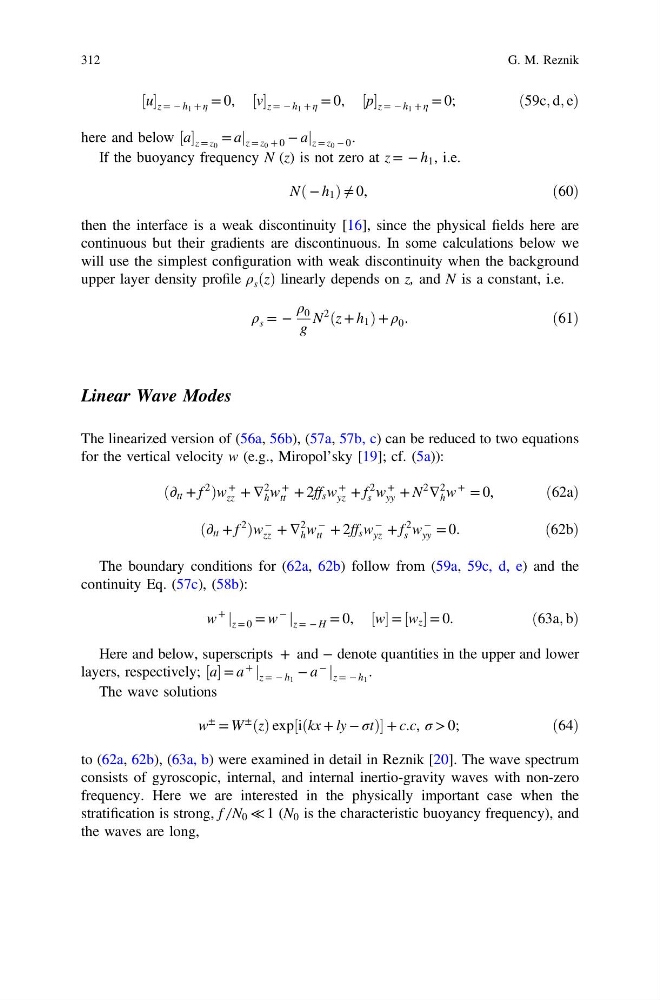
½u z = − h 1 + η = 0, ½v z = − h 1 + η = 0, ½p z = − h 1 + η = 0;
ð59c; d; eÞ
here and below ½a z = z 0 = aj z = z 0 + 0 − aj z = z 0 − 0 .
If the buoyancy frequency N (z) is not zero at z = − h 1 , i.e.
Nð − h 1 Þ ≠ 0,
ð60Þ
then the interface is a weak discontinuity [16], since the physical fields here are
continuous but their gradients are discontinuous. In some calculations below we
will use the simplest configuration with weak discontinuity when the background
upper layer density profile ρ s ðzÞ linearly depends on z, and N is a constant, i.e.
ρ s = −
ρ 0
g
N
2
ðz + h 1 Þ + ρ 0 .
ð61Þ
Linear Wave Modes
The linearized version of (56a, 56b), (57a, 57b, c) can be reduced to two equations
for the vertical velocity w (e.g., Miropol’sky [19]; cf. (5a)):
ð∂ tt + f
2
Þw
+
zz + ∇
2
h w
+
tt + 2ff s w
+
yz + f
2
s w
+
yy + N
2
∇
2
h w
+ = 0,
ð62aÞ
ð∂ tt + f
2
Þw
−
zz + ∇
2
h w
−
tt + 2ff s w
−
yz + f
2
s w
−
yy = 0.
ð62bÞ
The boundary conditions for (62a, 62b) follow from (59a, 59c, d, e) and the
continuity Eq. (57c), (58b):
w
+
j z = 0 = w
−
j z = − H = 0, ½w = ½w z = 0.
ð63a; bÞ
Here and below, superscripts + and − denote quantities in the upper and lower
layers, respectively; ½a = a
+
j z = − h 1 − a
−
j z = − h 1 .
The wave solutions
w
± = W
±
ðzÞ exp½iðkx + ly − σtÞ + c.c, σ > 0;
ð64Þ
to (62a, 62b), (63a, b) were examined in detail in Reznik [20]. The wave spectrum
consists of gyroscopic, internal, and internal inertio-gravity waves with non-zero
frequency. Here we are interested in the physically important case when the
stratification is strong, f ̸ N 0 ≪ 1 (N 0 is the characteristic buoyancy frequency), and
the waves are long,
312
G. M. Reznik
ð59c; d; eÞ
here and below ½a z = z 0 = aj z = z 0 + 0 − aj z = z 0 − 0 .
If the buoyancy frequency N (z) is not zero at z = − h 1 , i.e.
Nð − h 1 Þ ≠ 0,
ð60Þ
then the interface is a weak discontinuity [16], since the physical fields here are
continuous but their gradients are discontinuous. In some calculations below we
will use the simplest configuration with weak discontinuity when the background
upper layer density profile ρ s ðzÞ linearly depends on z, and N is a constant, i.e.
ρ s = −
ρ 0
g
N
2
ðz + h 1 Þ + ρ 0 .
ð61Þ
Linear Wave Modes
The linearized version of (56a, 56b), (57a, 57b, c) can be reduced to two equations
for the vertical velocity w (e.g., Miropol’sky [19]; cf. (5a)):
ð∂ tt + f
2
Þw
+
zz + ∇
2
h w
+
tt + 2ff s w
+
yz + f
2
s w
+
yy + N
2
∇
2
h w
+ = 0,
ð62aÞ
ð∂ tt + f
2
Þw
−
zz + ∇
2
h w
−
tt + 2ff s w
−
yz + f
2
s w
−
yy = 0.
ð62bÞ
The boundary conditions for (62a, 62b) follow from (59a, 59c, d, e) and the
continuity Eq. (57c), (58b):
w
+
j z = 0 = w
−
j z = − H = 0, ½w = ½w z = 0.
ð63a; bÞ
Here and below, superscripts + and − denote quantities in the upper and lower
layers, respectively; ½a = a
+
j z = − h 1 − a
−
j z = − h 1 .
The wave solutions
w
± = W
±
ðzÞ exp½iðkx + ly − σtÞ + c.c, σ > 0;
ð64Þ
to (62a, 62b), (63a, b) were examined in detail in Reznik [20]. The wave spectrum
consists of gyroscopic, internal, and internal inertio-gravity waves with non-zero
frequency. Here we are interested in the physically important case when the
stratification is strong, f ̸ N 0 ≪ 1 (N 0 is the characteristic buoyancy frequency), and
the waves are long,
312
G. M. Reznik