

layers, and η = ηðx, y, tÞ is the perturbation of interface between the layers (see
Fig. 5). Obviously, the condition N min < f of coexistence of internal and gyroscopic
waves is satisfied here.
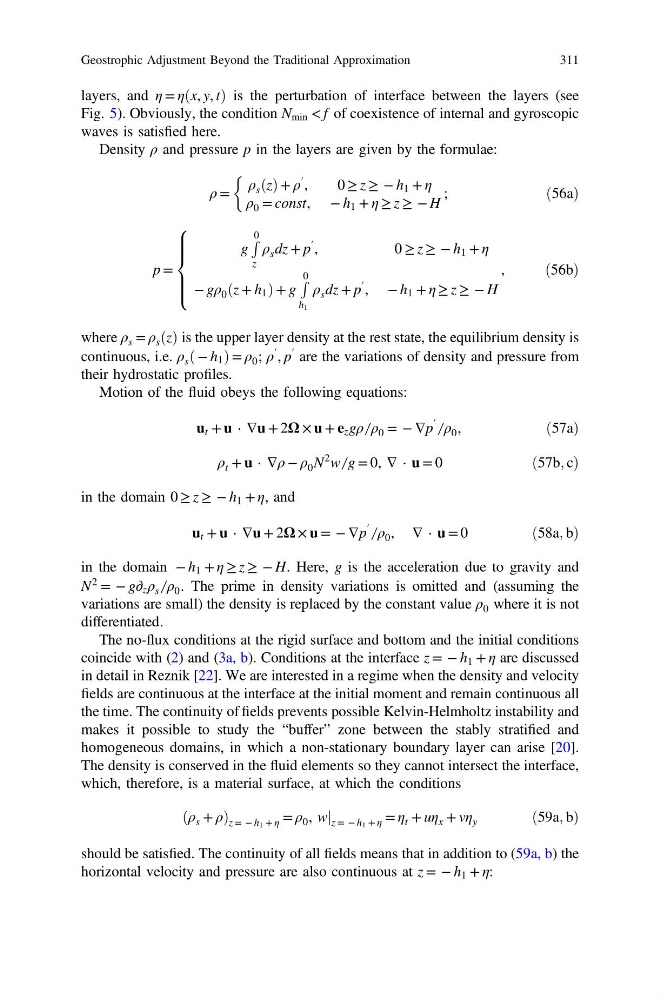
Density ρ and pressure p in the layers are given by the formulae:
ρ =
ρ s ðzÞ + ρ
′ ,
0≥ z ≥ − h 1 + η
ρ 0 = const, − h 1 + η ≥ z ≥ − H
&
;
ð56aÞ
p =
g
R 0
z
ρ s dz + p
′ ,
0 ≥ z ≥ − h 1 + η
− gρ 0 ðz + h 1 Þ + g
R 0
h 1
ρ s dz + p
′ , − h 1 + η ≥ z ≥ − H
8
> > > <
> > > :
,
ð56bÞ
where ρ s = ρ s ðzÞ is the upper layer density at the rest state, the equilibrium density is
continuous, i.e. ρ s ð − h 1 Þ = ρ 0 ; ρ
′ , p
′ are the variations of density and pressure from
their hydrostatic profiles.
Motion of the fluid obeys the following equations:
u t + u ⋅ ∇u + 2Ω × u + e z gρ ̸ ρ 0 = − ∇p
′
̸ ρ 0 ,
ð57aÞ
ρ t + u ⋅ ∇ρ − ρ 0 N
2 w ̸ g = 0, ∇ ⋅ u = 0
ð57b; cÞ
in the domain 0 ≥ z ≥ − h 1 + η, and
u t + u ⋅ ∇u + 2Ω × u = − ∇p
′
̸ ρ 0 , ∇ ⋅ u = 0
ð58a; bÞ
in the domain − h 1 + η ≥ z ≥ − H. Here, g is the acceleration due to gravity and
N
2 = − g∂ z ρ s ̸ ρ 0 . The prime in density variations is omitted and (assuming the
variations are small) the density is replaced by the constant value ρ 0 where it is not
differentiated.
The no-flux conditions at the rigid surface and bottom and the initial conditions
coincide with (2) and (3a, b). Conditions at the interface z = − h 1 + η are discussed
in detail in Reznik [22]. We are interested in a regime when the density and velocity
fields are continuous at the interface at the initial moment and remain continuous all
the time. The continuity of fields prevents possible Kelvin-Helmholtz instability and
makes it possible to study the “buffer” zone between the stably stratified and
homogeneous domains, in which a non-stationary boundary layer can arise [20].
The density is conserved in the fluid elements so they cannot intersect the interface,
which, therefore, is a material surface, at which the conditions
ðρ s + ρÞ z = − h 1 + η = ρ 0 , wj z = − h 1 + η = η t + uη x + vη y
ð59a; bÞ
should be satisfied. The continuity of all fields means that in addition to (59a, b) the
horizontal velocity and pressure are also continuous at z = − h 1 + η:
Geostrophic Adjustment Beyond the Traditional Approximation
311
Fig. 5). Obviously, the condition N min < f of coexistence of internal and gyroscopic
waves is satisfied here.
Density ρ and pressure p in the layers are given by the formulae:
ρ =
ρ s ðzÞ + ρ
′ ,
0≥ z ≥ − h 1 + η
ρ 0 = const, − h 1 + η ≥ z ≥ − H
&
;
ð56aÞ
p =
g
R 0
z
ρ s dz + p
′ ,
0 ≥ z ≥ − h 1 + η
− gρ 0 ðz + h 1 Þ + g
R 0
h 1
ρ s dz + p
′ , − h 1 + η ≥ z ≥ − H
8
> > > <
> > > :
,
ð56bÞ
where ρ s = ρ s ðzÞ is the upper layer density at the rest state, the equilibrium density is
continuous, i.e. ρ s ð − h 1 Þ = ρ 0 ; ρ
′ , p
′ are the variations of density and pressure from
their hydrostatic profiles.
Motion of the fluid obeys the following equations:
u t + u ⋅ ∇u + 2Ω × u + e z gρ ̸ ρ 0 = − ∇p
′
̸ ρ 0 ,
ð57aÞ
ρ t + u ⋅ ∇ρ − ρ 0 N
2 w ̸ g = 0, ∇ ⋅ u = 0
ð57b; cÞ
in the domain 0 ≥ z ≥ − h 1 + η, and
u t + u ⋅ ∇u + 2Ω × u = − ∇p
′
̸ ρ 0 , ∇ ⋅ u = 0
ð58a; bÞ
in the domain − h 1 + η ≥ z ≥ − H. Here, g is the acceleration due to gravity and
N
2 = − g∂ z ρ s ̸ ρ 0 . The prime in density variations is omitted and (assuming the
variations are small) the density is replaced by the constant value ρ 0 where it is not
differentiated.
The no-flux conditions at the rigid surface and bottom and the initial conditions
coincide with (2) and (3a, b). Conditions at the interface z = − h 1 + η are discussed
in detail in Reznik [22]. We are interested in a regime when the density and velocity
fields are continuous at the interface at the initial moment and remain continuous all
the time. The continuity of fields prevents possible Kelvin-Helmholtz instability and
makes it possible to study the “buffer” zone between the stably stratified and
homogeneous domains, in which a non-stationary boundary layer can arise [20].
The density is conserved in the fluid elements so they cannot intersect the interface,
which, therefore, is a material surface, at which the conditions
ðρ s + ρÞ z = − h 1 + η = ρ 0 , wj z = − h 1 + η = η t + uη x + vη y
ð59a; bÞ
should be satisfied. The continuity of all fields means that in addition to (59a, b) the
horizontal velocity and pressure are also continuous at z = − h 1 + η:
Geostrophic Adjustment Beyond the Traditional Approximation
311