

Thus, the typical time of the wave adjustment is of the order of the inertial time
f
− 1 for perturbations of moderate scales with L ∼ H and greatly exceeds this time in
the large-scale (L ≫ H) and short-scale (L ≪ H) domains.
Nonlinear adjustment at small Rossby number Ro = U ̸ fL ≪ 1 (U is the horizontal velocity scale) results in a slow (as compared to the inertial time f
− 1 )
evolution of the geostrophic component on the advective time T a = Oð1 ̸ Rof Þ.
Scenario of the adjustment depends on the relationship between the typical flow
velocity U and group velocity c g of fast waves (see Reznik [23] for more detail). In
the case T w ≪ T a , group velocity c g greatly exceeds the flow velocity U, i.e. the
waves rapidly run away from the initial perturbation and do not interact effectively
with the geostrophic mode. The residual flow left behind, after all the waves have
been propagated away, slowly changes on the advective time and is close to the
geostrophic balance. This scenario is realized for perturbations with moderate scale
L ∼ H since in this case, T w = Oðf
− 1
Þ ≪ T a = OðRo
− 1 f
− 1
Þ. For large- and
small-scale perturbations, time T w ≫ f
− 1 , therefore in these scale domains the
waves can effectively interact with the geostrophic mode if T w ≥ T a and, therefore,
c g ≤ U. In the rest of paper we examine nonlinear evolution of large-scale perturbations with L ≫ H assuming that the advective time T a and the wave time T w from
(36a) are of the same order. The assumption means that group velocity c g is of the
order of the flow velocity U:
c g = OðfHÞ ∼ U.
ð37Þ
Non-dimensional Equations and Asymptotic Solution
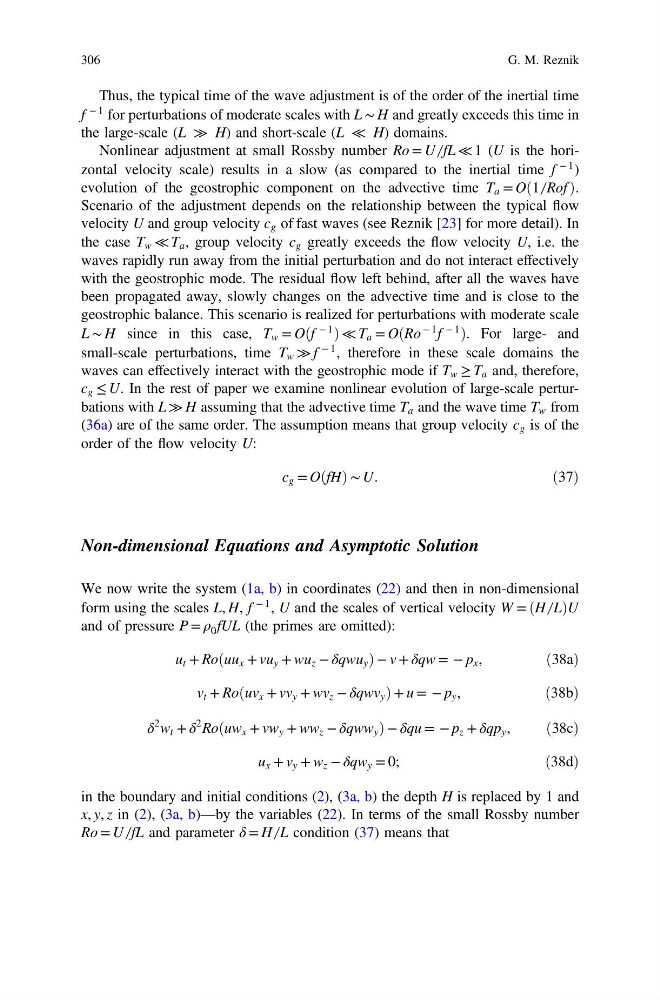
We now write the system (1a, b) in coordinates (22) and then in non-dimensional
form using the scales L, H, f
− 1 , U and the scales of vertical velocity W = ðH ̸ LÞU
and of pressure P = ρ 0 fUL (the primes are omitted):
u t + Roðuu x + vu y + wu z − δqwu y Þ − v + δqw = − p x ,
ð38aÞ
v t + Roðuv x + vv y + wv z − δqwv y Þ + u = − p y ,
ð38bÞ
δ
2 w t + δ
2 Roðuw x + vw y + ww z − δqww y Þ − δqu = − p z + δqp y ,
ð38cÞ
u x + v y + w z − δqw y = 0;
ð38dÞ
in the boundary and initial conditions (2), (3a, b) the depth H is replaced by 1 and
x, y, z in (2), (3a, b)—by the variables (22). In terms of the small Rossby number
Ro = U ̸ fL and parameter δ = H ̸ L condition (37) means that
306
G. M. Reznik
f
− 1 for perturbations of moderate scales with L ∼ H and greatly exceeds this time in
the large-scale (L ≫ H) and short-scale (L ≪ H) domains.
Nonlinear adjustment at small Rossby number Ro = U ̸ fL ≪ 1 (U is the horizontal velocity scale) results in a slow (as compared to the inertial time f
− 1 )
evolution of the geostrophic component on the advective time T a = Oð1 ̸ Rof Þ.
Scenario of the adjustment depends on the relationship between the typical flow
velocity U and group velocity c g of fast waves (see Reznik [23] for more detail). In
the case T w ≪ T a , group velocity c g greatly exceeds the flow velocity U, i.e. the
waves rapidly run away from the initial perturbation and do not interact effectively
with the geostrophic mode. The residual flow left behind, after all the waves have
been propagated away, slowly changes on the advective time and is close to the
geostrophic balance. This scenario is realized for perturbations with moderate scale
L ∼ H since in this case, T w = Oðf
− 1
Þ ≪ T a = OðRo
− 1 f
− 1
Þ. For large- and
small-scale perturbations, time T w ≫ f
− 1 , therefore in these scale domains the
waves can effectively interact with the geostrophic mode if T w ≥ T a and, therefore,
c g ≤ U. In the rest of paper we examine nonlinear evolution of large-scale perturbations with L ≫ H assuming that the advective time T a and the wave time T w from
(36a) are of the same order. The assumption means that group velocity c g is of the
order of the flow velocity U:
c g = OðfHÞ ∼ U.
ð37Þ
Non-dimensional Equations and Asymptotic Solution
We now write the system (1a, b) in coordinates (22) and then in non-dimensional
form using the scales L, H, f
− 1 , U and the scales of vertical velocity W = ðH ̸ LÞU
and of pressure P = ρ 0 fUL (the primes are omitted):
u t + Roðuu x + vu y + wu z − δqwu y Þ − v + δqw = − p x ,
ð38aÞ
v t + Roðuv x + vv y + wv z − δqwv y Þ + u = − p y ,
ð38bÞ
δ
2 w t + δ
2 Roðuw x + vw y + ww z − δqww y Þ − δqu = − p z + δqp y ,
ð38cÞ
u x + v y + w z − δqw y = 0;
ð38dÞ
in the boundary and initial conditions (2), (3a, b) the depth H is replaced by 1 and
x, y, z in (2), (3a, b)—by the variables (22). In terms of the small Rossby number
Ro = U ̸ fL and parameter δ = H ̸ L condition (37) means that
306
G. M. Reznik