

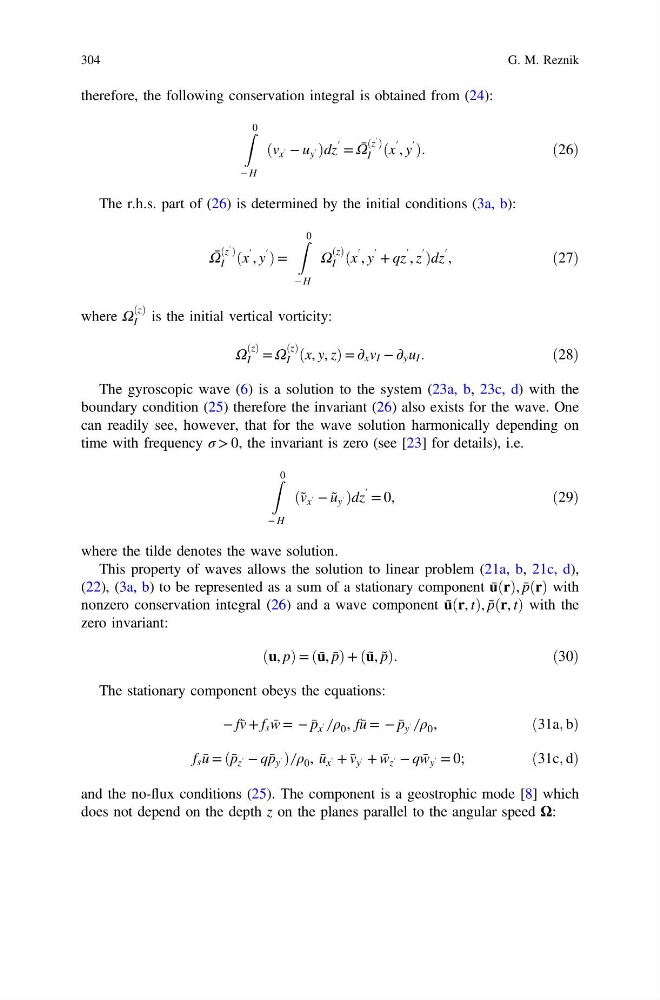
therefore, the following conservation integral is obtained from (24):
Z 0
− H
ðv x ′ − u y ′ Þdz
′ = Ω ̄ ðz
′ Þ
I ðx
′ , y
′
Þ.
ð26Þ
The r.h.s. part of (26) is determined by the initial conditions (3a, b):
Ω ̄
ðz
′ Þ
I ðx
′ , y
′
Þ =
Z 0
− H
Ω
ðzÞ
I ðx
′ , y
′ + qz
′ , z
′
Þdz
′ ,
ð27Þ
where Ω
ðzÞ
I is the initial vertical vorticity:
Ω
ðzÞ
I = Ω
ðzÞ
I ðx, y, zÞ = ∂ x v I − ∂ y u I .
ð28Þ
The gyroscopic wave (6) is a solution to the system (23a, b, 23c, d) with the
boundary condition (25) therefore the invariant (26) also exists for the wave. One
can readily see, however, that for the wave solution harmonically depending on
time with frequency σ > 0, the invariant is zero (see [23] for details), i.e.
Z 0
− H
ðṽ x ′ − ũ y ′ Þdz
′ = 0,
ð29Þ
where the tilde denotes the wave solution.
This property of waves allows the solution to linear problem (21a, b, 21c, d),
(22), (3a, b) to be represented as a sum of a stationary component ū ðrÞ, p̄ ðrÞ with
nonzero conservation integral (26) and a wave component ũ ðr, tÞ, p̃ ðr, tÞ with the
zero invariant:
ðu, pÞ = ðū , p̄ Þ + ðũ , p̃ Þ.
ð30Þ
The stationary component obeys the equations:
− fv̄ + f s w̄ = − p̄ x ′ ̸ ρ 0 , fū = − p̄ y ′ ̸ ρ 0 ,
ð31a; bÞ
f s ū = ðp̄ z ′ − qp̄ y ′ Þ ̸ ρ 0 , ū x ′ + v̄ y ′ + w̄ z ′ − qw̄ y ′ = 0;
ð31c; dÞ
and the no-flux conditions (25). The component is a geostrophic mode [8] which
does not depend on the depth z on the planes parallel to the angular speed Ω:
304
G. M. Reznik
Z 0
− H
ðv x ′ − u y ′ Þdz
′ = Ω ̄ ðz
′ Þ
I ðx
′ , y
′
Þ.
ð26Þ
The r.h.s. part of (26) is determined by the initial conditions (3a, b):
Ω ̄
ðz
′ Þ
I ðx
′ , y
′
Þ =
Z 0
− H
Ω
ðzÞ
I ðx
′ , y
′ + qz
′ , z
′
Þdz
′ ,
ð27Þ
where Ω
ðzÞ
I is the initial vertical vorticity:
Ω
ðzÞ
I = Ω
ðzÞ
I ðx, y, zÞ = ∂ x v I − ∂ y u I .
ð28Þ
The gyroscopic wave (6) is a solution to the system (23a, b, 23c, d) with the
boundary condition (25) therefore the invariant (26) also exists for the wave. One
can readily see, however, that for the wave solution harmonically depending on
time with frequency σ > 0, the invariant is zero (see [23] for details), i.e.
Z 0
− H
ðṽ x ′ − ũ y ′ Þdz
′ = 0,
ð29Þ
where the tilde denotes the wave solution.
This property of waves allows the solution to linear problem (21a, b, 21c, d),
(22), (3a, b) to be represented as a sum of a stationary component ū ðrÞ, p̄ ðrÞ with
nonzero conservation integral (26) and a wave component ũ ðr, tÞ, p̃ ðr, tÞ with the
zero invariant:
ðu, pÞ = ðū , p̄ Þ + ðũ , p̃ Þ.
ð30Þ
The stationary component obeys the equations:
− fv̄ + f s w̄ = − p̄ x ′ ̸ ρ 0 , fū = − p̄ y ′ ̸ ρ 0 ,
ð31a; bÞ
f s ū = ðp̄ z ′ − qp̄ y ′ Þ ̸ ρ 0 , ū x ′ + v̄ y ′ + w̄ z ′ − qw̄ y ′ = 0;
ð31c; dÞ
and the no-flux conditions (25). The component is a geostrophic mode [8] which
does not depend on the depth z on the planes parallel to the angular speed Ω:
304
G. M. Reznik