

u t − fv + f s w = − p x ̸ ρ 0 , v t + fu = − p y ̸ ρ 0 ,
ð21a; bÞ
w t − f s u = − p z ̸ ρ 0 , u x + v y + w z = 0.
ð21c; dÞ
To derive the linear invariant we introduce the new variables:
x
′ = x, y
′ = y − qz, z
′ = z.
ð22Þ
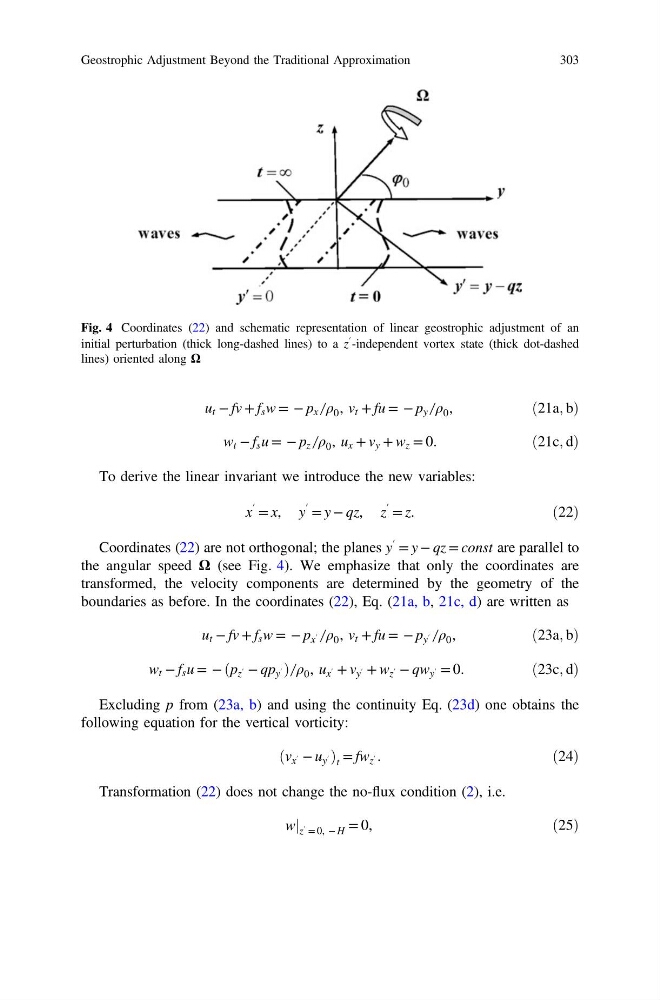
Coordinates (22) are not orthogonal; the planes y
′ = y − qz = const are parallel to
the angular speed Ω (see Fig. 4). We emphasize that only the coordinates are
transformed, the velocity components are determined by the geometry of the
boundaries as before. In the coordinates (22), Eq. (21a, b, 21c, d) are written as
u t − fv + f s w = − p x ′ ̸ ρ 0 , v t + fu = − p y ′ ̸ ρ 0 ,
ð23a; bÞ
w t − f s u = − ðp z ′ − qp y ′ Þ ̸ ρ 0 , u x ′ + v y ′ + w z ′ − qw y ′ = 0.
ð23c; dÞ
Excluding p from (23a, b) and using the continuity Eq. (23d) one obtains the
following equation for the vertical vorticity:
ðv x ′ − u y ′ Þ t = fw z ′ .
ð24Þ
Transformation (22) does not change the no-flux condition (2), i.e.
wj z ′ = 0, − H = 0,
ð25Þ
Fig. 4 Coordinates (22) and schematic representation of linear geostrophic adjustment of an
initial perturbation (thick long-dashed lines) to a z
′ -independent vortex state (thick dot-dashed
lines) oriented along Ω
Geostrophic Adjustment Beyond the Traditional Approximation
303
ð21a; bÞ
w t − f s u = − p z ̸ ρ 0 , u x + v y + w z = 0.
ð21c; dÞ
To derive the linear invariant we introduce the new variables:
x
′ = x, y
′ = y − qz, z
′ = z.
ð22Þ
Coordinates (22) are not orthogonal; the planes y
′ = y − qz = const are parallel to
the angular speed Ω (see Fig. 4). We emphasize that only the coordinates are
transformed, the velocity components are determined by the geometry of the
boundaries as before. In the coordinates (22), Eq. (21a, b, 21c, d) are written as
u t − fv + f s w = − p x ′ ̸ ρ 0 , v t + fu = − p y ′ ̸ ρ 0 ,
ð23a; bÞ
w t − f s u = − ðp z ′ − qp y ′ Þ ̸ ρ 0 , u x ′ + v y ′ + w z ′ − qw y ′ = 0.
ð23c; dÞ
Excluding p from (23a, b) and using the continuity Eq. (23d) one obtains the
following equation for the vertical vorticity:
ðv x ′ − u y ′ Þ t = fw z ′ .
ð24Þ
Transformation (22) does not change the no-flux condition (2), i.e.
wj z ′ = 0, − H = 0,
ð25Þ
Fig. 4 Coordinates (22) and schematic representation of linear geostrophic adjustment of an
initial perturbation (thick long-dashed lines) to a z
′ -independent vortex state (thick dot-dashed
lines) oriented along Ω
Geostrophic Adjustment Beyond the Traditional Approximation
303