

Simulation of Standing and Propagating Sea Waves . . .
267
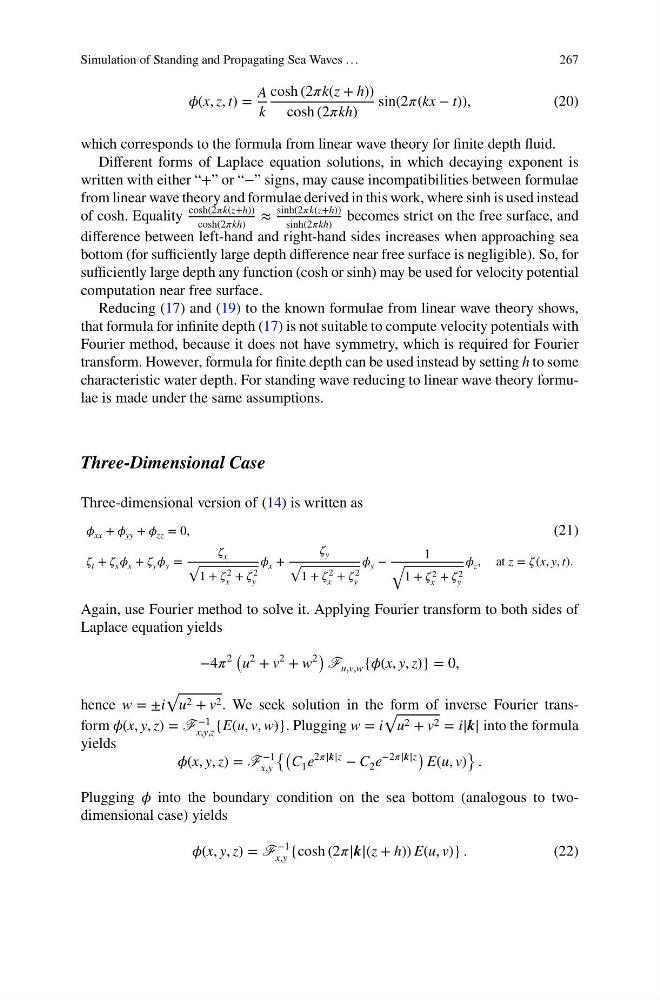
í µí¼(x, z, t) =
A
k
cosh (2í µí¼k(z + h))
cosh (2í µí¼kh)
sin(2í µí¼(kx − t)),
(20)
which corresponds to the formula from linear wave theory for finite depth fluid.
Different forms of Laplace equation solutions, in which decaying exponent is
written with either “+” or “−” signs, may cause incompatibilities between formulae
from linear wave theory and formulae derived in this work, where sinh is used instead
of cosh. Equality
cosh(2í µí¼k(z+h))
cosh(2í µí¼kh)
≈
sinh(2í µí¼k(z+h))
sinh(2í µí¼kh)
becomes strict on the free surface, and
difference between left-hand and right-hand sides increases when approaching sea
bottom (for sufficiently large depth difference near free surface is negligible). So, for
sufficiently large depth any function (cosh or sinh) may be used for velocity potential
computation near free surface.
Reducing (17) and (19) to the known formulae from linear wave theory shows,
that formula for infinite depth (17) is not suitable to compute velocity potentials with
Fourier method, because it does not have symmetry, which is required for Fourier
transform. However, formula for finite depth can be used instead by setting h to some
characteristic water depth. For standing wave reducing to linear wave theory formulae is made under the same assumptions.
Three-Dimensional Case
Three-dimensional version of (14) is written as
í µí¼ xx + í µí¼ yy + í µí¼ zz = 0,
(21)
í µí¼ t + í µí¼ x í µí¼ x + í µí¼ y í µí¼ y =
í µí¼ x
√
1 + í µí¼ 2
x
+ í µí¼ 2
y
í µí¼ x +
í µí¼ y
√
1 + í µí¼ 2
x
+ í µí¼ 2
y
í µí¼ y −
1
√
1 + í µí¼ 2
x + í µí¼ 2
y
í µí¼ z , at z = í µí¼(x, y, t).
Again, use Fourier method to solve it. Applying Fourier transform to both sides of
Laplace equation yields
−4í µí¼
2
(
u
2
+ v
2
+ w
2
) F u,v,w {í µí¼(x, y, z)} = 0,
hence w = ±i
√
u 2 + v 2 . We seek solution in the form of inverse Fourier transform í µí¼(x, y, z) = F
−1
x,y,z {E(u, v, w)}. Plugging w = i
√
u 2 + v 2 = i|k| into the formula
yields
í µí¼(x, y, z) = F
−1
x,y
{(
C 1 e
2í µí¼|k|z
− C 2 e
−2í µí¼|k|z
)
E(u, v)
} .
Plugging í µí¼ into the boundary condition on the sea bottom (analogous to twodimensional case) yields
í µí¼(x, y, z) = F
−1
x,y {cosh (2í µí¼|k|(z + h)) E(u, v)} .
(22)
267
í µí¼(x, z, t) =
A
k
cosh (2í µí¼k(z + h))
cosh (2í µí¼kh)
sin(2í µí¼(kx − t)),
(20)
which corresponds to the formula from linear wave theory for finite depth fluid.
Different forms of Laplace equation solutions, in which decaying exponent is
written with either “+” or “−” signs, may cause incompatibilities between formulae
from linear wave theory and formulae derived in this work, where sinh is used instead
of cosh. Equality
cosh(2í µí¼k(z+h))
cosh(2í µí¼kh)
≈
sinh(2í µí¼k(z+h))
sinh(2í µí¼kh)
becomes strict on the free surface, and
difference between left-hand and right-hand sides increases when approaching sea
bottom (for sufficiently large depth difference near free surface is negligible). So, for
sufficiently large depth any function (cosh or sinh) may be used for velocity potential
computation near free surface.
Reducing (17) and (19) to the known formulae from linear wave theory shows,
that formula for infinite depth (17) is not suitable to compute velocity potentials with
Fourier method, because it does not have symmetry, which is required for Fourier
transform. However, formula for finite depth can be used instead by setting h to some
characteristic water depth. For standing wave reducing to linear wave theory formulae is made under the same assumptions.
Three-Dimensional Case
Three-dimensional version of (14) is written as
í µí¼ xx + í µí¼ yy + í µí¼ zz = 0,
(21)
í µí¼ t + í µí¼ x í µí¼ x + í µí¼ y í µí¼ y =
í µí¼ x
√
1 + í µí¼ 2
x
+ í µí¼ 2
y
í µí¼ x +
í µí¼ y
√
1 + í µí¼ 2
x
+ í µí¼ 2
y
í µí¼ y −
1
√
1 + í µí¼ 2
x + í µí¼ 2
y
í µí¼ z , at z = í µí¼(x, y, t).
Again, use Fourier method to solve it. Applying Fourier transform to both sides of
Laplace equation yields
−4í µí¼
2
(
u
2
+ v
2
+ w
2
) F u,v,w {í µí¼(x, y, z)} = 0,
hence w = ±i
√
u 2 + v 2 . We seek solution in the form of inverse Fourier transform í µí¼(x, y, z) = F
−1
x,y,z {E(u, v, w)}. Plugging w = i
√
u 2 + v 2 = i|k| into the formula
yields
í µí¼(x, y, z) = F
−1
x,y
{(
C 1 e
2í µí¼|k|z
− C 2 e
−2í µí¼|k|z
)
E(u, v)
} .
Plugging í µí¼ into the boundary condition on the sea bottom (analogous to twodimensional case) yields
í µí¼(x, y, z) = F
−1
x,y {cosh (2í µí¼|k|(z + h)) E(u, v)} .
(22)