

230
T. Dauxois et al.
0
10
20
30
40
0
10
20
30
-30
-15
0
+15
+30
0
1 0
2 0
3 0
4 0
(a)
(b)
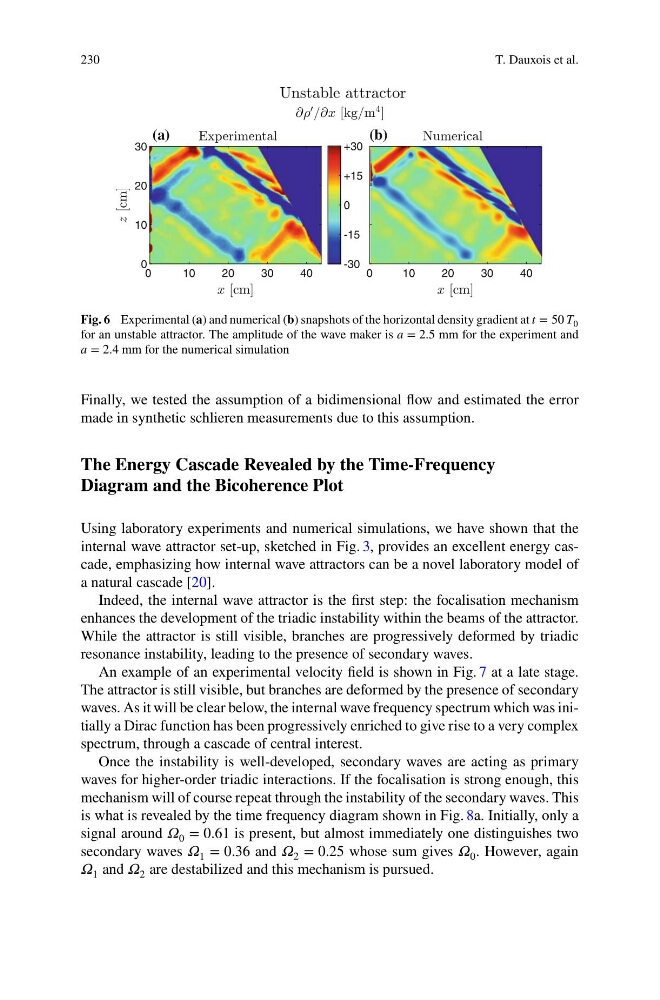
Fig. 6 Experimental (a) and numerical (b) snapshots of the horizontal density gradient at t = 50 T 0
for an unstable attractor. The amplitude of the wave maker is a = 2.5 mm for the experiment and
a = 2.4 mm for the numerical simulation
Finally, we tested the assumption of a bidimensional flow and estimated the error
made in synthetic schlieren measurements due to this assumption.
The Energy Cascade Revealed by the Time-Frequency
Diagram and the Bicoherence Plot
Using laboratory experiments and numerical simulations, we have shown that the
internal wave attractor set-up, sketched in Fig. 3, provides an excellent energy cascade, emphasizing how internal wave attractors can be a novel laboratory model of
a natural cascade [20].
Indeed, the internal wave attractor is the first step: the focalisation mechanism
enhances the development of the triadic instability within the beams of the attractor.
While the attractor is still visible, branches are progressively deformed by triadic
resonance instability, leading to the presence of secondary waves.
An example of an experimental velocity field is shown in Fig. 7 at a late stage.
The attractor is still visible, but branches are deformed by the presence of secondary
waves. As it will be clear below, the internal wave frequency spectrum which was initially a Dirac function has been progressively enriched to give rise to a very complex
spectrum, through a cascade of central interest.
Once the instability is well-developed, secondary waves are acting as primary
waves for higher-order triadic interactions. If the focalisation is strong enough, this
mechanism will of course repeat through the instability of the secondary waves. This
is what is revealed by the time frequency diagram shown in Fig. 8a. Initially, only a
signal around í µí»º 0 = 0.61 is present, but almost immediately one distinguishes two
secondary waves í µí»º 1 = 0.36 and í µí»º 2 = 0.25 whose sum gives í µí»º 0 . However, again
í µí»º 1 and í µí»º 2 are destabilized and this mechanism is pursued.
T. Dauxois et al.
0
10
20
30
40
0
10
20
30
-30
-15
0
+15
+30
0
1 0
2 0
3 0
4 0
(a)
(b)
Fig. 6 Experimental (a) and numerical (b) snapshots of the horizontal density gradient at t = 50 T 0
for an unstable attractor. The amplitude of the wave maker is a = 2.5 mm for the experiment and
a = 2.4 mm for the numerical simulation
Finally, we tested the assumption of a bidimensional flow and estimated the error
made in synthetic schlieren measurements due to this assumption.
The Energy Cascade Revealed by the Time-Frequency
Diagram and the Bicoherence Plot
Using laboratory experiments and numerical simulations, we have shown that the
internal wave attractor set-up, sketched in Fig. 3, provides an excellent energy cascade, emphasizing how internal wave attractors can be a novel laboratory model of
a natural cascade [20].
Indeed, the internal wave attractor is the first step: the focalisation mechanism
enhances the development of the triadic instability within the beams of the attractor.
While the attractor is still visible, branches are progressively deformed by triadic
resonance instability, leading to the presence of secondary waves.
An example of an experimental velocity field is shown in Fig. 7 at a late stage.
The attractor is still visible, but branches are deformed by the presence of secondary
waves. As it will be clear below, the internal wave frequency spectrum which was initially a Dirac function has been progressively enriched to give rise to a very complex
spectrum, through a cascade of central interest.
Once the instability is well-developed, secondary waves are acting as primary
waves for higher-order triadic interactions. If the focalisation is strong enough, this
mechanism will of course repeat through the instability of the secondary waves. This
is what is revealed by the time frequency diagram shown in Fig. 8a. Initially, only a
signal around í µí»º 0 = 0.61 is present, but almost immediately one distinguishes two
secondary waves í µí»º 1 = 0.36 and í µí»º 2 = 0.25 whose sum gives í µí»º 0 . However, again
í µí»º 1 and í µí»º 2 are destabilized and this mechanism is pursued.