

228
T. Dauxois et al.
form by the horizontal motion of a stack of 47 plates. The whole-field velocity measurements are performed via the standard Particle Image Velocimetry (PIV) technique. To achieve this, the fluid is seeded with light-reflecting hollow glass spheres
of size 8 µm and density 1100 kg/m 3 . The sedimentation velocity of such particles
is found to be very low, with negligible effect on results of velocity measurements.
The longitudinal (x, y = 0, z) mid-plane of the test section is illuminated by a vertical
laser sheet coming through the side of the tank. The PIV acquisition leads to 2 velocity fields per second. This sampling rate is found to provide a sufficient resolution of
the significant frequency components of the signal and the mesh of measurements is
also found to be sufficient to resolve the small-scale details of the wave field.
Numerical Computations
Numerical computations were performed with a spectral element method [14, 15],
using the modified open code nek5000. The geometry of the numerical set-up closely
reproduces the experimental one. The full system of equations being solved consists of the Navier-Stokes equation in the Boussinesq approximation, the continuity equation and the equation for the transport of salt. Typical meshes used in
calculations consist of 50 thousands to half-million elements, with 8 to 10-order
polynomial decomposition within each element. Time discretization was 10 −4 to
10
−5 of the external forcing period. Comparisons of experimental and numerical
results present a beautiful agreement, not only qualitative but also quantitative [16].
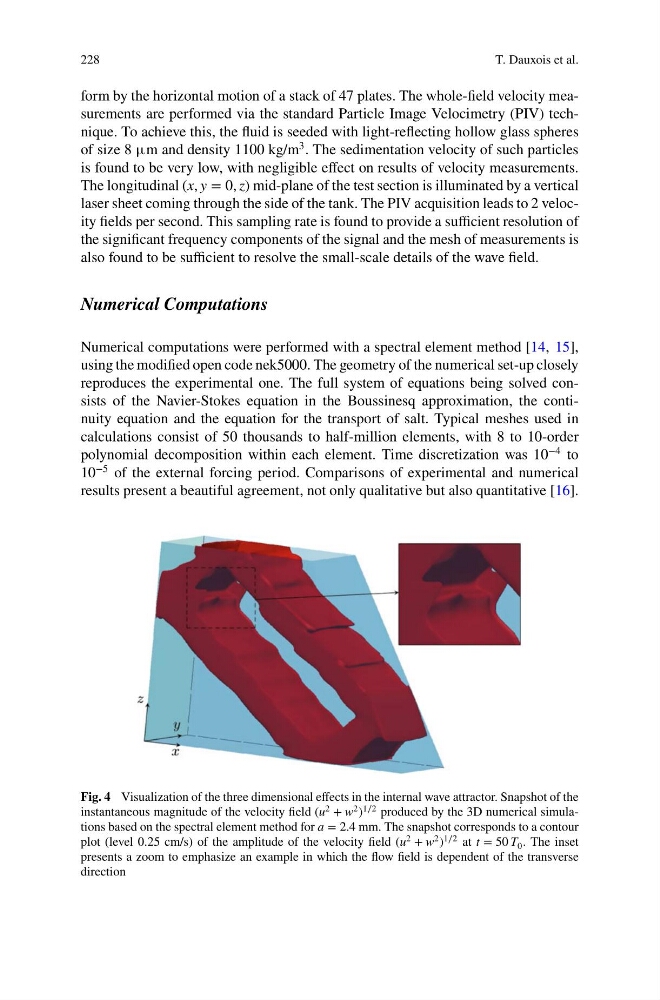
Fig. 4 Visualization of the three dimensional effects in the internal wave attractor. Snapshot of the
instantaneous magnitude of the velocity field (u 2 + w 2 ) 1∕2 produced by the 3D numerical simulations based on the spectral element method for a = 2.4 mm. The snapshot corresponds to a contour
plot (level 0.25 cm/s) of the amplitude of the velocity field (u 2 + w 2 ) 1∕2 at t = 50 T 0 . The inset
presents a zoom to emphasize an example in which the flow field is dependent of the transverse
direction
T. Dauxois et al.
form by the horizontal motion of a stack of 47 plates. The whole-field velocity measurements are performed via the standard Particle Image Velocimetry (PIV) technique. To achieve this, the fluid is seeded with light-reflecting hollow glass spheres
of size 8 µm and density 1100 kg/m 3 . The sedimentation velocity of such particles
is found to be very low, with negligible effect on results of velocity measurements.
The longitudinal (x, y = 0, z) mid-plane of the test section is illuminated by a vertical
laser sheet coming through the side of the tank. The PIV acquisition leads to 2 velocity fields per second. This sampling rate is found to provide a sufficient resolution of
the significant frequency components of the signal and the mesh of measurements is
also found to be sufficient to resolve the small-scale details of the wave field.
Numerical Computations
Numerical computations were performed with a spectral element method [14, 15],
using the modified open code nek5000. The geometry of the numerical set-up closely
reproduces the experimental one. The full system of equations being solved consists of the Navier-Stokes equation in the Boussinesq approximation, the continuity equation and the equation for the transport of salt. Typical meshes used in
calculations consist of 50 thousands to half-million elements, with 8 to 10-order
polynomial decomposition within each element. Time discretization was 10 −4 to
10
−5 of the external forcing period. Comparisons of experimental and numerical
results present a beautiful agreement, not only qualitative but also quantitative [16].
Fig. 4 Visualization of the three dimensional effects in the internal wave attractor. Snapshot of the
instantaneous magnitude of the velocity field (u 2 + w 2 ) 1∕2 produced by the 3D numerical simulations based on the spectral element method for a = 2.4 mm. The snapshot corresponds to a contour
plot (level 0.25 cm/s) of the amplitude of the velocity field (u 2 + w 2 ) 1∕2 at t = 50 T 0 . The inset
presents a zoom to emphasize an example in which the flow field is dependent of the transverse
direction