

Abyssal Mixing in the Laboratory
227
Experimental and Numerical Set-Up
We have combined numerical and experimental approaches to study the dynamics of
stable and unstable internal wave attractors. The problem is considered in a classic
trapezoidal set-up filled with a uniformly stratified fluid. Energy is injected into the
system at global scale by the small-amplitude motion of a vertical wall.
Experimental Set-Up
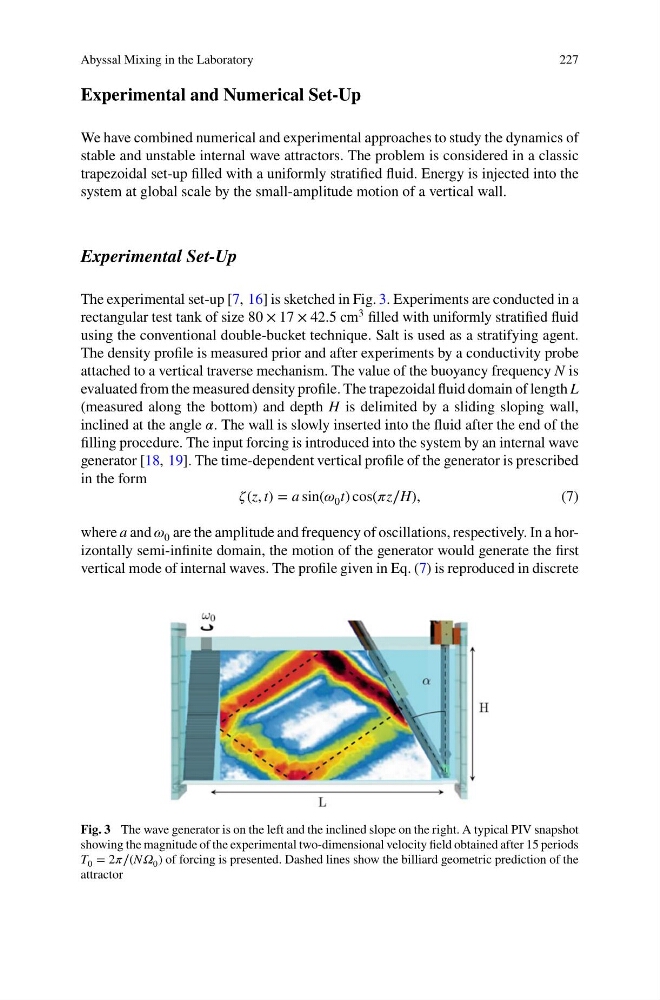
The experimental set-up [7, 16] is sketched in Fig. 3. Experiments are conducted in a
rectangular test tank of size 80 × 17 × 42.5 cm 3 filled with uniformly stratified fluid
using the conventional double-bucket technique. Salt is used as a stratifying agent.
The density profile is measured prior and after experiments by a conductivity probe
attached to a vertical traverse mechanism. The value of the buoyancy frequency N is
evaluated from the measured density profile. The trapezoidal fluid domain of length L
(measured along the bottom) and depth H is delimited by a sliding sloping wall,
inclined at the angle í µí»¼. The wall is slowly inserted into the fluid after the end of the
filling procedure. The input forcing is introduced into the system by an internal wave
generator [18, 19]. The time-dependent vertical profile of the generator is prescribed
in the form
í µí¼ (z, t) = a sin(í µí¼ 0 t) cos(í µí¼z∕H),
(7)
where a and í µí¼ 0 are the amplitude and frequency of oscillations, respectively. In a horizontally semi-infinite domain, the motion of the generator would generate the first
vertical mode of internal waves. The profile given in Eq. (7) is reproduced in discrete
Fig. 3 The wave generator is on the left and the inclined slope on the right. A typical PIV snapshot
showing the magnitude of the experimental two-dimensional velocity field obtained after 15 periods
T 0 = 2í µí¼∕(Ní µí»º 0 ) of forcing is presented. Dashed lines show the billiard geometric prediction of the
attractor
227
Experimental and Numerical Set-Up
We have combined numerical and experimental approaches to study the dynamics of
stable and unstable internal wave attractors. The problem is considered in a classic
trapezoidal set-up filled with a uniformly stratified fluid. Energy is injected into the
system at global scale by the small-amplitude motion of a vertical wall.
Experimental Set-Up
The experimental set-up [7, 16] is sketched in Fig. 3. Experiments are conducted in a
rectangular test tank of size 80 × 17 × 42.5 cm 3 filled with uniformly stratified fluid
using the conventional double-bucket technique. Salt is used as a stratifying agent.
The density profile is measured prior and after experiments by a conductivity probe
attached to a vertical traverse mechanism. The value of the buoyancy frequency N is
evaluated from the measured density profile. The trapezoidal fluid domain of length L
(measured along the bottom) and depth H is delimited by a sliding sloping wall,
inclined at the angle í µí»¼. The wall is slowly inserted into the fluid after the end of the
filling procedure. The input forcing is introduced into the system by an internal wave
generator [18, 19]. The time-dependent vertical profile of the generator is prescribed
in the form
í µí¼ (z, t) = a sin(í µí¼ 0 t) cos(í µí¼z∕H),
(7)
where a and í µí¼ 0 are the amplitude and frequency of oscillations, respectively. In a horizontally semi-infinite domain, the motion of the generator would generate the first
vertical mode of internal waves. The profile given in Eq. (7) is reproduced in discrete
Fig. 3 The wave generator is on the left and the inclined slope on the right. A typical PIV snapshot
showing the magnitude of the experimental two-dimensional velocity field obtained after 15 periods
T 0 = 2í µí¼∕(Ní µí»º 0 ) of forcing is presented. Dashed lines show the billiard geometric prediction of the
attractor