

226
T. Dauxois et al.
L
0
L
0
0
H
(a)
(b)
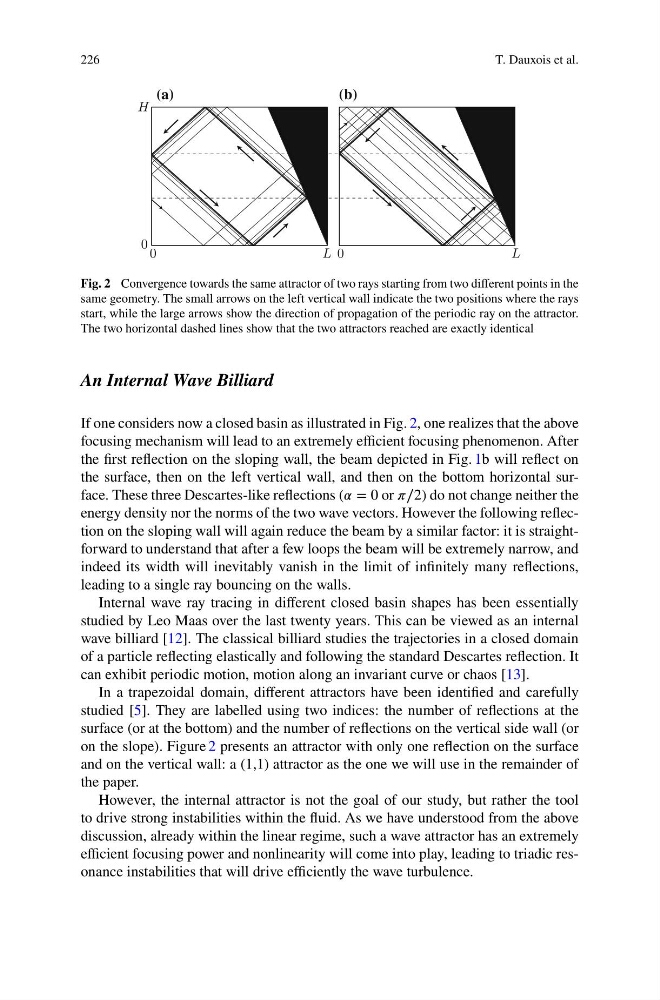
Fig. 2 Convergence towards the same attractor of two rays starting from two different points in the
same geometry. The small arrows on the left vertical wall indicate the two positions where the rays
start, while the large arrows show the direction of propagation of the periodic ray on the attractor.
The two horizontal dashed lines show that the two attractors reached are exactly identical
An Internal Wave Billiard
If one considers now a closed basin as illustrated in Fig. 2, one realizes that the above
focusing mechanism will lead to an extremely efficient focusing phenomenon. After
the first reflection on the sloping wall, the beam depicted in Fig. 1b will reflect on
the surface, then on the left vertical wall, and then on the bottom horizontal surface. These three Descartes-like reflections (í µí»¼ = 0 or í µí¼∕2) do not change neither the
energy density nor the norms of the two wave vectors. However the following reflection on the sloping wall will again reduce the beam by a similar factor: it is straightforward to understand that after a few loops the beam will be extremely narrow, and
indeed its width will inevitably vanish in the limit of infinitely many reflections,
leading to a single ray bouncing on the walls.
Internal wave ray tracing in different closed basin shapes has been essentially
studied by Leo Maas over the last twenty years. This can be viewed as an internal
wave billiard [12]. The classical billiard studies the trajectories in a closed domain
of a particle reflecting elastically and following the standard Descartes reflection. It
can exhibit periodic motion, motion along an invariant curve or chaos [13].
In a trapezoidal domain, different attractors have been identified and carefully
studied [5]. They are labelled using two indices: the number of reflections at the
surface (or at the bottom) and the number of reflections on the vertical side wall (or
on the slope). Figure 2 presents an attractor with only one reflection on the surface
and on the vertical wall: a (1,1) attractor as the one we will use in the remainder of
the paper.
However, the internal attractor is not the goal of our study, but rather the tool
to drive strong instabilities within the fluid. As we have understood from the above
discussion, already within the linear regime, such a wave attractor has an extremely
efficient focusing power and nonlinearity will come into play, leading to triadic resonance instabilities that will drive efficiently the wave turbulence.
T. Dauxois et al.
L
0
L
0
0
H
(a)
(b)
Fig. 2 Convergence towards the same attractor of two rays starting from two different points in the
same geometry. The small arrows on the left vertical wall indicate the two positions where the rays
start, while the large arrows show the direction of propagation of the periodic ray on the attractor.
The two horizontal dashed lines show that the two attractors reached are exactly identical
An Internal Wave Billiard
If one considers now a closed basin as illustrated in Fig. 2, one realizes that the above
focusing mechanism will lead to an extremely efficient focusing phenomenon. After
the first reflection on the sloping wall, the beam depicted in Fig. 1b will reflect on
the surface, then on the left vertical wall, and then on the bottom horizontal surface. These three Descartes-like reflections (í µí»¼ = 0 or í µí¼∕2) do not change neither the
energy density nor the norms of the two wave vectors. However the following reflection on the sloping wall will again reduce the beam by a similar factor: it is straightforward to understand that after a few loops the beam will be extremely narrow, and
indeed its width will inevitably vanish in the limit of infinitely many reflections,
leading to a single ray bouncing on the walls.
Internal wave ray tracing in different closed basin shapes has been essentially
studied by Leo Maas over the last twenty years. This can be viewed as an internal
wave billiard [12]. The classical billiard studies the trajectories in a closed domain
of a particle reflecting elastically and following the standard Descartes reflection. It
can exhibit periodic motion, motion along an invariant curve or chaos [13].
In a trapezoidal domain, different attractors have been identified and carefully
studied [5]. They are labelled using two indices: the number of reflections at the
surface (or at the bottom) and the number of reflections on the vertical side wall (or
on the slope). Figure 2 presents an attractor with only one reflection on the surface
and on the vertical wall: a (1,1) attractor as the one we will use in the remainder of
the paper.
However, the internal attractor is not the goal of our study, but rather the tool
to drive strong instabilities within the fluid. As we have understood from the above
discussion, already within the linear regime, such a wave attractor has an extremely
efficient focusing power and nonlinearity will come into play, leading to triadic resonance instabilities that will drive efficiently the wave turbulence.