

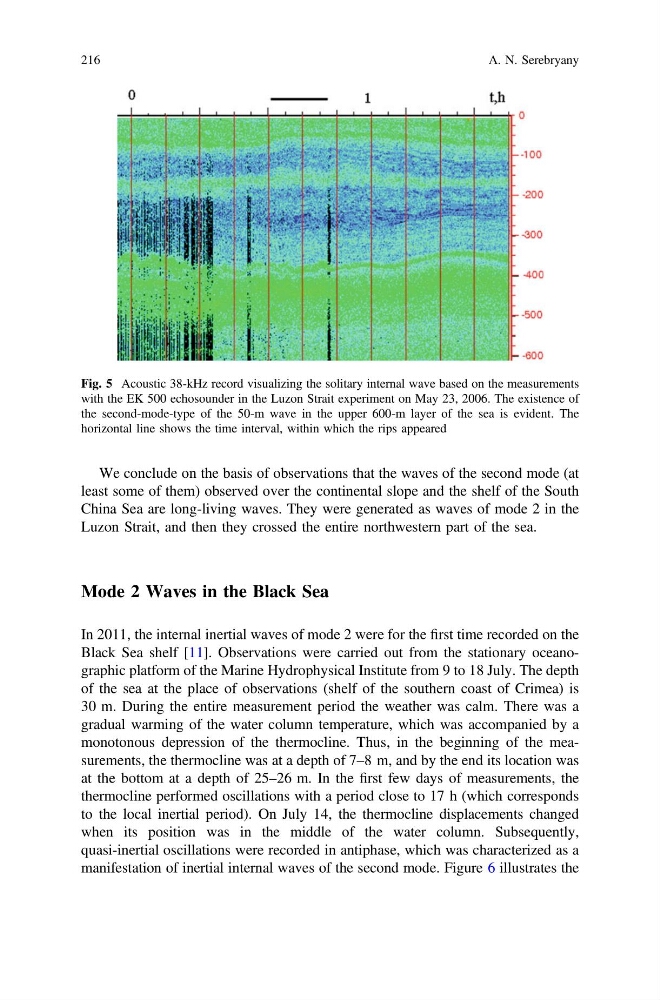
We conclude on the basis of observations that the waves of the second mode (at
least some of them) observed over the continental slope and the shelf of the South
China Sea are long-living waves. They were generated as waves of mode 2 in the
Luzon Strait, and then they crossed the entire northwestern part of the sea.
Mode 2 Waves in the Black Sea
In 2011, the internal inertial waves of mode 2 were for the first time recorded on the
Black Sea shelf [11]. Observations were carried out from the stationary oceanographic platform of the Marine Hydrophysical Institute from 9 to 18 July. The depth
of the sea at the place of observations (shelf of the southern coast of Crimea) is
30 m. During the entire measurement period the weather was calm. There was a
gradual warming of the water column temperature, which was accompanied by a
monotonous depression of the thermocline. Thus, in the beginning of the measurements, the thermocline was at a depth of 7–8 m, and by the end its location was
at the bottom at a depth of 25–26 m. In the first few days of measurements, the
thermocline performed oscillations with a period close to 17 h (which corresponds
to the local inertial period). On July 14, the thermocline displacements changed
when its position was in the middle of the water column. Subsequently,
quasi-inertial oscillations were recorded in antiphase, which was characterized as a
manifestation of inertial internal waves of the second mode. Figure 6 illustrates the
Fig. 5 Acoustic 38-kHz record visualizing the solitary internal wave based on the measurements
with the EK 500 echosounder in the Luzon Strait experiment on May 23, 2006. The existence of
the second-mode-type of the 50-m wave in the upper 600-m layer of the sea is evident. The
horizontal line shows the time interval, within which the rips appeared
216
A. N. Serebryany
least some of them) observed over the continental slope and the shelf of the South
China Sea are long-living waves. They were generated as waves of mode 2 in the
Luzon Strait, and then they crossed the entire northwestern part of the sea.
Mode 2 Waves in the Black Sea
In 2011, the internal inertial waves of mode 2 were for the first time recorded on the
Black Sea shelf [11]. Observations were carried out from the stationary oceanographic platform of the Marine Hydrophysical Institute from 9 to 18 July. The depth
of the sea at the place of observations (shelf of the southern coast of Crimea) is
30 m. During the entire measurement period the weather was calm. There was a
gradual warming of the water column temperature, which was accompanied by a
monotonous depression of the thermocline. Thus, in the beginning of the measurements, the thermocline was at a depth of 7–8 m, and by the end its location was
at the bottom at a depth of 25–26 m. In the first few days of measurements, the
thermocline performed oscillations with a period close to 17 h (which corresponds
to the local inertial period). On July 14, the thermocline displacements changed
when its position was in the middle of the water column. Subsequently,
quasi-inertial oscillations were recorded in antiphase, which was characterized as a
manifestation of inertial internal waves of the second mode. Figure 6 illustrates the
Fig. 5 Acoustic 38-kHz record visualizing the solitary internal wave based on the measurements
with the EK 500 echosounder in the Luzon Strait experiment on May 23, 2006. The existence of
the second-mode-type of the 50-m wave in the upper 600-m layer of the sea is evident. The
horizontal line shows the time interval, within which the rips appeared
216
A. N. Serebryany