

the second mode in intense internal waves of the South China Sea, especially in
winter [8]. Internal waves of the second mode have been recorded here many times
over the continental slope and on the shelf using autonomous moored stations
equipped with vertical chains of thermistors and current meters [8, 9].
In 2006, while conducting studies on the underwater ambient noise associated
with internal waves in the Luzon Strait, we encountered there a large-amplitude
solitary wave of the second mode [10]. The measurements were carried out from the
R/V “Ocean Researcher 1”, which was drifting. The vessel recorded a wave of
mode 2 at the point with coordinates 21.112°N, 119.999°E north-west of the
underwater ridge Heng Chun on May 23 at 11:40 local time. The passage of the
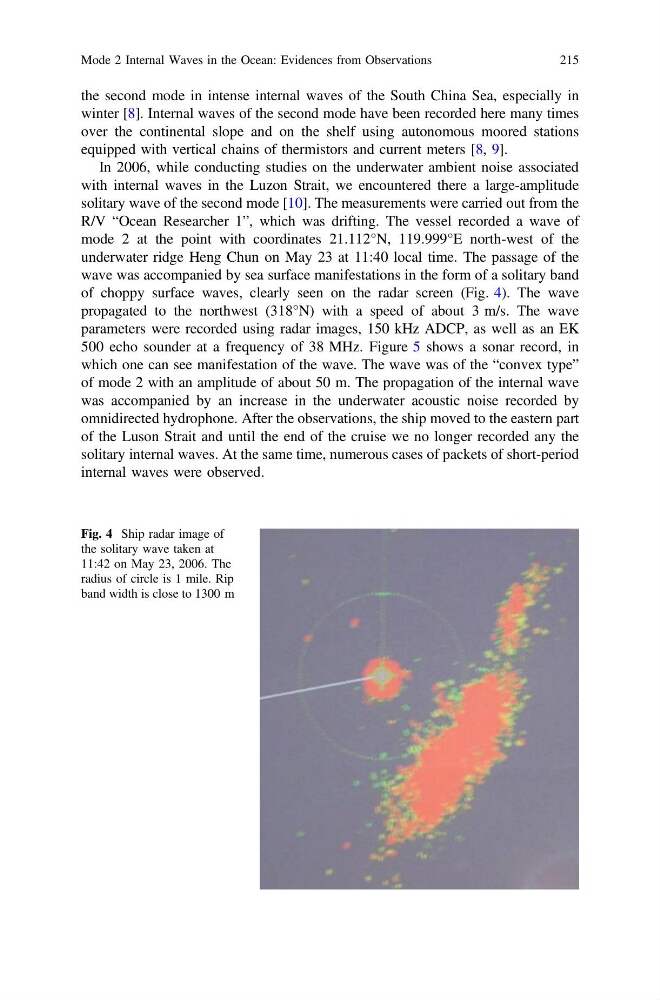
wave was accompanied by sea surface manifestations in the form of a solitary band
of choppy surface waves, clearly seen on the radar screen (Fig. 4). The wave
propagated to the northwest (318°N) with a speed of about 3 m/s. The wave
parameters were recorded using radar images, 150 kHz ADCP, as well as an EK
500 echo sounder at a frequency of 38 MHz. Figure 5 shows a sonar record, in
which one can see manifestation of the wave. The wave was of the “convex type”
of mode 2 with an amplitude of about 50 m. The propagation of the internal wave
was accompanied by an increase in the underwater acoustic noise recorded by
omnidirected hydrophone. After the observations, the ship moved to the eastern part
of the Luson Strait and until the end of the cruise we no longer recorded any the
solitary internal waves. At the same time, numerous cases of packets of short-period
internal waves were observed.
Fig. 4 Ship radar image of
the solitary wave taken at
11:42 on May 23, 2006. The
radius of circle is 1 mile. Rip
band width is close to 1300 m
Mode 2 Internal Waves in the Ocean: Evidences from Observations
215
winter [8]. Internal waves of the second mode have been recorded here many times
over the continental slope and on the shelf using autonomous moored stations
equipped with vertical chains of thermistors and current meters [8, 9].
In 2006, while conducting studies on the underwater ambient noise associated
with internal waves in the Luzon Strait, we encountered there a large-amplitude
solitary wave of the second mode [10]. The measurements were carried out from the
R/V “Ocean Researcher 1”, which was drifting. The vessel recorded a wave of
mode 2 at the point with coordinates 21.112°N, 119.999°E north-west of the
underwater ridge Heng Chun on May 23 at 11:40 local time. The passage of the
wave was accompanied by sea surface manifestations in the form of a solitary band
of choppy surface waves, clearly seen on the radar screen (Fig. 4). The wave
propagated to the northwest (318°N) with a speed of about 3 m/s. The wave
parameters were recorded using radar images, 150 kHz ADCP, as well as an EK
500 echo sounder at a frequency of 38 MHz. Figure 5 shows a sonar record, in
which one can see manifestation of the wave. The wave was of the “convex type”
of mode 2 with an amplitude of about 50 m. The propagation of the internal wave
was accompanied by an increase in the underwater acoustic noise recorded by
omnidirected hydrophone. After the observations, the ship moved to the eastern part
of the Luson Strait and until the end of the cruise we no longer recorded any the
solitary internal waves. At the same time, numerous cases of packets of short-period
internal waves were observed.
Fig. 4 Ship radar image of
the solitary wave taken at
11:42 on May 23, 2006. The
radius of circle is 1 mile. Rip
band width is close to 1300 m
Mode 2 Internal Waves in the Ocean: Evidences from Observations
215