

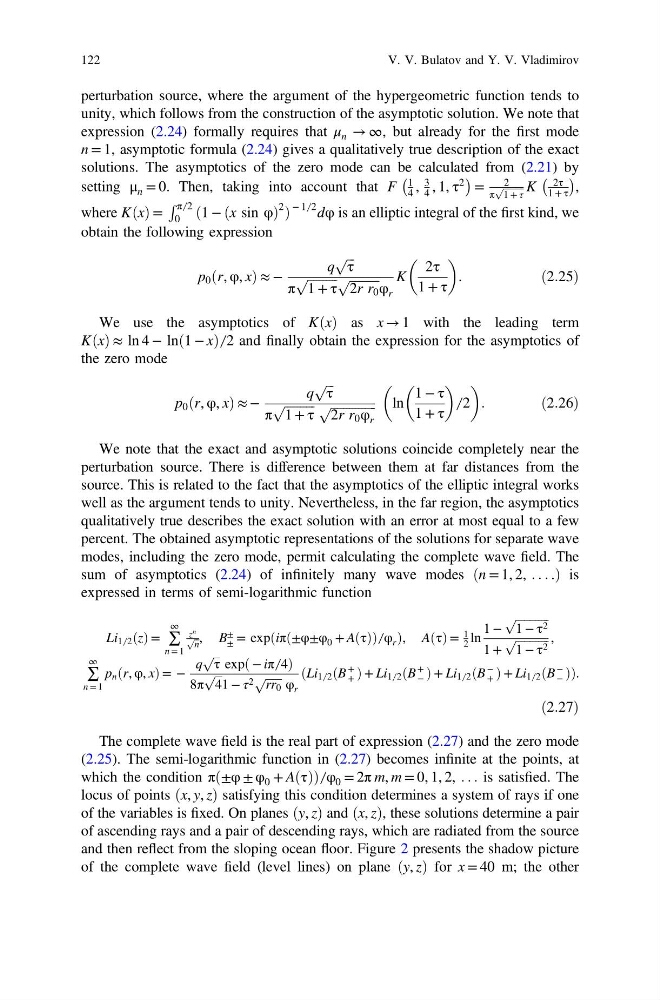
perturbation source, where the argument of the hypergeometric function tends to
unity, which follows from the construction of the asymptotic solution. We note that
expression (2.24) formally requires that μ n → ∞, but already for the first mode
n = 1, asymptotic formula (2.24) gives a qualitatively true description of the exact
solutions. The asymptotics of the zero mode can be calculated from (2.21) by
setting μ n = 0. Then, taking into account that F
1
4 ,
3
4 , 1, τ
2
À
Á
=
2
π
ffiffiffiffiffiffiffi
1 + τ
p
K
2τ
1 + τ
À Á
,
where KðxÞ =
R π ̸ 2
0 ð1 − ðx sin φÞ
2 Þ
− 1 ̸ 2 dφ is an elliptic integral of the first kind, we
obtain the following expression
p 0 ðr, φ, xÞ ≈ −
q
ffiffi ffi
τ
p
π
ffiffiffiffiffiffiffiffiffiffi
1 + τ
p
ffiffiffiffiffiffiffiffiffiffi
2r r 0
p
φ r
K
2τ
1 + τ
.
ð2:25Þ
We use the asymptotics of KðxÞ as x → 1 with the leading term
KðxÞ ≈ ln 4 − lnð1 − xÞ ̸ 2 and finally obtain the expression for the asymptotics of
the zero mode
p 0 ðr, φ, xÞ ≈ −
q
ffiffi ffi
τ
p
π
ffiffiffiffiffiffiffiffiffiffi
1 + τ
p
ffiffiffiffiffiffiffiffiffiffiffiffiffiffi ffi
2r r 0 φ r
p
ln
1 − τ
1 + τ
̸ 2
:
ð2:26Þ
We note that the exact and asymptotic solutions coincide completely near the
perturbation source. There is difference between them at far distances from the
source. This is related to the fact that the asymptotics of the elliptic integral works
well as the argument tends to unity. Nevertheless, in the far region, the asymptotics
qualitatively true describes the exact solution with an error at most equal to a few
percent. The obtained asymptotic representations of the solutions for separate wave
modes, including the zero mode, permit calculating the complete wave field. The
sum of asymptotics (2.24) of infinitely many wave modes ðn = 1, 2, . . . .Þ is
expressed in terms of semi-logarithmic function
Li 1 ̸ 2 ðzÞ = ∑
∞
n = 1
z
n
ffiffi
n
p , B
±
± = expðiπð±φ±φ 0 + AðτÞÞ ̸ φ r Þ, AðτÞ =
1
2 ln
1 −
ffiffiffiffiffiffiffiffiffiffiffi ffi
1 − τ 2
p
1 +
ffiffiffiffiffiffiffiffiffiffiffi ffi
1 − τ 2
p
,
∑
∞
n = 1
p n ðr, φ, xÞ = −
q
ffiffi ffi
τ
p
expð − iπ ̸ 4Þ
8π
ffiffi ffi
4
p
1 − τ 2 ffiffiffiffiffiffi
rr 0
p φ r
ðLi 1 ̸ 2 ðB
+
+ Þ + Li 1 ̸ 2 ðB
+
− Þ + Li 1 ̸ 2 ðB
−
+ Þ + Li 1 ̸ 2 ðB
−
− ÞÞ.
ð2:27Þ
The complete wave field is the real part of expression (2.27) and the zero mode
(2.25). The semi-logarithmic function in (2.27) becomes infinite at the points, at
which the condition πð±φ ± φ 0 + AðτÞÞ ̸ φ 0 = 2π m, m = 0, 1, 2, . . . is satisfied. The
locus of points ðx, y, zÞ satisfying this condition determines a system of rays if one
of the variables is fixed. On planes ðy, zÞ and ðx, zÞ, these solutions determine a pair
of ascending rays and a pair of descending rays, which are radiated from the source
and then reflect from the sloping ocean floor. Figure 2 presents the shadow picture
of the complete wave field (level lines) on plane ðy, zÞ for x = 40 m; the other
122
V. V. Bulatov and Y. V. Vladimirov
unity, which follows from the construction of the asymptotic solution. We note that
expression (2.24) formally requires that μ n → ∞, but already for the first mode
n = 1, asymptotic formula (2.24) gives a qualitatively true description of the exact
solutions. The asymptotics of the zero mode can be calculated from (2.21) by
setting μ n = 0. Then, taking into account that F
1
4 ,
3
4 , 1, τ
2
À
Á
=
2
π
ffiffiffiffiffiffiffi
1 + τ
p
K
2τ
1 + τ
À Á
,
where KðxÞ =
R π ̸ 2
0 ð1 − ðx sin φÞ
2 Þ
− 1 ̸ 2 dφ is an elliptic integral of the first kind, we
obtain the following expression
p 0 ðr, φ, xÞ ≈ −
q
ffiffi ffi
τ
p
π
ffiffiffiffiffiffiffiffiffiffi
1 + τ
p
ffiffiffiffiffiffiffiffiffiffi
2r r 0
p
φ r
K
2τ
1 + τ
.
ð2:25Þ
We use the asymptotics of KðxÞ as x → 1 with the leading term
KðxÞ ≈ ln 4 − lnð1 − xÞ ̸ 2 and finally obtain the expression for the asymptotics of
the zero mode
p 0 ðr, φ, xÞ ≈ −
q
ffiffi ffi
τ
p
π
ffiffiffiffiffiffiffiffiffiffi
1 + τ
p
ffiffiffiffiffiffiffiffiffiffiffiffiffiffi ffi
2r r 0 φ r
p
ln
1 − τ
1 + τ
̸ 2
:
ð2:26Þ
We note that the exact and asymptotic solutions coincide completely near the
perturbation source. There is difference between them at far distances from the
source. This is related to the fact that the asymptotics of the elliptic integral works
well as the argument tends to unity. Nevertheless, in the far region, the asymptotics
qualitatively true describes the exact solution with an error at most equal to a few
percent. The obtained asymptotic representations of the solutions for separate wave
modes, including the zero mode, permit calculating the complete wave field. The
sum of asymptotics (2.24) of infinitely many wave modes ðn = 1, 2, . . . .Þ is
expressed in terms of semi-logarithmic function
Li 1 ̸ 2 ðzÞ = ∑
∞
n = 1
z
n
ffiffi
n
p , B
±
± = expðiπð±φ±φ 0 + AðτÞÞ ̸ φ r Þ, AðτÞ =
1
2 ln
1 −
ffiffiffiffiffiffiffiffiffiffiffi ffi
1 − τ 2
p
1 +
ffiffiffiffiffiffiffiffiffiffiffi ffi
1 − τ 2
p
,
∑
∞
n = 1
p n ðr, φ, xÞ = −
q
ffiffi ffi
τ
p
expð − iπ ̸ 4Þ
8π
ffiffi ffi
4
p
1 − τ 2 ffiffiffiffiffiffi
rr 0
p φ r
ðLi 1 ̸ 2 ðB
+
+ Þ + Li 1 ̸ 2 ðB
+
− Þ + Li 1 ̸ 2 ðB
−
+ Þ + Li 1 ̸ 2 ðB
−
− ÞÞ.
ð2:27Þ
The complete wave field is the real part of expression (2.27) and the zero mode
(2.25). The semi-logarithmic function in (2.27) becomes infinite at the points, at
which the condition πð±φ ± φ 0 + AðτÞÞ ̸ φ 0 = 2π m, m = 0, 1, 2, . . . is satisfied. The
locus of points ðx, y, zÞ satisfying this condition determines a system of rays if one
of the variables is fixed. On planes ðy, zÞ and ðx, zÞ, these solutions determine a pair
of ascending rays and a pair of descending rays, which are radiated from the source
and then reflect from the sloping ocean floor. Figure 2 presents the shadow picture
of the complete wave field (level lines) on plane ðy, zÞ for x = 40 m; the other
122
V. V. Bulatov and Y. V. Vladimirov