

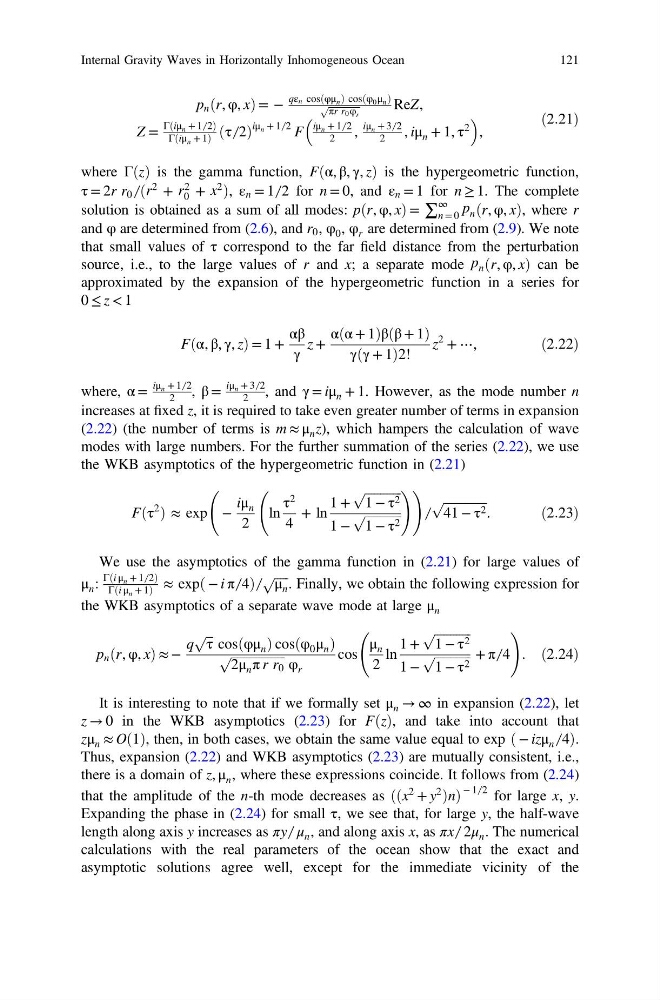
p n ðr, φ, xÞ = −
qε n cosðφμ n Þ cosðφ 0 μ n Þ
ffiffiffiffiffiffiffiffiffiffi ffi
πr r 0 φ r
p
ReZ,
Z =
Γðiμ n + 1 ̸ 2Þ
Γðiμ n + 1Þ ðτ ̸ 2Þ
iμ n + 1 ̸ 2 F
iμ n + 1 ̸ 2
2
,
iμ n + 3 ̸ 2
2
, iμ n + 1, τ
2
,
ð2:21Þ
where ΓðzÞ is the gamma function, Fðα, β, γ, zÞ is the hypergeometric function,
τ = 2r r 0 ̸ ðr
2 + r 2
0 + x 2 Þ, ε n = 1 ̸ 2 for n = 0, and ε n = 1 for n ≥ 1. The complete
solution is obtained as a sum of all modes: pðr, φ, xÞ = ∑
∞
n = 0
p n ðr, φ, xÞ, where r
and φ are determined from (2.6), and r 0 , φ 0 , φ r are determined from (2.9). We note
that small values of τ correspond to the far field distance from the perturbation
source, i.e., to the large values of r and x; a separate mode p n ðr, φ, xÞ can be
approximated by the expansion of the hypergeometric function in a series for
0 ≤ z < 1
Fðα, β, γ, zÞ = 1 +
αβ
γ
z +
αðα + 1Þβðβ + 1Þ
γðγ + 1Þ2!
z
2 + ⋯,
ð2:22Þ
where, α =
iμ n + 1 ̸ 2
2
, β =
iμ n + 3 ̸ 2
2
, and γ = iμ n + 1. However, as the mode number n
increases at fixed z, it is required to take even greater number of terms in expansion
(2.22) (the number of terms is m ≈ μ n z), which hampers the calculation of wave
modes with large numbers. For the further summation of the series (2.22), we use
the WKB asymptotics of the hypergeometric function in (2.21)
Fðτ
2
Þ ≈ exp −
iμ n
2
ln
τ
2
4
+ ln
1 +
ffiffiffiffiffiffiffiffiffiffiffi ffi
1 − τ 2
p
1 −
ffiffiffiffiffiffiffiffiffiffiffi ffi
1 − τ 2
p
! !
̸
ffiffiffiffiffiffiffiffiffiffiffiffiffiffi
41 − τ 2
p
.
ð2:23Þ
We use the asymptotics of the gamma function in (2.21) for large values of
μ n :
Γði μ n + 1 ̸ 2Þ
Γði μ n + 1Þ ≈ expð − i π ̸ 4Þ ̸
ffiffiffiffi ffi
μ n
p . Finally, we obtain the following expression for
the WKB asymptotics of a separate wave mode at large μ n
p n ðr, φ, xÞ ≈ −
q
ffiffi ffi
τ
p
cosðφμ n Þ cosðφ 0 μ n Þ
ffiffiffiffiffiffiffiffiffiffiffiffiffiffiffiffiffi ffi
2μ n π r r 0
p
φ r
cos
μ n
2
ln
1 +
ffiffiffiffiffiffiffiffiffiffiffi ffi
1 − τ 2
p
1 −
ffiffiffiffiffiffiffiffiffiffiffi ffi
1 − τ 2
p
+ π ̸ 4
!
. ð2:24Þ
It is interesting to note that if we formally set μ n → ∞ in expansion (2.22), let
z → 0 in the WKB asymptotics (2.23) for FðzÞ, and take into account that
zμ n ≈ Oð1Þ, then, in both cases, we obtain the same value equal to exp ð − izμ n ̸ 4Þ.
Thus, expansion (2.22) and WKB asymptotics (2.23) are mutually consistent, i.e.,
there is a domain of z, μ n , where these expressions coincide. It follows from (2.24)
that the amplitude of the n-th mode decreases as ððx
2 + y
2
ÞnÞ
− 1 ̸ 2 for large x, y.
Expanding the phase in (2.24) for small τ, we see that, for large y, the half-wave
length along axis y increases as πy ̸ μ n , and along axis x, as πx ̸ 2μ n . The numerical
calculations with the real parameters of the ocean show that the exact and
asymptotic solutions agree well, except for the immediate vicinity of the
Internal Gravity Waves in Horizontally Inhomogeneous Ocean
121
qε n cosðφμ n Þ cosðφ 0 μ n Þ
ffiffiffiffiffiffiffiffiffiffi ffi
πr r 0 φ r
p
ReZ,
Z =
Γðiμ n + 1 ̸ 2Þ
Γðiμ n + 1Þ ðτ ̸ 2Þ
iμ n + 1 ̸ 2 F
iμ n + 1 ̸ 2
2
,
iμ n + 3 ̸ 2
2
, iμ n + 1, τ
2
,
ð2:21Þ
where ΓðzÞ is the gamma function, Fðα, β, γ, zÞ is the hypergeometric function,
τ = 2r r 0 ̸ ðr
2 + r 2
0 + x 2 Þ, ε n = 1 ̸ 2 for n = 0, and ε n = 1 for n ≥ 1. The complete
solution is obtained as a sum of all modes: pðr, φ, xÞ = ∑
∞
n = 0
p n ðr, φ, xÞ, where r
and φ are determined from (2.6), and r 0 , φ 0 , φ r are determined from (2.9). We note
that small values of τ correspond to the far field distance from the perturbation
source, i.e., to the large values of r and x; a separate mode p n ðr, φ, xÞ can be
approximated by the expansion of the hypergeometric function in a series for
0 ≤ z < 1
Fðα, β, γ, zÞ = 1 +
αβ
γ
z +
αðα + 1Þβðβ + 1Þ
γðγ + 1Þ2!
z
2 + ⋯,
ð2:22Þ
where, α =
iμ n + 1 ̸ 2
2
, β =
iμ n + 3 ̸ 2
2
, and γ = iμ n + 1. However, as the mode number n
increases at fixed z, it is required to take even greater number of terms in expansion
(2.22) (the number of terms is m ≈ μ n z), which hampers the calculation of wave
modes with large numbers. For the further summation of the series (2.22), we use
the WKB asymptotics of the hypergeometric function in (2.21)
Fðτ
2
Þ ≈ exp −
iμ n
2
ln
τ
2
4
+ ln
1 +
ffiffiffiffiffiffiffiffiffiffiffi ffi
1 − τ 2
p
1 −
ffiffiffiffiffiffiffiffiffiffiffi ffi
1 − τ 2
p
! !
̸
ffiffiffiffiffiffiffiffiffiffiffiffiffiffi
41 − τ 2
p
.
ð2:23Þ
We use the asymptotics of the gamma function in (2.21) for large values of
μ n :
Γði μ n + 1 ̸ 2Þ
Γði μ n + 1Þ ≈ expð − i π ̸ 4Þ ̸
ffiffiffiffi ffi
μ n
p . Finally, we obtain the following expression for
the WKB asymptotics of a separate wave mode at large μ n
p n ðr, φ, xÞ ≈ −
q
ffiffi ffi
τ
p
cosðφμ n Þ cosðφ 0 μ n Þ
ffiffiffiffiffiffiffiffiffiffiffiffiffiffiffiffiffi ffi
2μ n π r r 0
p
φ r
cos
μ n
2
ln
1 +
ffiffiffiffiffiffiffiffiffiffiffi ffi
1 − τ 2
p
1 −
ffiffiffiffiffiffiffiffiffiffiffi ffi
1 − τ 2
p
+ π ̸ 4
!
. ð2:24Þ
It is interesting to note that if we formally set μ n → ∞ in expansion (2.22), let
z → 0 in the WKB asymptotics (2.23) for FðzÞ, and take into account that
zμ n ≈ Oð1Þ, then, in both cases, we obtain the same value equal to exp ð − izμ n ̸ 4Þ.
Thus, expansion (2.22) and WKB asymptotics (2.23) are mutually consistent, i.e.,
there is a domain of z, μ n , where these expressions coincide. It follows from (2.24)
that the amplitude of the n-th mode decreases as ððx
2 + y
2
ÞnÞ
− 1 ̸ 2 for large x, y.
Expanding the phase in (2.24) for small τ, we see that, for large y, the half-wave
length along axis y increases as πy ̸ μ n , and along axis x, as πx ̸ 2μ n . The numerical
calculations with the real parameters of the ocean show that the exact and
asymptotic solutions agree well, except for the immediate vicinity of the
Internal Gravity Waves in Horizontally Inhomogeneous Ocean
121