

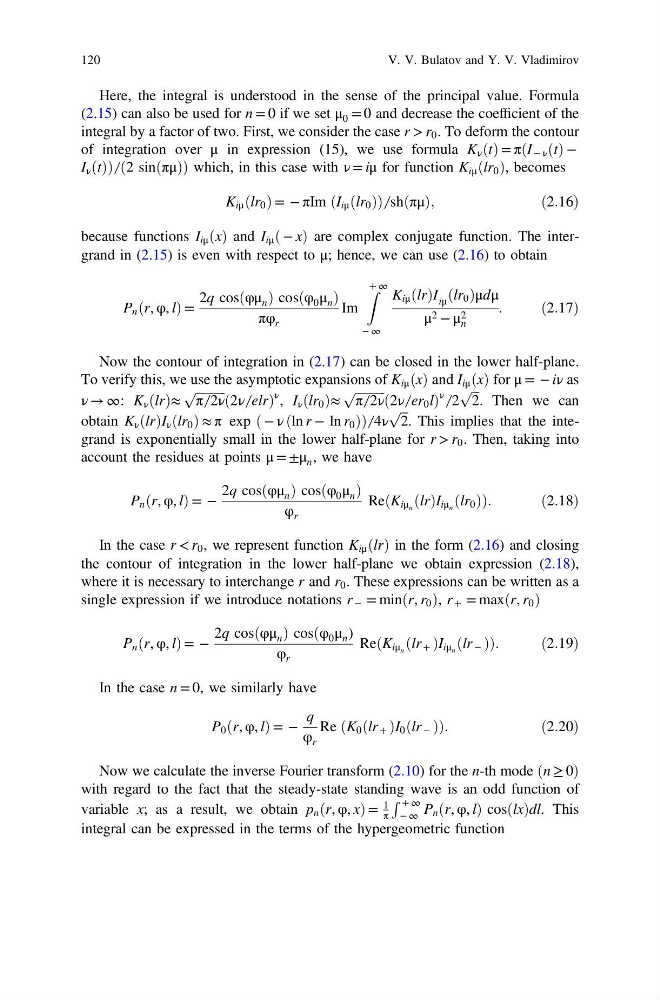
Here, the integral is understood in the sense of the principal value. Formula
(2.15) can also be used for n = 0 if we set μ 0 = 0 and decrease the coefficient of the
integral by a factor of two. First, we consider the case r > r 0 . To deform the contour
of integration over μ in expression (15), we use formula K ν ðtÞ = πðI − ν ðtÞ −
I ν ðtÞÞ ̸ ð2 sinðπμÞÞ which, in this case with ν = iμ for function K iμ ðlr 0 Þ, becomes
K iμ ðlr 0 Þ = − πIm ðI iμ ðlr 0 ÞÞ ̸ shðπμÞ;
ð2:16Þ
because functions I iμ ðxÞ and I iμ ð − xÞ are complex conjugate function. The intergrand in (2.15) is even with respect to μ; hence, we can use (2.16) to obtain
P n ðr, φ, lÞ =
2q cosðφμ n Þ cosðφ 0 μ n Þ
πφ r
Im
Z + ∞
− ∞
K iμ ðlrÞI iμ ðlr 0 Þμdμ
μ 2 − μ 2
n
.
ð2:17Þ
Now the contour of integration in (2.17) can be closed in the lower half-plane.
To verify this, we use the asymptotic expansions of K iμ ðxÞ and I iμ ðxÞ for μ = − iν as
ν → ∞: K ν ðlrÞ≈
ffiffiffiffiffiffiffiffiffi ffi
π ̸ 2ν
p
2ν ̸ elr
ð
Þ
ν , I ν ðlr 0 Þ≈
ffiffiffiffiffiffiffiffiffi ffi
π ̸ 2ν
p
2ν ̸ er 0 l
ð
Þ
ν ̸ 2
ffiffi ffi
2
p
. Then we can
obtain K ν ðlrÞI ν ðlr 0 Þ ≈ π exp ð − ν ðln r − ln r 0 ÞÞ ̸ 4ν
ffiffi ffi
2
p
. This implies that the integrand is exponentially small in the lower half-plane for r > r 0 . Then, taking into
account the residues at points μ = ±μ n , we have
P n ðr, φ, lÞ = −
2q cosðφμ n Þ cosðφ 0 μ n Þ
φ r
ReðK iμ n ðlrÞI iμ n ðlr 0 ÞÞ:
ð2:18Þ
In the case r < r 0 , we represent function K iμ ðlrÞ in the form (2.16) and closing
the contour of integration in the lower half-plane we obtain expression (2.18),
where it is necessary to interchange r and r 0 . These expressions can be written as a
single expression if we introduce notations r − = minðr, r 0 Þ, r + = maxðr, r 0 Þ
P n ðr, φ, lÞ = −
2q cosðφμ n Þ cosðφ 0 μ n )
φ r
ReðK iμ n ðlr + ÞI iμ n ðlr − ÞÞ.
ð2:19Þ
In the case n = 0, we similarly have
P 0 ðr, φ, lÞ = −
q
φ r
Re ðK 0 ðlr + ÞI 0 ðlr − ÞÞ:
ð2:20Þ
Now we calculate the inverse Fourier transform (2.10) for the n-th mode ðn ≥ 0Þ
with regard to the fact that the steady-state standing wave is an odd function of
variable x; as a result, we obtain p n ðr, φ, xÞ =
1
π
R + ∞
− ∞ P n ðr, φ, lÞ cosðlxÞdl. This
integral can be expressed in the terms of the hypergeometric function
120
V. V. Bulatov and Y. V. Vladimirov
(2.15) can also be used for n = 0 if we set μ 0 = 0 and decrease the coefficient of the
integral by a factor of two. First, we consider the case r > r 0 . To deform the contour
of integration over μ in expression (15), we use formula K ν ðtÞ = πðI − ν ðtÞ −
I ν ðtÞÞ ̸ ð2 sinðπμÞÞ which, in this case with ν = iμ for function K iμ ðlr 0 Þ, becomes
K iμ ðlr 0 Þ = − πIm ðI iμ ðlr 0 ÞÞ ̸ shðπμÞ;
ð2:16Þ
because functions I iμ ðxÞ and I iμ ð − xÞ are complex conjugate function. The intergrand in (2.15) is even with respect to μ; hence, we can use (2.16) to obtain
P n ðr, φ, lÞ =
2q cosðφμ n Þ cosðφ 0 μ n Þ
πφ r
Im
Z + ∞
− ∞
K iμ ðlrÞI iμ ðlr 0 Þμdμ
μ 2 − μ 2
n
.
ð2:17Þ
Now the contour of integration in (2.17) can be closed in the lower half-plane.
To verify this, we use the asymptotic expansions of K iμ ðxÞ and I iμ ðxÞ for μ = − iν as
ν → ∞: K ν ðlrÞ≈
ffiffiffiffiffiffiffiffiffi ffi
π ̸ 2ν
p
2ν ̸ elr
ð
Þ
ν , I ν ðlr 0 Þ≈
ffiffiffiffiffiffiffiffiffi ffi
π ̸ 2ν
p
2ν ̸ er 0 l
ð
Þ
ν ̸ 2
ffiffi ffi
2
p
. Then we can
obtain K ν ðlrÞI ν ðlr 0 Þ ≈ π exp ð − ν ðln r − ln r 0 ÞÞ ̸ 4ν
ffiffi ffi
2
p
. This implies that the integrand is exponentially small in the lower half-plane for r > r 0 . Then, taking into
account the residues at points μ = ±μ n , we have
P n ðr, φ, lÞ = −
2q cosðφμ n Þ cosðφ 0 μ n Þ
φ r
ReðK iμ n ðlrÞI iμ n ðlr 0 ÞÞ:
ð2:18Þ
In the case r < r 0 , we represent function K iμ ðlrÞ in the form (2.16) and closing
the contour of integration in the lower half-plane we obtain expression (2.18),
where it is necessary to interchange r and r 0 . These expressions can be written as a
single expression if we introduce notations r − = minðr, r 0 Þ, r + = maxðr, r 0 Þ
P n ðr, φ, lÞ = −
2q cosðφμ n Þ cosðφ 0 μ n )
φ r
ReðK iμ n ðlr + ÞI iμ n ðlr − ÞÞ.
ð2:19Þ
In the case n = 0, we similarly have
P 0 ðr, φ, lÞ = −
q
φ r
Re ðK 0 ðlr + ÞI 0 ðlr − ÞÞ:
ð2:20Þ
Now we calculate the inverse Fourier transform (2.10) for the n-th mode ðn ≥ 0Þ
with regard to the fact that the steady-state standing wave is an odd function of
variable x; as a result, we obtain p n ðr, φ, xÞ =
1
π
R + ∞
− ∞ P n ðr, φ, lÞ cosðlxÞdl. This
integral can be expressed in the terms of the hypergeometric function
120
V. V. Bulatov and Y. V. Vladimirov