

computational parameters are typical for the real ocean parameters: N = 0.001 s
− 1 ,
ω = 0.004 s
− 1 , γ = 0.2, c = 0.44, ρ 0 = 1000 kg ̸ m
− 3 , Q = 1600 m
3
̸ s, y 0 = 500 m,
z 0 = − 4 m.
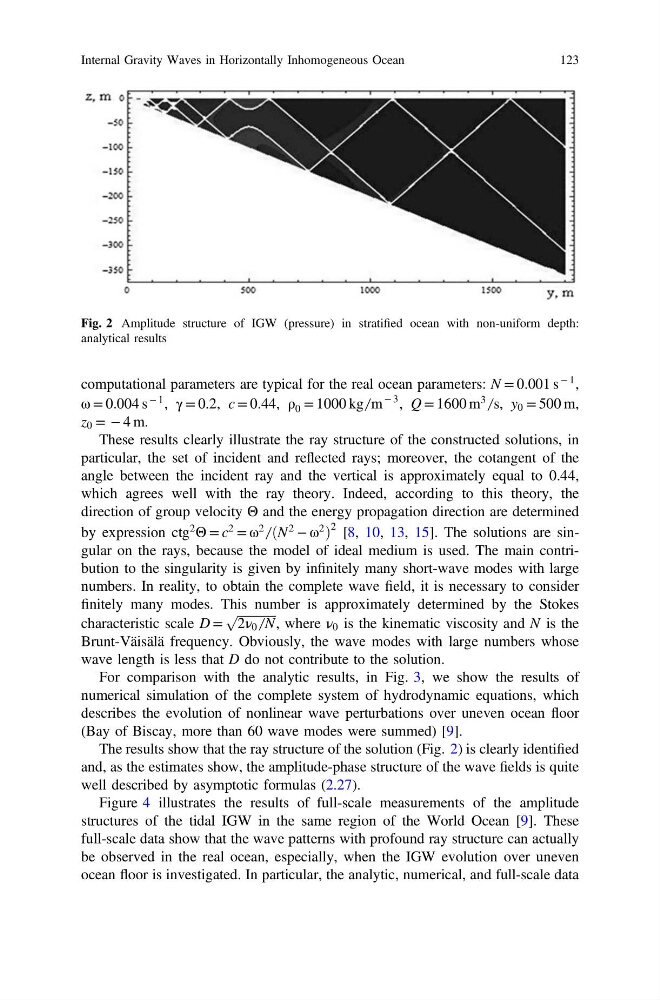
These results clearly illustrate the ray structure of the constructed solutions, in
particular, the set of incident and reflected rays; moreover, the cotangent of the
angle between the incident ray and the vertical is approximately equal to 0.44,
which agrees well with the ray theory. Indeed, according to this theory, the
direction of group velocity Θ and the energy propagation direction are determined
by expression ctg
2
Θ = c
2 = ω
2
̸ ðN
2
− ω
2
Þ
2 [8, 10, 13, 15]. The solutions are singular on the rays, because the model of ideal medium is used. The main contribution to the singularity is given by infinitely many short-wave modes with large
numbers. In reality, to obtain the complete wave field, it is necessary to consider
finitely many modes. This number is approximately determined by the Stokes
characteristic scale D =
ffiffiffiffiffiffiffiffiffiffiffiffi ffi
2ν 0 ̸ N
p
, where ν 0 is the kinematic viscosity and N is the
Brunt-Väisälä frequency. Obviously, the wave modes with large numbers whose
wave length is less that D do not contribute to the solution.
For comparison with the analytic results, in Fig. 3, we show the results of
numerical simulation of the complete system of hydrodynamic equations, which
describes the evolution of nonlinear wave perturbations over uneven ocean floor
(Bay of Biscay, more than 60 wave modes were summed) [9].
The results show that the ray structure of the solution (Fig. 2) is clearly identified
and, as the estimates show, the amplitude-phase structure of the wave fields is quite
well described by asymptotic formulas (2.27).
Figure 4 illustrates the results of full-scale measurements of the amplitude
structures of the tidal IGW in the same region of the World Ocean [9]. These
full-scale data show that the wave patterns with profound ray structure can actually
be observed in the real ocean, especially, when the IGW evolution over uneven
ocean floor is investigated. In particular, the analytic, numerical, and full-scale data
Fig. 2 Amplitude structure of IGW (pressure) in stratified ocean with non-uniform depth:
analytical results
Internal Gravity Waves in Horizontally Inhomogeneous Ocean
123
− 1 ,
ω = 0.004 s
− 1 , γ = 0.2, c = 0.44, ρ 0 = 1000 kg ̸ m
− 3 , Q = 1600 m
3
̸ s, y 0 = 500 m,
z 0 = − 4 m.
These results clearly illustrate the ray structure of the constructed solutions, in
particular, the set of incident and reflected rays; moreover, the cotangent of the
angle between the incident ray and the vertical is approximately equal to 0.44,
which agrees well with the ray theory. Indeed, according to this theory, the
direction of group velocity Θ and the energy propagation direction are determined
by expression ctg
2
Θ = c
2 = ω
2
̸ ðN
2
− ω
2
Þ
2 [8, 10, 13, 15]. The solutions are singular on the rays, because the model of ideal medium is used. The main contribution to the singularity is given by infinitely many short-wave modes with large
numbers. In reality, to obtain the complete wave field, it is necessary to consider
finitely many modes. This number is approximately determined by the Stokes
characteristic scale D =
ffiffiffiffiffiffiffiffiffiffiffiffi ffi
2ν 0 ̸ N
p
, where ν 0 is the kinematic viscosity and N is the
Brunt-Väisälä frequency. Obviously, the wave modes with large numbers whose
wave length is less that D do not contribute to the solution.
For comparison with the analytic results, in Fig. 3, we show the results of
numerical simulation of the complete system of hydrodynamic equations, which
describes the evolution of nonlinear wave perturbations over uneven ocean floor
(Bay of Biscay, more than 60 wave modes were summed) [9].
The results show that the ray structure of the solution (Fig. 2) is clearly identified
and, as the estimates show, the amplitude-phase structure of the wave fields is quite
well described by asymptotic formulas (2.27).
Figure 4 illustrates the results of full-scale measurements of the amplitude
structures of the tidal IGW in the same region of the World Ocean [9]. These
full-scale data show that the wave patterns with profound ray structure can actually
be observed in the real ocean, especially, when the IGW evolution over uneven
ocean floor is investigated. In particular, the analytic, numerical, and full-scale data
Fig. 2 Amplitude structure of IGW (pressure) in stratified ocean with non-uniform depth:
analytical results
Internal Gravity Waves in Horizontally Inhomogeneous Ocean
123