

Chapter 7: APPLICATIONS
The nature of the influence on the electromagnetic velocity sensor by the
individual types of plankton is not completely clear. The interference signal
from plankton was of significantly higher frequency than that from the
turbulent velocity signal. The plankton layer did not affect the microstructure
conductivity sensor signal. Professor Percy Donaghay (URI) (private
communication) suggested that this disturbance might be caused by plankton
species accumulating iron (magnetic material).
Most information about the thin layers of biota comes from a single fjord
in the Pacific Northwest (the same fjord where the data illustrated in Figure
7-9 are taken). Evidence of thin layers has also been reported in Monterey
Bay, in the South Atlantic Bight, as well as on the shelf off west Florida,
Oregon, and southern California
7.4.3 Effects of bubbles on sound propagation
Wave breaking at the surface of the ocean entrains air and produces
bubbles. Raindrops can also generate bubbles. Bubbles represent a great
disturbance to sound propagation in the ocean. Populated with bubbles, the
near-surface layer under high wind speed conditions represents a two-phase
medium, which significantly modifies the phase speed (Figure 7-10),
scattering, and absorption of acoustic waves (Farmer and Lemon, 1984).
Intense near-surface bubble layers formed during heavy rains may also
value of the buoyancy frequency in the near-surface layer of the ocean,
which can result in the so-called bubble mode of the internal wave field
(Grimshaw and Khusnutdinova, 2004).
The big difference in density and compressibility between an air bubble
and the surrounding water provides a mechanism for bubbles to both
generate and interact with acoustic (pressure) waves. Bubbles resonate at
characteristic frequencies that are determined by their radius. The lowest
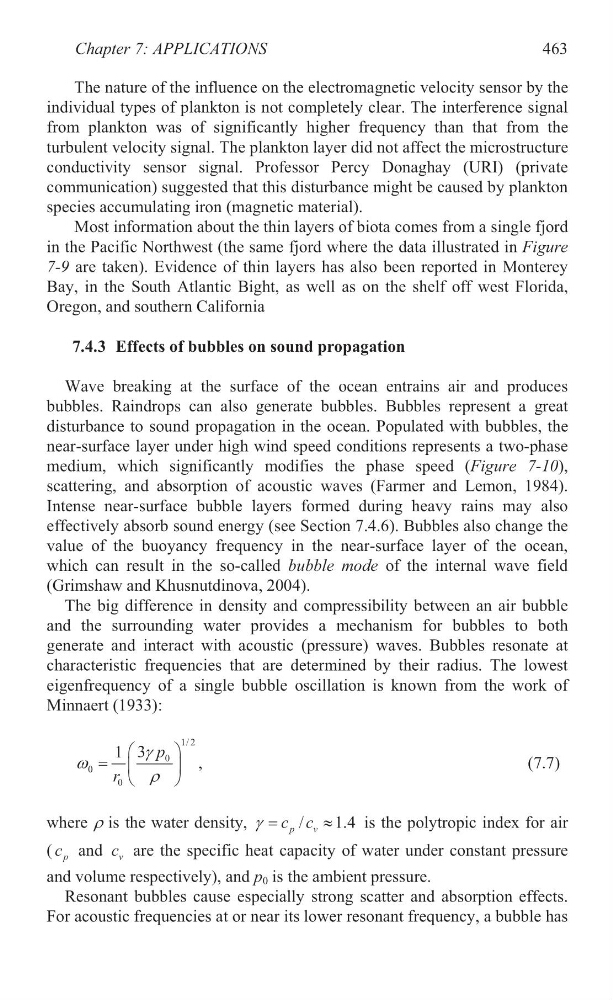
eigenfrequency of a single bubble oscillation is known from the work of
Minnaert (1933):
1/ 2
0
0
0
3
1
p
r
J
Z
U
§
·
¨
¸
©
¹
,
(7.7)
where U is the water density,
/
1.4
p
v
c c
J
|
is the polytropic index for air
( p
c and v
c are the specific heat capacity of water under constant pressure
and volume respectively), and p 0 is the ambient pressure.
Resonant bubbles cause especially strong scatter and absorption effects.
For acoustic frequencies at or near its lower resonant frequency, a bubble has
463
effectively absorb sound energy (see Section 7.4.6). Bubbles also change the
The nature of the influence on the electromagnetic velocity sensor by the
individual types of plankton is not completely clear. The interference signal
from plankton was of significantly higher frequency than that from the
turbulent velocity signal. The plankton layer did not affect the microstructure
conductivity sensor signal. Professor Percy Donaghay (URI) (private
communication) suggested that this disturbance might be caused by plankton
species accumulating iron (magnetic material).
Most information about the thin layers of biota comes from a single fjord
in the Pacific Northwest (the same fjord where the data illustrated in Figure
7-9 are taken). Evidence of thin layers has also been reported in Monterey
Bay, in the South Atlantic Bight, as well as on the shelf off west Florida,
Oregon, and southern California
7.4.3 Effects of bubbles on sound propagation
Wave breaking at the surface of the ocean entrains air and produces
bubbles. Raindrops can also generate bubbles. Bubbles represent a great
disturbance to sound propagation in the ocean. Populated with bubbles, the
near-surface layer under high wind speed conditions represents a two-phase
medium, which significantly modifies the phase speed (Figure 7-10),
scattering, and absorption of acoustic waves (Farmer and Lemon, 1984).
Intense near-surface bubble layers formed during heavy rains may also
value of the buoyancy frequency in the near-surface layer of the ocean,
which can result in the so-called bubble mode of the internal wave field
(Grimshaw and Khusnutdinova, 2004).
The big difference in density and compressibility between an air bubble
and the surrounding water provides a mechanism for bubbles to both
generate and interact with acoustic (pressure) waves. Bubbles resonate at
characteristic frequencies that are determined by their radius. The lowest
eigenfrequency of a single bubble oscillation is known from the work of
Minnaert (1933):
1/ 2
0
0
0
3
1
p
r
J
Z
U
§
·
¨
¸
©
¹
,
(7.7)
where U is the water density,
/
1.4
p
v
c c
J
|
is the polytropic index for air
( p
c and v
c are the specific heat capacity of water under constant pressure
and volume respectively), and p 0 is the ambient pressure.
Resonant bubbles cause especially strong scatter and absorption effects.
For acoustic frequencies at or near its lower resonant frequency, a bubble has
463
effectively absorb sound energy (see Section 7.4.6). Bubbles also change the