

where U a is the air density, and a
u is the friction velocity in the air. The sea
spray generation function has not yet been determined for friction velocities
2
a
u t m s
-1 . In the range
2
a
u m s
-1 , sp
W estimated with (6.25) is much
less than W . Nevertheless, the estimated spray stress increases approximately
as the fourth power of a
u , because
3
0
0
/
~ a
dF dr u and U is linear in a
u . At
the same time, W is just quadratic in a
u . Andreas (2004) therefore assumes
that when the winds reach hurricane strength, spray stresses may become
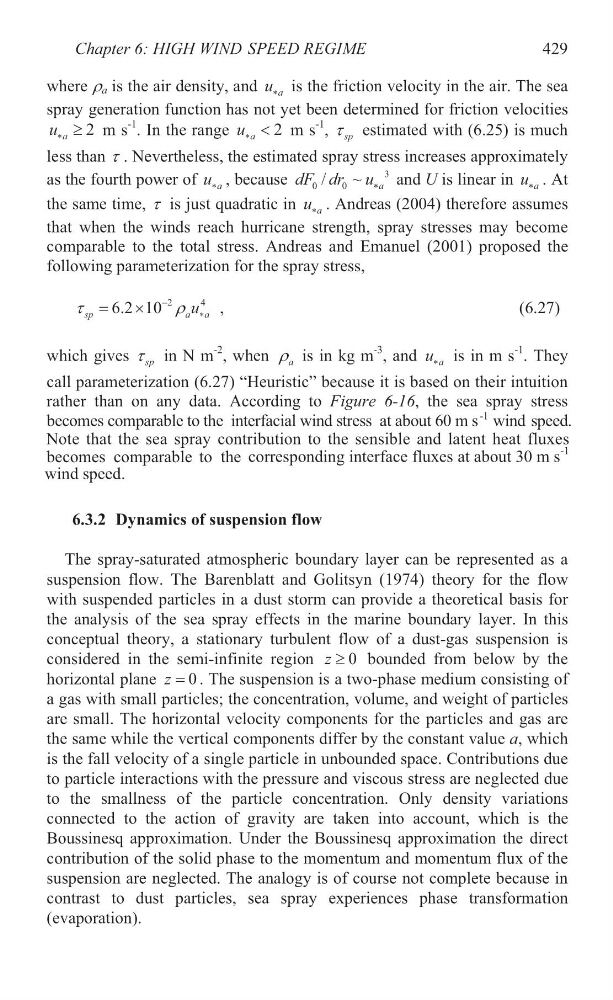
comparable to the total stress. Andreas and Emanuel (2001) proposed the
following parameterization for the spray stress,
2
4
6.2 10
sp
aa u
W
U
u
,
(6.27)
which gives sp
W in N m
-2 , when a
U is in kg m
-3 , and a
u is in m s
-1 . They
call parameterization (6.27) “Heuristic” because it is based on their intuition
rather than on any data. According to Figure 6-16, the sea spray stress
-1 wind speed.
Note that the sea spray contribution to the sensible and latent heat fluxes
becomes comparable to the corresponding interface fluxes at about 30 m s
-1
wind speed.
6.3.2 Dynamics of suspension flow
The spray-saturated atmospheric boundary layer can be represented as a
suspension flow. The Barenblatt and Golitsyn (1974) theory for the flow
with suspended particles in a dust storm can provide a theoretical basis for
the analysis of the sea spray effects in the marine boundary layer. In this
conceptual theory, a stationary turbulent flow of a dust-gas suspension is
considered in the semi-infinite region
0
z t bounded from below by the
horizontal plane
0
z
. The suspension is a two-phase medium consisting of
a gas with small particles; the concentration, volume, and weight of particles
are small. The horizontal velocity components for the particles and gas are
the same while the vertical components differ by the constant value a, which
is the fall velocity of a single particle in unbounded space. Contributions due
to particle interactions with the pressure and viscous stress are neglected due
to the smallness of the particle concentration. Only density variations
connected to the action of gravity are taken into account, which is the
Boussinesq approximation. Under the Boussinesq approximation the direct
contribution of the solid phase to the momentum and momentum flux of the
suspension are neglected. The analogy is of course not complete because in
contrast to dust particles, sea spray experiences phase transformation
(evaporation).
Chapter 6: HIGH WIND SPEED REGIME
429
becomes comparable to the interfacial wind stress at about 60 m s
u is the friction velocity in the air. The sea
spray generation function has not yet been determined for friction velocities
2
a
u t m s
-1 . In the range
2
a
u m s
-1 , sp
W estimated with (6.25) is much
less than W . Nevertheless, the estimated spray stress increases approximately
as the fourth power of a
u , because
3
0
0
/
~ a
dF dr u and U is linear in a
u . At
the same time, W is just quadratic in a
u . Andreas (2004) therefore assumes
that when the winds reach hurricane strength, spray stresses may become
comparable to the total stress. Andreas and Emanuel (2001) proposed the
following parameterization for the spray stress,
2
4
6.2 10
sp
aa u
W
U
u
,
(6.27)
which gives sp
W in N m
-2 , when a
U is in kg m
-3 , and a
u is in m s
-1 . They
call parameterization (6.27) “Heuristic” because it is based on their intuition
rather than on any data. According to Figure 6-16, the sea spray stress
-1 wind speed.
Note that the sea spray contribution to the sensible and latent heat fluxes
becomes comparable to the corresponding interface fluxes at about 30 m s
-1
wind speed.
6.3.2 Dynamics of suspension flow
The spray-saturated atmospheric boundary layer can be represented as a
suspension flow. The Barenblatt and Golitsyn (1974) theory for the flow
with suspended particles in a dust storm can provide a theoretical basis for
the analysis of the sea spray effects in the marine boundary layer. In this
conceptual theory, a stationary turbulent flow of a dust-gas suspension is
considered in the semi-infinite region
0
z t bounded from below by the
horizontal plane
0
z
. The suspension is a two-phase medium consisting of
a gas with small particles; the concentration, volume, and weight of particles
are small. The horizontal velocity components for the particles and gas are
the same while the vertical components differ by the constant value a, which
is the fall velocity of a single particle in unbounded space. Contributions due
to particle interactions with the pressure and viscous stress are neglected due
to the smallness of the particle concentration. Only density variations
connected to the action of gravity are taken into account, which is the
Boussinesq approximation. Under the Boussinesq approximation the direct
contribution of the solid phase to the momentum and momentum flux of the
suspension are neglected. The analogy is of course not complete because in
contrast to dust particles, sea spray experiences phase transformation
(evaporation).
Chapter 6: HIGH WIND SPEED REGIME
429
becomes comparable to the interfacial wind stress at about 60 m s