

THE NEAR-SURFACE LAYER OF THE OCEAN
where dF 0 /dr 0 is the sea spray generation function, and U is the wind speed
at one significant wave height above the mean sea level. Equation (6.25)
implies that all droplets reach this level. Some justification for this
assumption comes from the fact that the droplets that contribute most to the
spray momentum flux are the large ones torn right off the wave crests.)
Equation (6.25) is nevertheless only an upper bound on the surface stress
that falling spray droplets produce on the ocean surface layer. In fact, some
small spray droplets are entrained in the turbulent flow and never return back
to the ocean. The droplets that return to the sea partially evaporate and
therefore have a reduced radius r 0 , and thus reduced momentum.
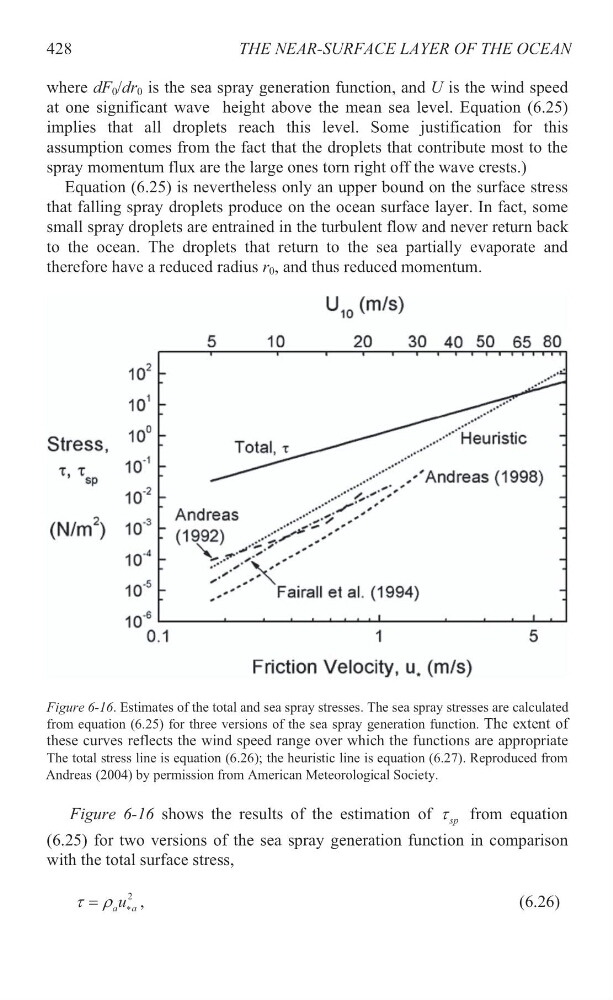
Figure 6-16. Estimates of the total and sea spray stresses. The sea spray stresses are calculated
from equation (6.25) for three versions of the sea spray generation function. The extent of
these curves reflects the wind speed range over which the functions are appropriate
Figure 6-16 shows the results of the estimation of sp
W from equation
(6.25) for two versions of the sea spray generation function in comparison
with the total surface stress,
2
a a
u
W U ,
(6.26)
428
The total stress line is equation (6.26); the heuristic line is equation (6.27). Reproduced from
Andreas (2004) by permission from American Meteorological Society.
where dF 0 /dr 0 is the sea spray generation function, and U is the wind speed
at one significant wave height above the mean sea level. Equation (6.25)
implies that all droplets reach this level. Some justification for this
assumption comes from the fact that the droplets that contribute most to the
spray momentum flux are the large ones torn right off the wave crests.)
Equation (6.25) is nevertheless only an upper bound on the surface stress
that falling spray droplets produce on the ocean surface layer. In fact, some
small spray droplets are entrained in the turbulent flow and never return back
to the ocean. The droplets that return to the sea partially evaporate and
therefore have a reduced radius r 0 , and thus reduced momentum.
Figure 6-16. Estimates of the total and sea spray stresses. The sea spray stresses are calculated
from equation (6.25) for three versions of the sea spray generation function. The extent of
these curves reflects the wind speed range over which the functions are appropriate
Figure 6-16 shows the results of the estimation of sp
W from equation
(6.25) for two versions of the sea spray generation function in comparison
with the total surface stress,
2
a a
u
W U ,
(6.26)
428
The total stress line is equation (6.26); the heuristic line is equation (6.27). Reproduced from
Andreas (2004) by permission from American Meteorological Society.