

THE NEAR-SURFACE LAYER OF THE OCEAN
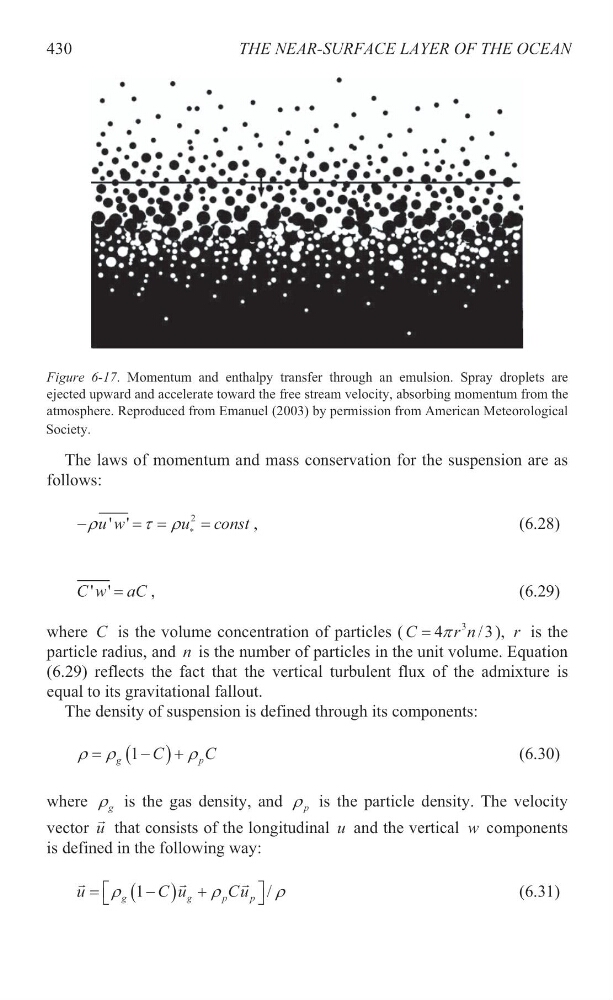
Figure 6-17. Momentum and enthalpy transfer through an emulsion. Spray droplets are
ejected upward and accelerate toward the free stream velocity, absorbing momentum from the
The laws of momentum and mass conservation for the suspension are as
follows:
2
' '
u w
u const
U
W U
,
(6.28)
' '
C w aC ,
(6.29)
where C is the volume concentration of particles (
3
4
/3
C
r n
S
), r is the
particle radius, and n is the number of particles in the unit volume. Equation
(6.29) reflects the fact that the vertical turbulent flux of the admixture is
equal to its gravitational fallout.
The density of suspension is defined through its components:
1
g
p
C
C
U U
U
(6.30)
where g
U is the gas density, and p
U is the particle density. The velocity
vector u
G that consists of the longitudinal u and the vertical w components
is defined in the following way:
1
/
g
g
p
p
u
C u
C u
U
U
U
ª
º
¬
¼
G
G
G
(6.31)
430
Society.
atmosphere. Reproduced from Emanuel (2003) by permission from American Meteorological
Figure 6-17. Momentum and enthalpy transfer through an emulsion. Spray droplets are
ejected upward and accelerate toward the free stream velocity, absorbing momentum from the
The laws of momentum and mass conservation for the suspension are as
follows:
2
' '
u w
u const
U
W U
,
(6.28)
' '
C w aC ,
(6.29)
where C is the volume concentration of particles (
3
4
/3
C
r n
S
), r is the
particle radius, and n is the number of particles in the unit volume. Equation
(6.29) reflects the fact that the vertical turbulent flux of the admixture is
equal to its gravitational fallout.
The density of suspension is defined through its components:
1
g
p
C
C
U U
U
(6.30)
where g
U is the gas density, and p
U is the particle density. The velocity
vector u
G that consists of the longitudinal u and the vertical w components
is defined in the following way:
1
/
g
g
p
p
u
C u
C u
U
U
U
ª
º
¬
¼
G
G
G
(6.31)
430
Society.
atmosphere. Reproduced from Emanuel (2003) by permission from American Meteorological