

Chapter 5. SPATIALLY-COHERENT STRUCTURES
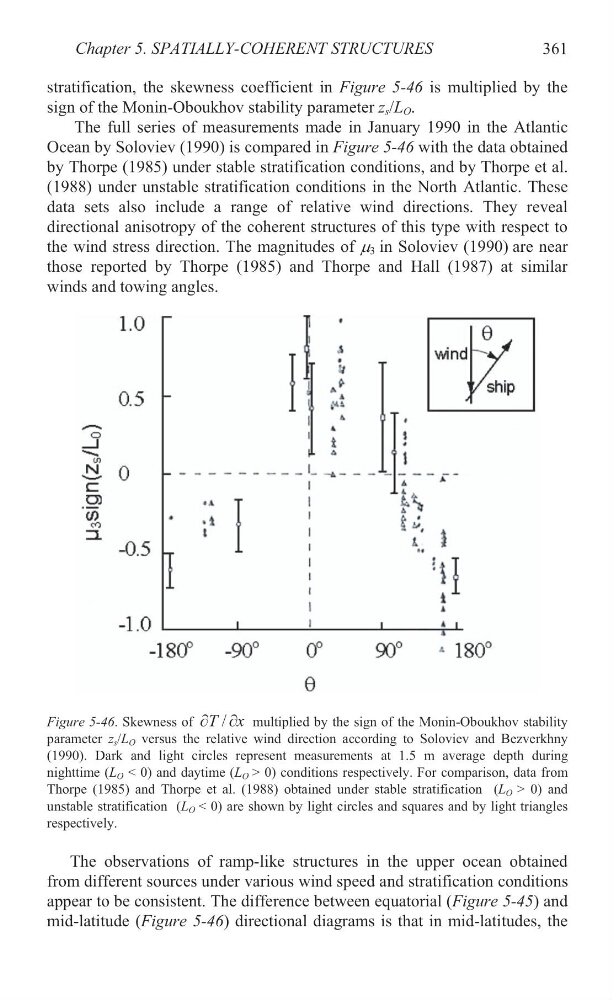
stratification, the skewness coefficient in Figure 5-46 is multiplied by the
sign of the Monin-Oboukhov stability parameter z s /L O .
The full series of measurements made in January 1990 in the Atlantic
Ocean by Soloviev (1990) is compared in Figure 5-46 with the data obtained
by Thorpe (1985) under stable stratification conditions, and by Thorpe et al.
(1988) under unstable stratification conditions in the North Atlantic. These
data sets also include a range of relative wind directions. They reveal
directional anisotropy of the coherent structures of this type with respect to
the wind stress direction. The magnitudes of P 3 in Soloviev (1990) are near
those reported by Thorpe (1985) and Thorpe and Hall (1987) at similar
winds and towing angles.
Figure 5-46. Skewness of
/
T x
w w multiplied by the sign of the Monin-Oboukhov stability
parameter z s /L O versus the relative wind direction according to Soloviev and Bezverkhny
(1990). Dark and light circles represent measurements at 1.5 m average depth during
nighttime (L O < 0) and daytime (L O > 0) conditions respectively. For comparison, data from
Thorpe (1985) and Thorpe et al. (1988) obtained under stable stratification (L O > 0) and
unstable stratification (L O < 0) are shown by light circles and squares and by light triangles
respectively.
The observations of ramp-like structures in the upper ocean obtained
from different sources under various wind speed and stratification conditions
appear to be consistent. The difference between equatorial (Figure 5-45) and
mid-latitude (Figure 5-46) directional diagrams is that in mid-latitudes, the
361
stratification, the skewness coefficient in Figure 5-46 is multiplied by the
sign of the Monin-Oboukhov stability parameter z s /L O .
The full series of measurements made in January 1990 in the Atlantic
Ocean by Soloviev (1990) is compared in Figure 5-46 with the data obtained
by Thorpe (1985) under stable stratification conditions, and by Thorpe et al.
(1988) under unstable stratification conditions in the North Atlantic. These
data sets also include a range of relative wind directions. They reveal
directional anisotropy of the coherent structures of this type with respect to
the wind stress direction. The magnitudes of P 3 in Soloviev (1990) are near
those reported by Thorpe (1985) and Thorpe and Hall (1987) at similar
winds and towing angles.
Figure 5-46. Skewness of
/
T x
w w multiplied by the sign of the Monin-Oboukhov stability
parameter z s /L O versus the relative wind direction according to Soloviev and Bezverkhny
(1990). Dark and light circles represent measurements at 1.5 m average depth during
nighttime (L O < 0) and daytime (L O > 0) conditions respectively. For comparison, data from
Thorpe (1985) and Thorpe et al. (1988) obtained under stable stratification (L O > 0) and
unstable stratification (L O < 0) are shown by light circles and squares and by light triangles
respectively.
The observations of ramp-like structures in the upper ocean obtained
from different sources under various wind speed and stratification conditions
appear to be consistent. The difference between equatorial (Figure 5-45) and
mid-latitude (Figure 5-46) directional diagrams is that in mid-latitudes, the
361