

THE NEAR-SURFACE LAYER OF THE OCEAN
3/ 2
3
3
2
/
M M
P
,
(5.52)
where
3
3
/
/
M
T
T
D
D
w w w w
,
2
2
/
/
M
T
T
D
D
w w w w
, and
/
T D
w w denotes the temperature derivative either over time, D = t, for fixedsensor measurements, or over the horizontal coordinate, D = x for towed
measurements.
The skewness of the oceanic temperature derivative for the upwind
direction of the ship in the observations of Soloviev (1990) under
convectively unstable near-surface conditions ocean falls in the range –0.7 to
–1.0. In the convectively unstable atmospheric boundary layer, the skewness
in the presence of coherent structures falls in a similar range (Thorpe and
Hall, 1987).
As mentioned before, based on the results of laboratory experiments the
vortex motion associated with a ramp-like structure in the upper ocean has
the rotation axis oriented perpendicular to the wind direction or, more
exactly, to the wind drift current direction. As a result, the mean value of P 3
depends on the direction of the ship’s motion relative to the wind.
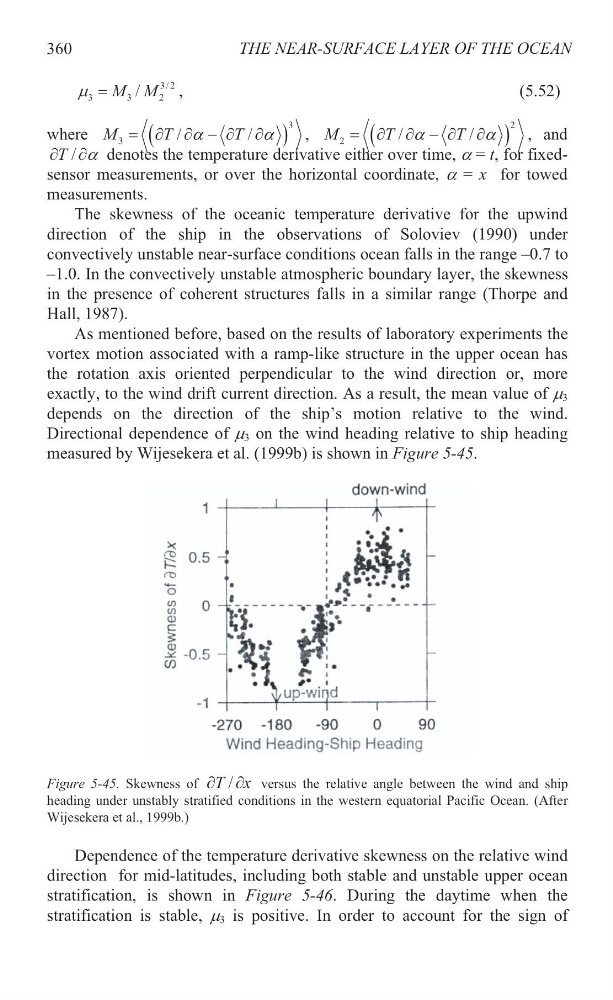
Directional dependence of P 3 on the wind heading relative to ship heading
measured by Wijesekera et al. (1999b) is shown in Figure 5-45.
Figure 5-45. Skewness of
/
T x
w w versus the relative angle between the wind and ship
heading under unstably stratified conditions in the western equatorial Pacific Ocean. (After
Wijesekera et al., 1999b.)
Dependence of the temperature derivative skewness on the relative wind
direction for mid-latitudes, including both stable and unstable upper ocean
stratification, is shown in Figure 5-46. During the daytime when the
stratification is stable, P 3 is positive. In order to account for the sign of
360
3/ 2
3
3
2
/
M M
P
,
(5.52)
where
3
3
/
/
M
T
T
D
D
w w w w
,
2
2
/
/
M
T
T
D
D
w w w w
, and
/
T D
w w denotes the temperature derivative either over time, D = t, for fixedsensor measurements, or over the horizontal coordinate, D = x for towed
measurements.
The skewness of the oceanic temperature derivative for the upwind
direction of the ship in the observations of Soloviev (1990) under
convectively unstable near-surface conditions ocean falls in the range –0.7 to
–1.0. In the convectively unstable atmospheric boundary layer, the skewness
in the presence of coherent structures falls in a similar range (Thorpe and
Hall, 1987).
As mentioned before, based on the results of laboratory experiments the
vortex motion associated with a ramp-like structure in the upper ocean has
the rotation axis oriented perpendicular to the wind direction or, more
exactly, to the wind drift current direction. As a result, the mean value of P 3
depends on the direction of the ship’s motion relative to the wind.
Directional dependence of P 3 on the wind heading relative to ship heading
measured by Wijesekera et al. (1999b) is shown in Figure 5-45.
Figure 5-45. Skewness of
/
T x
w w versus the relative angle between the wind and ship
heading under unstably stratified conditions in the western equatorial Pacific Ocean. (After
Wijesekera et al., 1999b.)
Dependence of the temperature derivative skewness on the relative wind
direction for mid-latitudes, including both stable and unstable upper ocean
stratification, is shown in Figure 5-46. During the daytime when the
stratification is stable, P 3 is positive. In order to account for the sign of
360