

THE NEAR-SURFACE LAYER OF THE OCEAN
,
0, J
,
0,
,
0
c
c
c
Q h t
h t
E h t
.
(4.45)
These are isolating boundary conditions; entrainment fluxes at the bottom of
the mixed layer are ignored. This assumption should not lead to significant
errors when c
h does not change substantially.
A small amount of heat and salt can penetrate through the bottom of
convective mixed layer because of double-diffusion. A warmer and slightly
saltier layer is formed near surface, which may result in convecting layers
(Stern and Turner, 1969). This effect is not accounted for here, but is
discussed in Section X 4.1.6X .
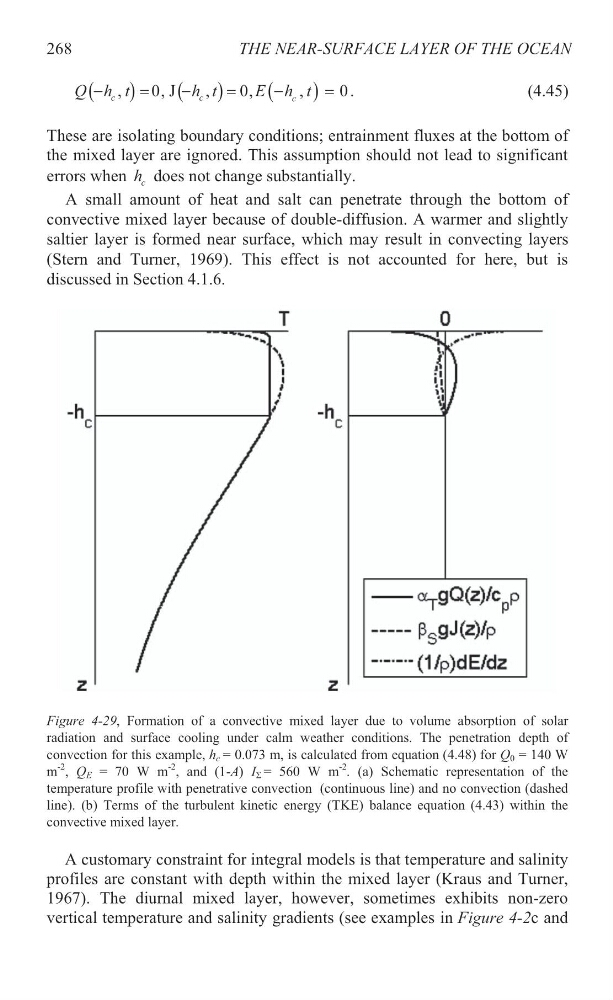
Figure 4-29, Formation of a convective mixed layer due to volume absorption of solar
radiation and surface cooling under calm weather conditions. The penetration depth of
convection for this example, hB c B = 0.073 m, is calculated from equation X (4.48)X for QB 0 B = 140 W
mP
-2
P,
QB E B = 70 W mP
-2
P,
and (1-A) IB 6 B = 560 W mP
-2
P.
(a) Schematic representation of the
temperature profile with penetrative convection (continuous line) and no convection (dashed
line). (b) Terms of the turbulent kinetic energy (TKE) balance equation X (4.43)X within the
convective mixed layer.
A customary constraint for integral models is that temperature and salinity
profiles are constant with depth within the mixed layer (Kraus and Turner,
1967). The diurnal mixed layer, however, sometimes exhibits non-zero
vertical temperature and salinity gradients (see examples in X Figure 4-2X c and
268
,
0, J
,
0,
,
0
c
c
c
Q h t
h t
E h t
.
(4.45)
These are isolating boundary conditions; entrainment fluxes at the bottom of
the mixed layer are ignored. This assumption should not lead to significant
errors when c
h does not change substantially.
A small amount of heat and salt can penetrate through the bottom of
convective mixed layer because of double-diffusion. A warmer and slightly
saltier layer is formed near surface, which may result in convecting layers
(Stern and Turner, 1969). This effect is not accounted for here, but is
discussed in Section X 4.1.6X .
Figure 4-29, Formation of a convective mixed layer due to volume absorption of solar
radiation and surface cooling under calm weather conditions. The penetration depth of
convection for this example, hB c B = 0.073 m, is calculated from equation X (4.48)X for QB 0 B = 140 W
mP
-2
P,
QB E B = 70 W mP
-2
P,
and (1-A) IB 6 B = 560 W mP
-2
P.
(a) Schematic representation of the
temperature profile with penetrative convection (continuous line) and no convection (dashed
line). (b) Terms of the turbulent kinetic energy (TKE) balance equation X (4.43)X within the
convective mixed layer.
A customary constraint for integral models is that temperature and salinity
profiles are constant with depth within the mixed layer (Kraus and Turner,
1967). The diurnal mixed layer, however, sometimes exhibits non-zero
vertical temperature and salinity gradients (see examples in X Figure 4-2X c and
268