

Chapter 4: FINE STRUCTURE AND MICROSTRUCTURE
R
p
I
T
Q
c
t
z
z
U
w
w
w
w
w
w
,
(4.41)
S
J
t
z
U
w
w
w
w
,
(4.42)
1
0
S
T
p
g J
gQ
E
c
z
E
D
U
U
U
w
w
,
(4.43)
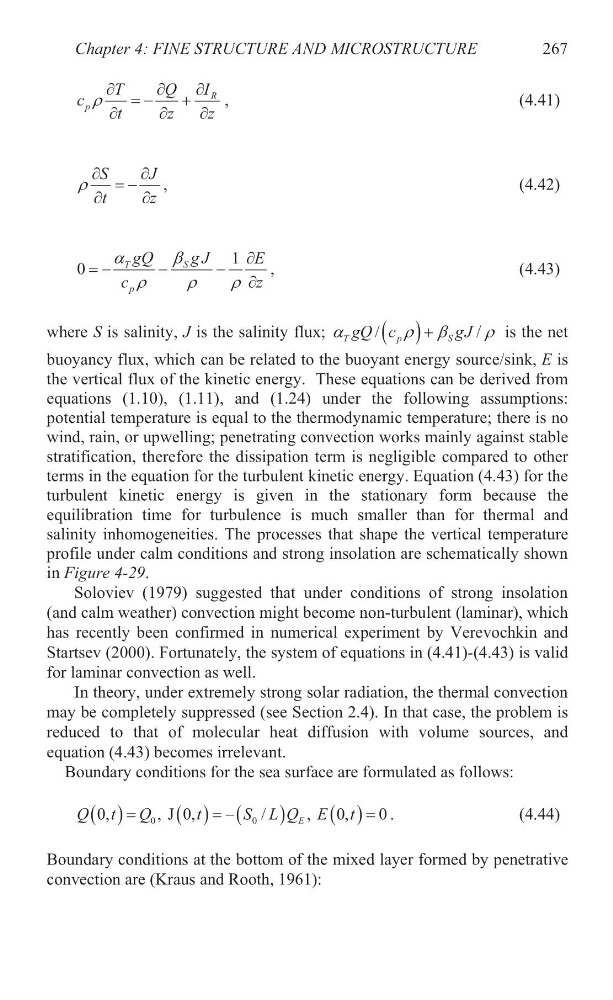
where S is salinity, J is the salinity flux;
/
/
T
p
S
gQ c
gJ
D
U E
U
is the net
buoyancy flux, which can be related to the buoyant energy source/sink, E is
the vertical flux of the kinetic energy. These equations can be derived from
equations (1.10), (1.11), and (1.24) under the following assumptions:
potential temperature is equal to the thermodynamic temperature; there is no
wind, rain, or upwelling; penetrating convection works mainly against stable
stratification, therefore the dissipation term is negligible compared to other
terms in the equation for the turbulent kinetic energy. Equation X (4.43)X for the
turbulent kinetic energy is given in the stationary form because the
equilibration time for turbulence is much smaller than for thermal and
salinity inhomogeneities. The processes that shape the vertical temperature
profile under calm conditions and strong insolation are schematically shown
in X Figure 4-29X .
Soloviev (1979) suggested that under conditions of strong insolation
(and calm weather) convection might become non-turbulent (laminar), which
has recently been confirmed in numerical experiment by Verevochkin and
Startsev (2000). Fortunately, the system of equations in X (4.41)X -X (4.43)X is valid
for laminar convection as well.
In theory, under extremely strong solar radiation, the thermal convection
may be completely suppressed (see Section 2.4). In that case, the problem is
reduced to that of molecular heat diffusion with volume sources, and
equation X (4.43)X becomes irrelevant.
Boundary conditions for the sea surface are formulated as follows:
0
0
0,
, J 0,
/
,
0,
0
E
Q t Q
t
S L Q E t
.
(4.44)
Boundary conditions at the bottom of the mixed layer formed by penetrative
convection are (Kraus and Rooth, 1961):
267
R
p
I
T
Q
c
t
z
z
U
w
w
w
w
w
w
,
(4.41)
S
J
t
z
U
w
w
w
w
,
(4.42)
1
0
S
T
p
g J
gQ
E
c
z
E
D
U
U
U
w
w
,
(4.43)
where S is salinity, J is the salinity flux;
/
/
T
p
S
gQ c
gJ
D
U E
U
is the net
buoyancy flux, which can be related to the buoyant energy source/sink, E is
the vertical flux of the kinetic energy. These equations can be derived from
equations (1.10), (1.11), and (1.24) under the following assumptions:
potential temperature is equal to the thermodynamic temperature; there is no
wind, rain, or upwelling; penetrating convection works mainly against stable
stratification, therefore the dissipation term is negligible compared to other
terms in the equation for the turbulent kinetic energy. Equation X (4.43)X for the
turbulent kinetic energy is given in the stationary form because the
equilibration time for turbulence is much smaller than for thermal and
salinity inhomogeneities. The processes that shape the vertical temperature
profile under calm conditions and strong insolation are schematically shown
in X Figure 4-29X .
Soloviev (1979) suggested that under conditions of strong insolation
(and calm weather) convection might become non-turbulent (laminar), which
has recently been confirmed in numerical experiment by Verevochkin and
Startsev (2000). Fortunately, the system of equations in X (4.41)X -X (4.43)X is valid
for laminar convection as well.
In theory, under extremely strong solar radiation, the thermal convection
may be completely suppressed (see Section 2.4). In that case, the problem is
reduced to that of molecular heat diffusion with volume sources, and
equation X (4.43)X becomes irrelevant.
Boundary conditions for the sea surface are formulated as follows:
0
0
0,
, J 0,
/
,
0,
0
E
Q t Q
t
S L Q E t
.
(4.44)
Boundary conditions at the bottom of the mixed layer formed by penetrative
convection are (Kraus and Rooth, 1961):
267