

Chapter 4: FINE STRUCTURE AND MICROSTRUCTURE
X
X
condition by requiring that
/
T t
w w and
/
S t
w w (rather than T and S) do not
depend on depth z. The latter condition does not prohibit dependence of T
and S on z within the radiative-convective layer.
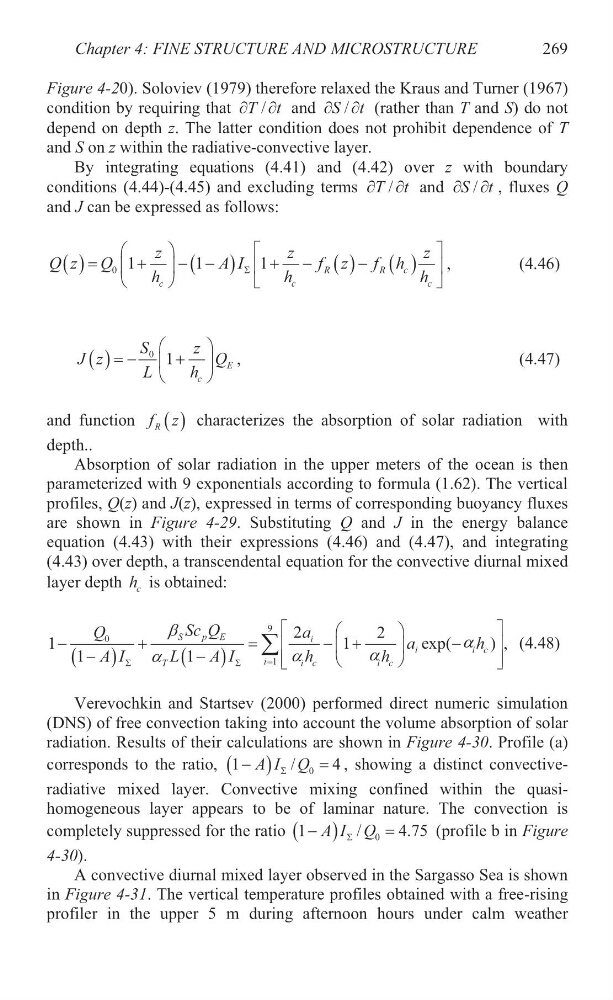
By integrating equations X (4.41)X and X (4.42)X over z with boundary
conditions X (4.44)X -X (4.45)X and excluding terms
/
T t
w w and
/
S t
w w , fluxes Q
and J can be expressed as follows:
0 1
1
1
R
R
c
c
c
c
z
z
z
Q z Q
A I
f z f h
h
h
h
6
§
·
ª
º
¨
¸
«
»
©
¹
¬
¼
,
(4.46)
0 1
E
c
S
z
J z
Q
L
h
§
·
¨
¸
©
¹
,
(4.47)
and function
R
f z characterizes the absorption of solar radiation with
depth..
Absorption of solar radiation in the upper meters of the ocean is then
parameterized with 9 exponentials according to formula (1.62). The vertical
profiles, Q(z) and J(z), expressed in terms of corresponding buoyancy fluxes
are shown in X Figure 4-29X . Substituting Q and J in the energy balance
equation X (4.43)X with their expressions X (4.46)X and X (4.47)X , and integrating
X (4.43)X over depth, a transcendental equation for the convective diurnal mixed
layer depth c
h is obtained:
9
0
1
2
2
1
1
exp(
) ,
1
1
S
p E
i
i
ic
i
T
i c
i c
Sc Q
Q
a
a
h
A I
L
A I
h
h
E
D
6
6
ª
º
§
·
«
»
¨
¸
«
»
©
¹
¬
¼
¦
(4.48)
Verevochkin and Startsev (2000) performed direct numeric simulation
(DNS) of free convection taking into account the volume absorption of solar
radiation. Results of their calculations are shown in X Figure 4-30X . Profile (a)
corresponds to the ratio,
0
1
/
4
A I Q
6
, showing a distinct convectiveradiative mixed layer. Convective mixing confined within the quasihomogeneous layer appears to be of laminar nature. The convection is
completely suppressed for the ratio
0
1
/
4.75
A I Q
6
(profile b in X Figure
4-30X ).
A convective diurnal mixed layer observed in the Sargasso Sea is shown
in X Figure 4-31X . The vertical temperature profiles obtained with a free-rising
profiler in the upper 5 m during afternoon hours under calm weather
269
Figure 4-20). Soloviev (1979) therefore relaxed the Kraus and Turner (1967)
D
D
D
X
X
condition by requiring that
/
T t
w w and
/
S t
w w (rather than T and S) do not
depend on depth z. The latter condition does not prohibit dependence of T
and S on z within the radiative-convective layer.
By integrating equations X (4.41)X and X (4.42)X over z with boundary
conditions X (4.44)X -X (4.45)X and excluding terms
/
T t
w w and
/
S t
w w , fluxes Q
and J can be expressed as follows:
0 1
1
1
R
R
c
c
c
c
z
z
z
Q z Q
A I
f z f h
h
h
h
6
§
·
ª
º
¨
¸
«
»
©
¹
¬
¼
,
(4.46)
0 1
E
c
S
z
J z
Q
L
h
§
·
¨
¸
©
¹
,
(4.47)
and function
R
f z characterizes the absorption of solar radiation with
depth..
Absorption of solar radiation in the upper meters of the ocean is then
parameterized with 9 exponentials according to formula (1.62). The vertical
profiles, Q(z) and J(z), expressed in terms of corresponding buoyancy fluxes
are shown in X Figure 4-29X . Substituting Q and J in the energy balance
equation X (4.43)X with their expressions X (4.46)X and X (4.47)X , and integrating
X (4.43)X over depth, a transcendental equation for the convective diurnal mixed
layer depth c
h is obtained:
9
0
1
2
2
1
1
exp(
) ,
1
1
S
p E
i
i
ic
i
T
i c
i c
Sc Q
Q
a
a
h
A I
L
A I
h
h
E
D
6
6
ª
º
§
·
«
»
¨
¸
«
»
©
¹
¬
¼
¦
(4.48)
Verevochkin and Startsev (2000) performed direct numeric simulation
(DNS) of free convection taking into account the volume absorption of solar
radiation. Results of their calculations are shown in X Figure 4-30X . Profile (a)
corresponds to the ratio,
0
1
/
4
A I Q
6
, showing a distinct convectiveradiative mixed layer. Convective mixing confined within the quasihomogeneous layer appears to be of laminar nature. The convection is
completely suppressed for the ratio
0
1
/
4.75
A I Q
6
(profile b in X Figure
4-30X ).
A convective diurnal mixed layer observed in the Sargasso Sea is shown
in X Figure 4-31X . The vertical temperature profiles obtained with a free-rising
profiler in the upper 5 m during afternoon hours under calm weather
269
Figure 4-20). Soloviev (1979) therefore relaxed the Kraus and Turner (1967)
D
D
D