

Chapter 4: FINE STRUCTURE AND MICROSTRUCTURE
An alternate estimate of the turbulent mixing coefficient can be obtained
from the Osborn and Cox (1972) equation:
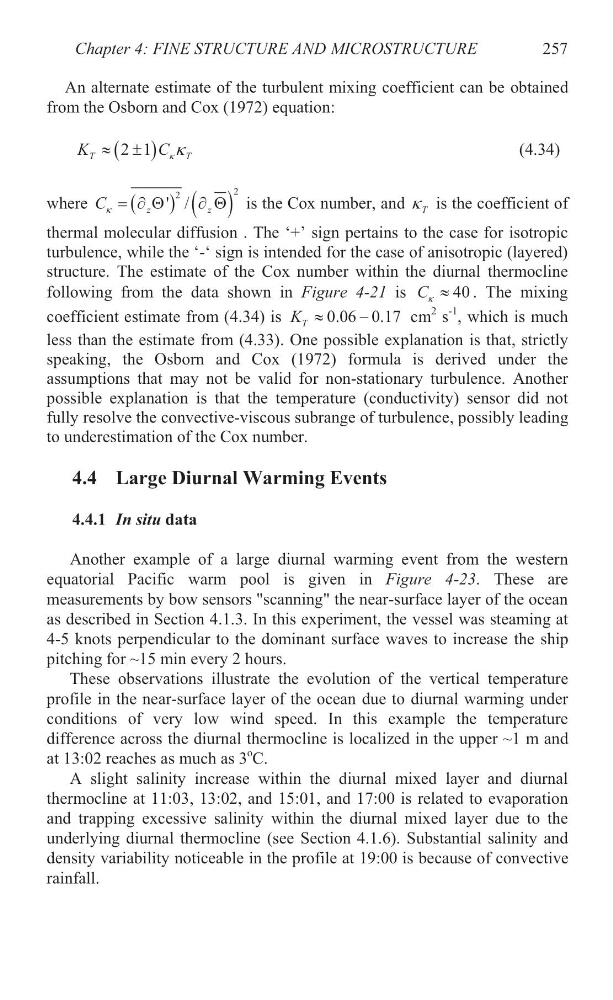
2 1
T
T
K
C N N
| r
(4.34)
where
2
2
' /
z
z
C N
w 4
w 4 is the Cox number, and T
N is the coefficient of
thermal molecular diffusion . The ‘+’ sign pertains to the case for isotropic
turbulence, while the ‘-‘ sign is intended for the case of anisotropic (layered)
structure. The estimate of the Cox number within the diurnal thermocline
following from the data shown in X Figure 4-21X is
40
C N | . The mixing
coefficient estimate from X (4.34)X is
0.06 0.17
T
K |
cmP
2
P
sP
-1
P,
which is much
less than the estimate from X (4.33)X . One possible explanation is that, strictly
speaking, the Osborn and Cox (1972) formula is derived under the
assumptions that may not be valid for non-stationary turbulence. Another
possible explanation is that the temperature (conductivity) sensor did not
fully resolve the convective-viscous subrange of turbulence, possibly leading
to underestimation of the Cox number.
4.4 Large Diurnal Warming Events
4.4.1 In situ data
Another example of a large diurnal warming event from the western
equatorial Pacific warm pool is given in X Figure 4-23X . These are
measurements by bow sensors "scanning" the near-surface layer of the ocean
as described in Section 4.1.3. In this experiment, the vessel was steaming at
4-5 knots perpendicular to the dominant surface waves to increase the ship
pitching for ~15 min every 2 hours.
These observations illustrate the evolution of the vertical temperature
profile in the near-surface layer of the ocean due to diurnal warming under
conditions of very low wind speed. In this example the temperature
difference across the diurnal thermocline is localized in the upper ~1 m and
at 13:02 reaches as much as 3P
o
PC.
A slight salinity increase within the diurnal mixed layer and diurnal
thermocline at 11:03, 13:02, and 15:01, and 17:00 is related to evaporation
and trapping excessive salinity within the diurnal mixed layer due to the
underlying diurnal thermocline (see Section X 4.1.6X ). Substantial salinity and
density variability noticeable in the profile at 19:00 is because of convective
rainfall.
257
An alternate estimate of the turbulent mixing coefficient can be obtained
from the Osborn and Cox (1972) equation:
2 1
T
T
K
C N N
| r
(4.34)
where
2
2
' /
z
z
C N
w 4
w 4 is the Cox number, and T
N is the coefficient of
thermal molecular diffusion . The ‘+’ sign pertains to the case for isotropic
turbulence, while the ‘-‘ sign is intended for the case of anisotropic (layered)
structure. The estimate of the Cox number within the diurnal thermocline
following from the data shown in X Figure 4-21X is
40
C N | . The mixing
coefficient estimate from X (4.34)X is
0.06 0.17
T
K |
cmP
2
P
sP
-1
P,
which is much
less than the estimate from X (4.33)X . One possible explanation is that, strictly
speaking, the Osborn and Cox (1972) formula is derived under the
assumptions that may not be valid for non-stationary turbulence. Another
possible explanation is that the temperature (conductivity) sensor did not
fully resolve the convective-viscous subrange of turbulence, possibly leading
to underestimation of the Cox number.
4.4 Large Diurnal Warming Events
4.4.1 In situ data
Another example of a large diurnal warming event from the western
equatorial Pacific warm pool is given in X Figure 4-23X . These are
measurements by bow sensors "scanning" the near-surface layer of the ocean
as described in Section 4.1.3. In this experiment, the vessel was steaming at
4-5 knots perpendicular to the dominant surface waves to increase the ship
pitching for ~15 min every 2 hours.
These observations illustrate the evolution of the vertical temperature
profile in the near-surface layer of the ocean due to diurnal warming under
conditions of very low wind speed. In this example the temperature
difference across the diurnal thermocline is localized in the upper ~1 m and
at 13:02 reaches as much as 3P
o
PC.
A slight salinity increase within the diurnal mixed layer and diurnal
thermocline at 11:03, 13:02, and 15:01, and 17:00 is related to evaporation
and trapping excessive salinity within the diurnal mixed layer due to the
underlying diurnal thermocline (see Section X 4.1.6X ). Substantial salinity and
density variability noticeable in the profile at 19:00 is because of convective
rainfall.
257