

THE NEAR-SURFACE LAYER OF THE OCEAN
Bezverkhny and Soloviev (1986) provide independent estimates of the
turbulent mixing coefficient KB T B obtained from fluctuation characteristics of
the velocity and temperature profiles shown in X Figure 4-21X . From the
fluctuation velocity signal they obtained estimates of bP
1/2
Pranging
from 0.2
cm sP
-1
P
to 0.3 cm sP
-1
P
in the diurnal thermocline (where b is the turbulent
kinetic energy). The turbulence length scale, l, estimated from the
temperature profiles (X Figure 4-21X ) within the diurnal thermocline was in the
range of 20 cm to 100 cm. Estimates of the mixing coefficient obtained with
the Kolmogorov’s (1942) formula
1/ 2
T
K lb ,
(4.33)
are within the range from 4 to 30 cmP
2
P
sP
-1
P,
consistent with the estimate
20
T
K | cmP
2
P
sP
-1
P
following from comparison of the average temperature
profiles with Barenblatt’s (1982) model.
256
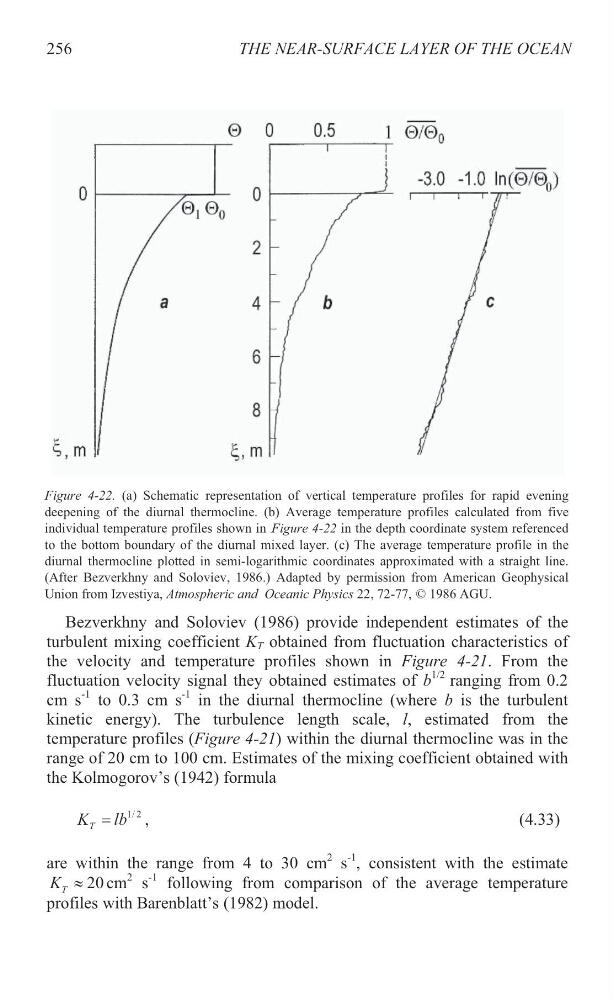
deepening of the diurnal thermocline. (b) Average temperature profiles calculated from five
individual temperature profiles shown in XFigure 4-22 in the depth coordinate system referenced
to the bottom boundary of the diurnal mixed layer. (c) The average temperature profile in the
diurnal thermocline plotted in semi-logarithmic coordinates approximated with a straight line.
(After Bezverkhny and Soloviev, 1986.) Adapted by permission from American Geophysical
Union from Izvestiya, Atmospheric and Oceanic Physics 22, 72-77, © 1986 AGU.
Figure 4-22. (a) Schematic representation of vertical temperature profiles for rapid evening
Bezverkhny and Soloviev (1986) provide independent estimates of the
turbulent mixing coefficient KB T B obtained from fluctuation characteristics of
the velocity and temperature profiles shown in X Figure 4-21X . From the
fluctuation velocity signal they obtained estimates of bP
1/2
Pranging
from 0.2
cm sP
-1
P
to 0.3 cm sP
-1
P
in the diurnal thermocline (where b is the turbulent
kinetic energy). The turbulence length scale, l, estimated from the
temperature profiles (X Figure 4-21X ) within the diurnal thermocline was in the
range of 20 cm to 100 cm. Estimates of the mixing coefficient obtained with
the Kolmogorov’s (1942) formula
1/ 2
T
K lb ,
(4.33)
are within the range from 4 to 30 cmP
2
P
sP
-1
P,
consistent with the estimate
20
T
K | cmP
2
P
sP
-1
P
following from comparison of the average temperature
profiles with Barenblatt’s (1982) model.
256
deepening of the diurnal thermocline. (b) Average temperature profiles calculated from five
individual temperature profiles shown in XFigure 4-22 in the depth coordinate system referenced
to the bottom boundary of the diurnal mixed layer. (c) The average temperature profile in the
diurnal thermocline plotted in semi-logarithmic coordinates approximated with a straight line.
(After Bezverkhny and Soloviev, 1986.) Adapted by permission from American Geophysical
Union from Izvestiya, Atmospheric and Oceanic Physics 22, 72-77, © 1986 AGU.
Figure 4-22. (a) Schematic representation of vertical temperature profiles for rapid evening