

THE NEAR-SURFACE LAYER OF THE OCEAN
0
0
0.5
t
D
D
u h
H
dt
W
U
c
'
'
³
,
(4.13)
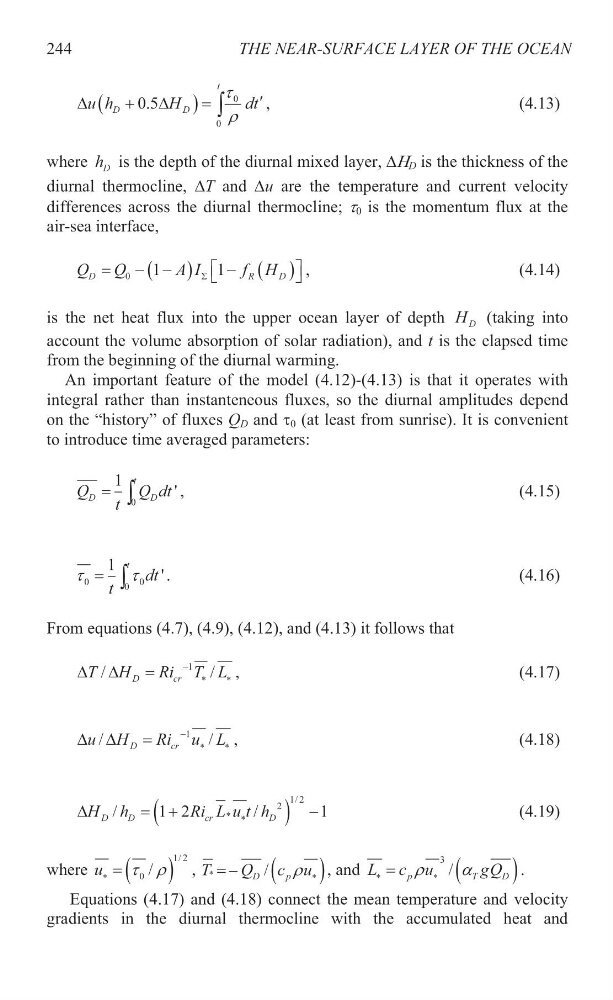
where D
h is the depth of the diurnal mixed layer, '+B D B is the thickness of the
diurnal thermocline, 'T and 'u are the temperature and current velocity
differences across the diurnal thermocline; WB 0 B is the momentum flux at the
air-sea interface,
0
1
1
D
RD
Q Q
A I
f H
6 ª
º
¬
¼ ,
(4.14)
is the net heat flux into the upper ocean layer of depth D
H (taking into
account the volume absorption of solar radiation), and t is the elapsed time
from the beginning of the diurnal warming.
An important feature of the model X (4.12)X -X (4.13)X is that it operates with
integral rather than instanteneous fluxes, so the diurnal amplitudes depend
on the “history” of fluxes QB D B and WB 0 B (at least from sunrise). It is convenient
to introduce time averaged parameters:
0
1
'
t
D
D
Q
Q dt
t ³
,
(4.15)
0
0
0
1
'
t
dt
t
W
W
³
.
(4.16)
From equations X (4.7)X , X (4.9)X , X (4.12)X , and X (4.13)X it follows that
1
/
/
D
c r
T H
Ri T L
' '
,
(4.17)
1
/
/
D
c r
u H
Ri u L
' '
,
(4.18)
1/ 2
2
/
1 2
/
1
D
D
c r
D
H h
Ri L u t h
'
(4.19)
where
1/ 2
0 /
u
W U
,
/
D
p
T
Q c u
U
, and
3
/
p
T
D
L c u
gQ
U
D
.
Equations X (4.17)X and X (4.18)X connect the mean temperature and velocity
gradients in the diurnal thermocline with the accumulated heat and
244
0
0
0.5
t
D
D
u h
H
dt
W
U
c
'
'
³
,
(4.13)
where D
h is the depth of the diurnal mixed layer, '+B D B is the thickness of the
diurnal thermocline, 'T and 'u are the temperature and current velocity
differences across the diurnal thermocline; WB 0 B is the momentum flux at the
air-sea interface,
0
1
1
D
RD
Q Q
A I
f H
6 ª
º
¬
¼ ,
(4.14)
is the net heat flux into the upper ocean layer of depth D
H (taking into
account the volume absorption of solar radiation), and t is the elapsed time
from the beginning of the diurnal warming.
An important feature of the model X (4.12)X -X (4.13)X is that it operates with
integral rather than instanteneous fluxes, so the diurnal amplitudes depend
on the “history” of fluxes QB D B and WB 0 B (at least from sunrise). It is convenient
to introduce time averaged parameters:
0
1
'
t
D
D
Q
Q dt
t ³
,
(4.15)
0
0
0
1
'
t
dt
t
W
W
³
.
(4.16)
From equations X (4.7)X , X (4.9)X , X (4.12)X , and X (4.13)X it follows that
1
/
/
D
c r
T H
Ri T L
' '
,
(4.17)
1
/
/
D
c r
u H
Ri u L
' '
,
(4.18)
1/ 2
2
/
1 2
/
1
D
D
c r
D
H h
Ri L u t h
'
(4.19)
where
1/ 2
0 /
u
W U
,
/
D
p
T
Q c u
U
, and
3
/
p
T
D
L c u
gQ
U
D
.
Equations X (4.17)X and X (4.18)X connect the mean temperature and velocity
gradients in the diurnal thermocline with the accumulated heat and
244