

Chapter 4: FINE STRUCTURE AND MICROSTRUCTURE
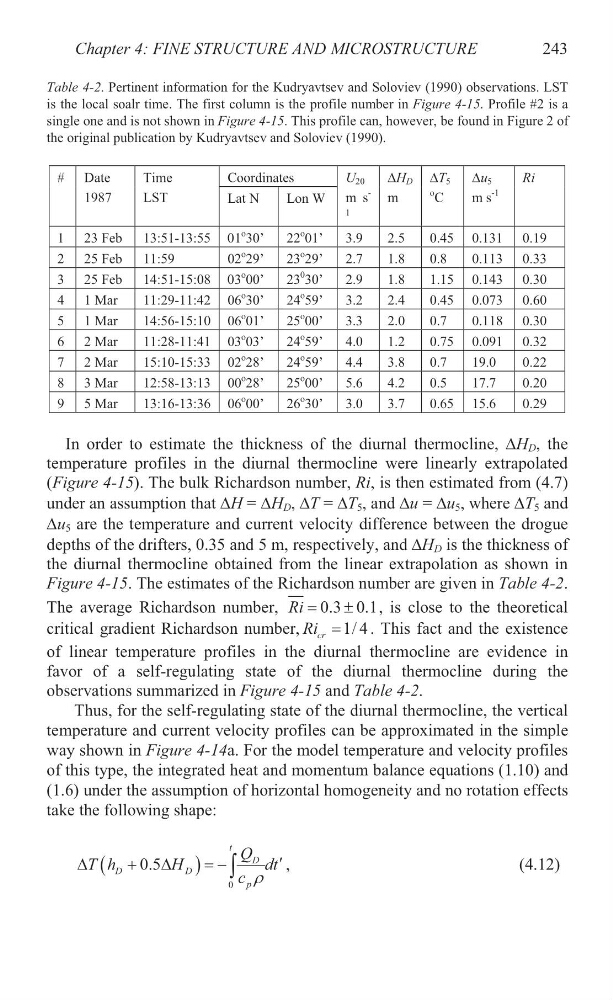
Table 4-2. Pertinent information for the Kudryavtsev and Soloviev (1990) observations. LST
is the local soalr time. The first column is the profile number in X Figure 4-15. Profile #2 is a
single one and is not shown in X Figure 4-15. This profile can, however, be found in Figure 2 of
the original publication by Kudryavtsev and Soloviev (1990).
Coordinates
# Date
1987
Time
LST
Lat N
Lon W
UB 20
m sP
-
1
P
'H D B
m
'TB 5
P
o
PC
'uB 5
m sP
-1
P
Ri
1 23 Feb
13:51-13:55 01P
o
P30’
22P
o
P01’
3.9
2.5
0.45 0.131 0.19
2 25 Feb
11:59
02P
o
P29’
23P
o
P29’
2.7
1.8
0.8
0.113 0.33
3 25 Feb
14:51-15:08 03P
o
P00’
23P
0
P30’
2.9
1.8
1.15 0.143 0.30
4 1 Mar
11:29-11:42 06P
o
P30’
24P
o
P59’
3.2
2.4
0.45 0.073 0.60
5 1 Mar
14:56-15:10 06P
o
P01’
25P
o
P00’
3.3
2.0
0.7
0.118 0.30
6 2 Mar
11:28-11:41 03P
o
P03’
24P
o
P59’
4.0
1.2
0.75 0.091 0.32
7 2 Mar
15:10-15:33 02P
o
P28’
24P
o
P59’
4.4
3.8
0.7
19.0
0.22
8 3 Mar
12:58-13:13 00P
o
P28’
25P
o
P00’
5.6
4.2
0.5
17.7
0.20
9 5 Mar
13:16-13:36 06P
o
P00’
26P
o
P30’
3.0
3.7
0.65 15.6
0.29
In order to estimate the thickness of the diurnal thermocline, 'HB D B , the
temperature profiles in the diurnal thermocline were linearly extrapolated
(Figure 4-15). The bulk Richardson number, Ri, is then estimated from X (4.7)X
under an assumption that 'H = 'HB D B , 'T = 'TB 5 B , and 'u = 'uB 5 B , where 'TB 5 B and
'uB 5 B are the temperature and current velocity difference between the drogue
depths of the drifters, 0.35 and 5 m, respectively, and 'H D B is the thickness of
the diurnal thermocline obtained from the linear extrapolation as shown in
X Figure 4-15. The estimates of the Richardson number are given in X Table 4-2X .
The average Richardson number,
0.3 0.1
Ri
r
, is close to the theoretical
critical gradient Richardson number,
1/ 4
cr
Ri
. This fact and the existence
of linear temperature profiles in the diurnal thermocline are evidence in
favor of a self-regulating state of the diurnal thermocline during the
observations summarized in X Figure 4-15 and X Table 4-2X .
Thus, for the self-regulating state of the diurnal thermocline, the vertical
temperature and current velocity profiles can be approximated in the simple
way shown in X Figure 4-14a. For the model temperature and velocity profiles
of this type, the integrated heat and momentum balance equations (1.10) and
(1.6) under the assumption of horizontal homogeneity and no rotation effects
take the following shape:
0
0.5
t
D
D
D
p
Q
T h
H
dt
c U
c
'
'
³
,
(4.12)
243
Table 4-2. Pertinent information for the Kudryavtsev and Soloviev (1990) observations. LST
is the local soalr time. The first column is the profile number in X Figure 4-15. Profile #2 is a
single one and is not shown in X Figure 4-15. This profile can, however, be found in Figure 2 of
the original publication by Kudryavtsev and Soloviev (1990).
Coordinates
# Date
1987
Time
LST
Lat N
Lon W
UB 20
m sP
-
1
P
'H D B
m
'TB 5
P
o
PC
'uB 5
m sP
-1
P
Ri
1 23 Feb
13:51-13:55 01P
o
P30’
22P
o
P01’
3.9
2.5
0.45 0.131 0.19
2 25 Feb
11:59
02P
o
P29’
23P
o
P29’
2.7
1.8
0.8
0.113 0.33
3 25 Feb
14:51-15:08 03P
o
P00’
23P
0
P30’
2.9
1.8
1.15 0.143 0.30
4 1 Mar
11:29-11:42 06P
o
P30’
24P
o
P59’
3.2
2.4
0.45 0.073 0.60
5 1 Mar
14:56-15:10 06P
o
P01’
25P
o
P00’
3.3
2.0
0.7
0.118 0.30
6 2 Mar
11:28-11:41 03P
o
P03’
24P
o
P59’
4.0
1.2
0.75 0.091 0.32
7 2 Mar
15:10-15:33 02P
o
P28’
24P
o
P59’
4.4
3.8
0.7
19.0
0.22
8 3 Mar
12:58-13:13 00P
o
P28’
25P
o
P00’
5.6
4.2
0.5
17.7
0.20
9 5 Mar
13:16-13:36 06P
o
P00’
26P
o
P30’
3.0
3.7
0.65 15.6
0.29
In order to estimate the thickness of the diurnal thermocline, 'HB D B , the
temperature profiles in the diurnal thermocline were linearly extrapolated
(Figure 4-15). The bulk Richardson number, Ri, is then estimated from X (4.7)X
under an assumption that 'H = 'HB D B , 'T = 'TB 5 B , and 'u = 'uB 5 B , where 'TB 5 B and
'uB 5 B are the temperature and current velocity difference between the drogue
depths of the drifters, 0.35 and 5 m, respectively, and 'H D B is the thickness of
the diurnal thermocline obtained from the linear extrapolation as shown in
X Figure 4-15. The estimates of the Richardson number are given in X Table 4-2X .
The average Richardson number,
0.3 0.1
Ri
r
, is close to the theoretical
critical gradient Richardson number,
1/ 4
cr
Ri
. This fact and the existence
of linear temperature profiles in the diurnal thermocline are evidence in
favor of a self-regulating state of the diurnal thermocline during the
observations summarized in X Figure 4-15 and X Table 4-2X .
Thus, for the self-regulating state of the diurnal thermocline, the vertical
temperature and current velocity profiles can be approximated in the simple
way shown in X Figure 4-14a. For the model temperature and velocity profiles
of this type, the integrated heat and momentum balance equations (1.10) and
(1.6) under the assumption of horizontal homogeneity and no rotation effects
take the following shape:
0
0.5
t
D
D
D
p
Q
T h
H
dt
c U
c
'
'
³
,
(4.12)
243