

THE NEAR-SURFACE LAYER OF THE OCEAN
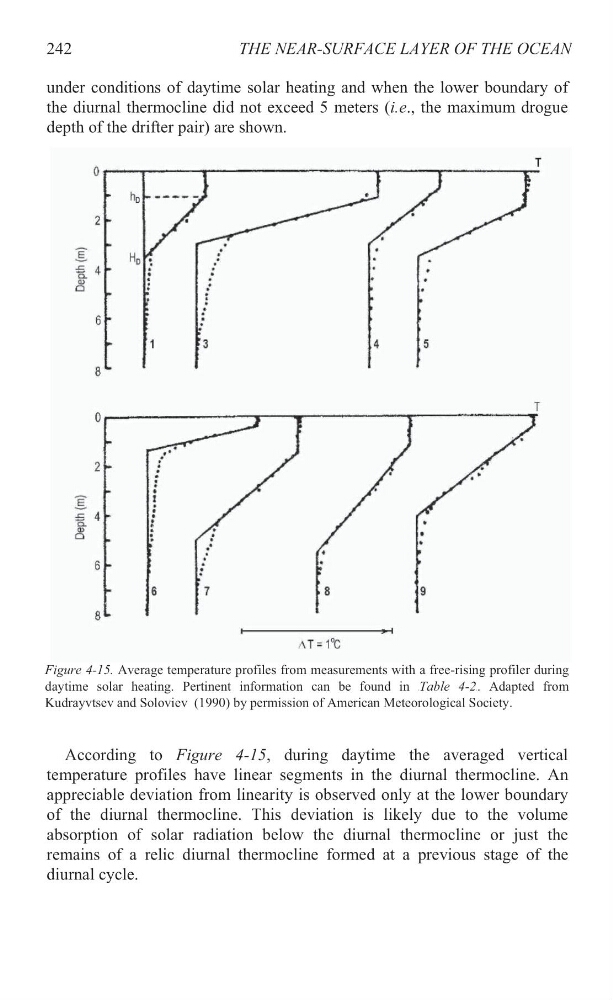
under conditions of daytime solar heating and when the lower boundary of
the diurnal thermocline did not exceed 5 meters (i.e., the maximum drogue
depth of the drifter pair) are shown.
According to X Figure 4-15, during daytime the averaged vertical
temperature profiles have linear segments in the diurnal thermocline. An
appreciable deviation from linearity is observed only at the lower boundary
of the diurnal thermocline. This deviation is likely due to the volume
absorption of solar radiation below the diurnal thermocline or just the
remains of a relic diurnal thermocline formed at a previous stage of the
diurnal cycle.
242
Figure 4-15. Average temperature profiles from measurements with a free-rising profiler during
daytime solar heating. Pertinent information can be found in XTable 4-2X . Adapted from
Kudrayvtsev and Soloviev (1990) by permission of American Meteorological Society.
under conditions of daytime solar heating and when the lower boundary of
the diurnal thermocline did not exceed 5 meters (i.e., the maximum drogue
depth of the drifter pair) are shown.
According to X Figure 4-15, during daytime the averaged vertical
temperature profiles have linear segments in the diurnal thermocline. An
appreciable deviation from linearity is observed only at the lower boundary
of the diurnal thermocline. This deviation is likely due to the volume
absorption of solar radiation below the diurnal thermocline or just the
remains of a relic diurnal thermocline formed at a previous stage of the
diurnal cycle.
242
Figure 4-15. Average temperature profiles from measurements with a free-rising profiler during
daytime solar heating. Pertinent information can be found in XTable 4-2X . Adapted from
Kudrayvtsev and Soloviev (1990) by permission of American Meteorological Society.