

Chapter 4: FINE STRUCTURE AND MICROSTRUCTURE
where KB 1 B and KB 2 B are nondimensional constants.
Relations X (4.10)X and X (4.11)X describe linear temperature and velocity
profiles. This is because the set of determining parameters no longer
includes vertical coordinate z, and no length scale can be produced
combining parameters
T g T
D
' and u
' . The interpretation is that in a
stable boundary layer the vertical size of turbulence eddies is restricted; the
turbulence is not directly affected by the presence of a boundary (the ocean
surface). As a result, the boundary layer structure no longer explicitly
depends on z (Neuwstadt, 1984).
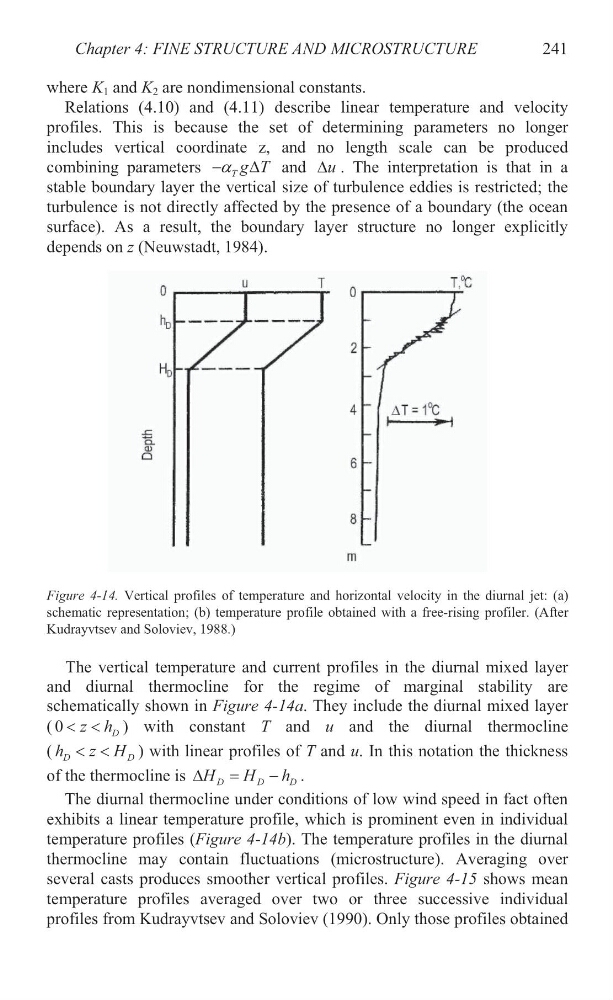
Figure 4-14. Vertical profiles of temperature and horizontal velocity in the diurnal jet: (a)
schematic representation; (b) temperature profile obtained with a free-rising profiler. (After
The vertical temperature and current profiles in the diurnal mixed layer
and diurnal thermocline for the regime of marginal stability are
schematically shown in X Figure 4-14a. They include the diurnal mixed layer
( 0
D
z h
) with constant T and u and the diurnal thermocline
( D
D
h
z H
) with linear profiles of T and u. In this notation the thickness
of the thermocline is
D
D
D
H
H
h
'
.
The diurnal thermocline under conditions of low wind speed in fact often
exhibits a linear temperature profile, which is prominent even in individual
temperature profiles (X Figure 4-14b). The temperature profiles in the diurnal
thermocline may contain fluctuations (microstructure). Averaging over
several casts produces smoother vertical profiles. X Figure 4-15 shows mean
temperature profiles averaged over two or three successive individual
profiles from Kudrayvtsev and Soloviev (1990). Only those profiles obtained
241
Kudrayvtsev and Soloviev, 1988.)
where KB 1 B and KB 2 B are nondimensional constants.
Relations X (4.10)X and X (4.11)X describe linear temperature and velocity
profiles. This is because the set of determining parameters no longer
includes vertical coordinate z, and no length scale can be produced
combining parameters
T g T
D
' and u
' . The interpretation is that in a
stable boundary layer the vertical size of turbulence eddies is restricted; the
turbulence is not directly affected by the presence of a boundary (the ocean
surface). As a result, the boundary layer structure no longer explicitly
depends on z (Neuwstadt, 1984).
Figure 4-14. Vertical profiles of temperature and horizontal velocity in the diurnal jet: (a)
schematic representation; (b) temperature profile obtained with a free-rising profiler. (After
The vertical temperature and current profiles in the diurnal mixed layer
and diurnal thermocline for the regime of marginal stability are
schematically shown in X Figure 4-14a. They include the diurnal mixed layer
( 0
D
z h
) with constant T and u and the diurnal thermocline
( D
D
h
z H
) with linear profiles of T and u. In this notation the thickness
of the thermocline is
D
D
D
H
H
h
'
.
The diurnal thermocline under conditions of low wind speed in fact often
exhibits a linear temperature profile, which is prominent even in individual
temperature profiles (X Figure 4-14b). The temperature profiles in the diurnal
thermocline may contain fluctuations (microstructure). Averaging over
several casts produces smoother vertical profiles. X Figure 4-15 shows mean
temperature profiles averaged over two or three successive individual
profiles from Kudrayvtsev and Soloviev (1990). Only those profiles obtained
241
Kudrayvtsev and Soloviev, 1988.)