

THE NEAR-SURFACE LAYER OF THE OCEAN
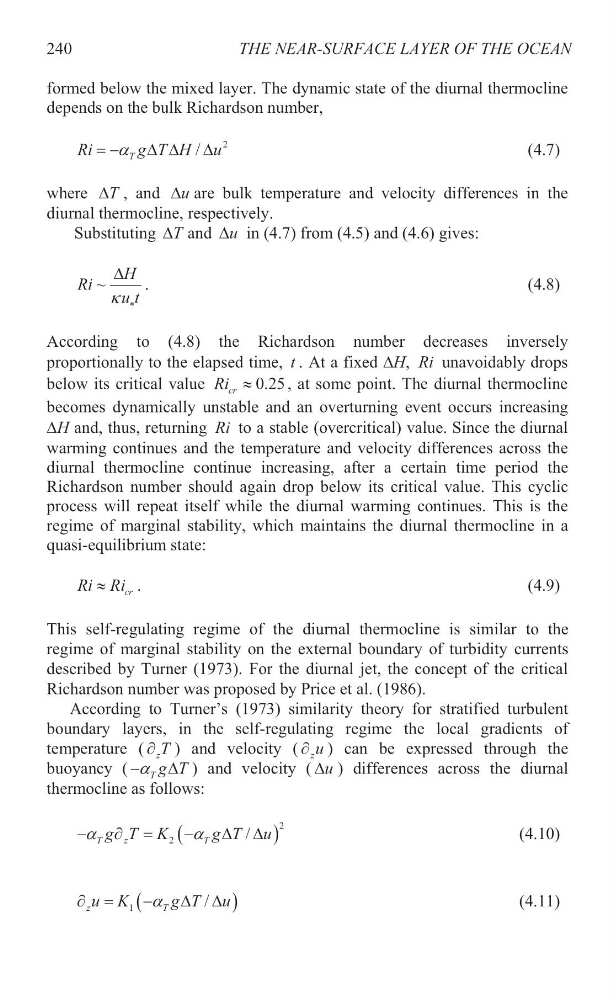
formed below the mixed layer. The dynamic state of the diurnal thermocline
depends on the bulk Richardson number,
2
/
T
Ri
g T H u
D
' ' '
(4.7)
where T
' , and u
' are bulk temperature and velocity differences in the
diurnal thermocline, respectively.
Substituting T
' and u
' in X (4.7)X from X (4.5)X and X (4.6)X gives:
~
H
Ri
u t
N
' .
(4.8)
According to X (4.8)X the Richardson number decreases inversely
proportionally to the elapsed time, t . At a fixed 'H, Ri unavoidably drops
below its critical value
0.25
cr
Ri |
, at some point. The diurnal thermocline
becomes dynamically unstable and an overturning event occurs increasing
'HB and, thus, returning Ri to a stable (overcritical) value. Since the diurnal
warming continues and the temperature and velocity differences across the
diurnal thermocline continue increasing, after a certain time period the
Richardson number should again drop below its critical value. This cyclic
process will repeat itself while the diurnal warming continues. This is the
regime of marginal stability, which maintains the diurnal thermocline in a
quasi-equilibrium state:
cr
Ri Ri
|
.
(4.9)
This self-regulating regime of the diurnal thermocline is similar to the
regime of marginal stability on the external boundary of turbidity currents
described by Turner (1973). For the diurnal jet, the concept of the critical
Richardson number was proposed by Price et al. (1986).
According to Turner’s (1973) similarity theory for stratified turbulent
boundary layers, in the self-regulating regime the local gradients of
temperature ( z T
w ) and velocity ( z u
w ) can be expressed through the
buoyancy ( T g T
D
' ) and velocity ( u
' ) differences across the diurnal
thermocline as follows:
2
2
/
T
z
T
g T K
g T u
D
D
w
' '
(4.10)
1
/
z
T
u K
g T u
D
w
' '
(4.11)
240
formed below the mixed layer. The dynamic state of the diurnal thermocline
depends on the bulk Richardson number,
2
/
T
Ri
g T H u
D
' ' '
(4.7)
where T
' , and u
' are bulk temperature and velocity differences in the
diurnal thermocline, respectively.
Substituting T
' and u
' in X (4.7)X from X (4.5)X and X (4.6)X gives:
~
H
Ri
u t
N
' .
(4.8)
According to X (4.8)X the Richardson number decreases inversely
proportionally to the elapsed time, t . At a fixed 'H, Ri unavoidably drops
below its critical value
0.25
cr
Ri |
, at some point. The diurnal thermocline
becomes dynamically unstable and an overturning event occurs increasing
'HB and, thus, returning Ri to a stable (overcritical) value. Since the diurnal
warming continues and the temperature and velocity differences across the
diurnal thermocline continue increasing, after a certain time period the
Richardson number should again drop below its critical value. This cyclic
process will repeat itself while the diurnal warming continues. This is the
regime of marginal stability, which maintains the diurnal thermocline in a
quasi-equilibrium state:
cr
Ri Ri
|
.
(4.9)
This self-regulating regime of the diurnal thermocline is similar to the
regime of marginal stability on the external boundary of turbidity currents
described by Turner (1973). For the diurnal jet, the concept of the critical
Richardson number was proposed by Price et al. (1986).
According to Turner’s (1973) similarity theory for stratified turbulent
boundary layers, in the self-regulating regime the local gradients of
temperature ( z T
w ) and velocity ( z u
w ) can be expressed through the
buoyancy ( T g T
D
' ) and velocity ( u
' ) differences across the diurnal
thermocline as follows:
2
2
/
T
z
T
g T K
g T u
D
D
w
' '
(4.10)
1
/
z
T
u K
g T u
D
w
' '
(4.11)
240