

Chapter 4: FINE STRUCTURE AND MICROSTRUCTURE
3
~
/
/
/
O
T
n
p
h L u
gQ c
L
ND
U
N
ª
º
¬
¼
,
(4.3)
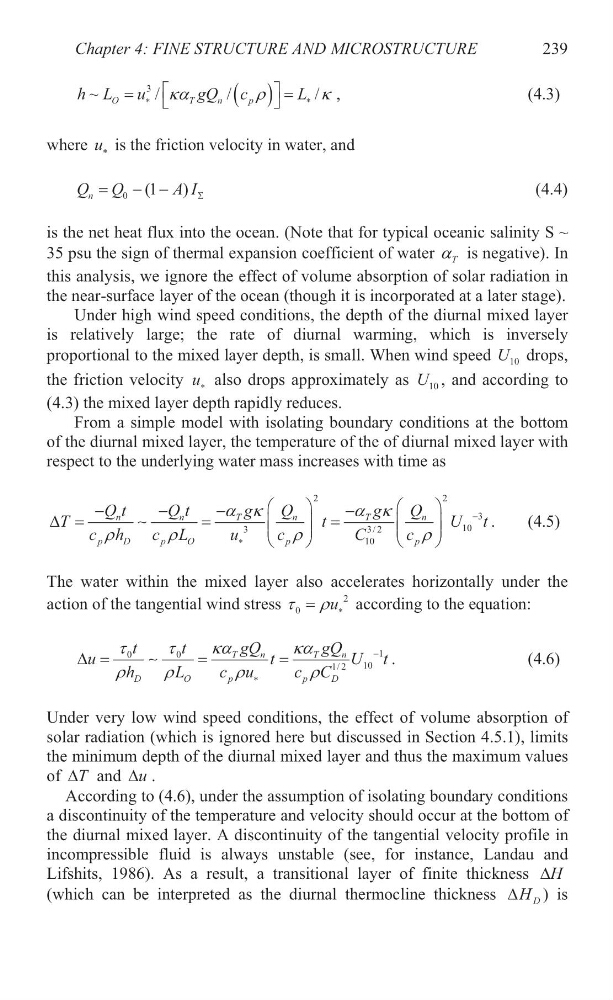
where u is the friction velocity in water, and
0
(1
)
n
Q Q
A I 6
(4.4)
is the net heat flux into the ocean. (Note that for typical oceanic salinity S ~
35 psu the sign of thermal expansion coefficient of water T
D is negative). In
this analysis, we ignore the effect of volume absorption of solar radiation in
the near-surface layer of the ocean (though it is incorporated at a later stage).
Under high wind speed conditions, the depth of the diurnal mixed layer
is relatively large; the rate of diurnal warming, which is inversely
proportional to the mixed layer depth, is small. When wind speed 10
U drops,
the friction velocity u also drops approximately as 10
U , and according to
X (4.3)X the mixed layer depth rapidly reduces.
From a simple model with isolating boundary conditions at the bottom
of the diurnal mixed layer, the temperature of the of diurnal mixed layer with
respect to the underlying water mass increases with time as
2
2
3
10
3
3 / 2
10
n
n
n
n
T
T
p
D
p
O
p
p
Q t
Q t
Q
Q
g
g
T
t
Ut
c h
c L
u
c
C
c
D N
D N
U
U
U
U
§
·
§
·
'
¨
¸
¨
¸
¨
¸
¨
¸
©
¹
©
¹
.
(4.5)
The water within the mixed layer also accelerates horizontally under the
action of the tangential wind stress
2
0
u
W U according to the equation:
1
0
0
10
1/ 2
T
n
T
n
D
O
p
p
D
t
t
gQ
gQ
u
t
U t
h
L
c u
c C
W
W
ND
ND
U
U
U
U
'
.
(4.6)
Under very low wind speed conditions, the effect of volume absorption of
the minimum depth of the diurnal mixed layer and thus the maximum values
of T
' and u
' .
According to X (4.6)X , under the assumption of isolating boundary conditions
a discontinuity of the temperature and velocity should occur at the bottom of
the diurnal mixed layer. A discontinuity of the tangential velocity profile in
incompressible fluid is always unstable (see, for instance, Landau and
Lifshits, 1986). As a result, a transitional layer of finite thickness H
'
(which can be interpreted as the diurnal thermocline thickness
D
H
' ) is
239
solar radiation (which is ignored here but discussed in Section 4.5.1), limits
3
~
/
/
/
O
T
n
p
h L u
gQ c
L
ND
U
N
ª
º
¬
¼
,
(4.3)
where u is the friction velocity in water, and
0
(1
)
n
Q Q
A I 6
(4.4)
is the net heat flux into the ocean. (Note that for typical oceanic salinity S ~
35 psu the sign of thermal expansion coefficient of water T
D is negative). In
this analysis, we ignore the effect of volume absorption of solar radiation in
the near-surface layer of the ocean (though it is incorporated at a later stage).
Under high wind speed conditions, the depth of the diurnal mixed layer
is relatively large; the rate of diurnal warming, which is inversely
proportional to the mixed layer depth, is small. When wind speed 10
U drops,
the friction velocity u also drops approximately as 10
U , and according to
X (4.3)X the mixed layer depth rapidly reduces.
From a simple model with isolating boundary conditions at the bottom
of the diurnal mixed layer, the temperature of the of diurnal mixed layer with
respect to the underlying water mass increases with time as
2
2
3
10
3
3 / 2
10
n
n
n
n
T
T
p
D
p
O
p
p
Q t
Q t
Q
Q
g
g
T
t
Ut
c h
c L
u
c
C
c
D N
D N
U
U
U
U
§
·
§
·
'
¨
¸
¨
¸
¨
¸
¨
¸
©
¹
©
¹
.
(4.5)
The water within the mixed layer also accelerates horizontally under the
action of the tangential wind stress
2
0
u
W U according to the equation:
1
0
0
10
1/ 2
T
n
T
n
D
O
p
p
D
t
t
gQ
gQ
u
t
U t
h
L
c u
c C
W
W
ND
ND
U
U
U
U
'
.
(4.6)
Under very low wind speed conditions, the effect of volume absorption of
the minimum depth of the diurnal mixed layer and thus the maximum values
of T
' and u
' .
According to X (4.6)X , under the assumption of isolating boundary conditions
a discontinuity of the temperature and velocity should occur at the bottom of
the diurnal mixed layer. A discontinuity of the tangential velocity profile in
incompressible fluid is always unstable (see, for instance, Landau and
Lifshits, 1986). As a result, a transitional layer of finite thickness H
'
(which can be interpreted as the diurnal thermocline thickness
D
H
' ) is
239
solar radiation (which is ignored here but discussed in Section 4.5.1), limits