

THE NEAR-SURFACE LAYER OF THE OCEAN
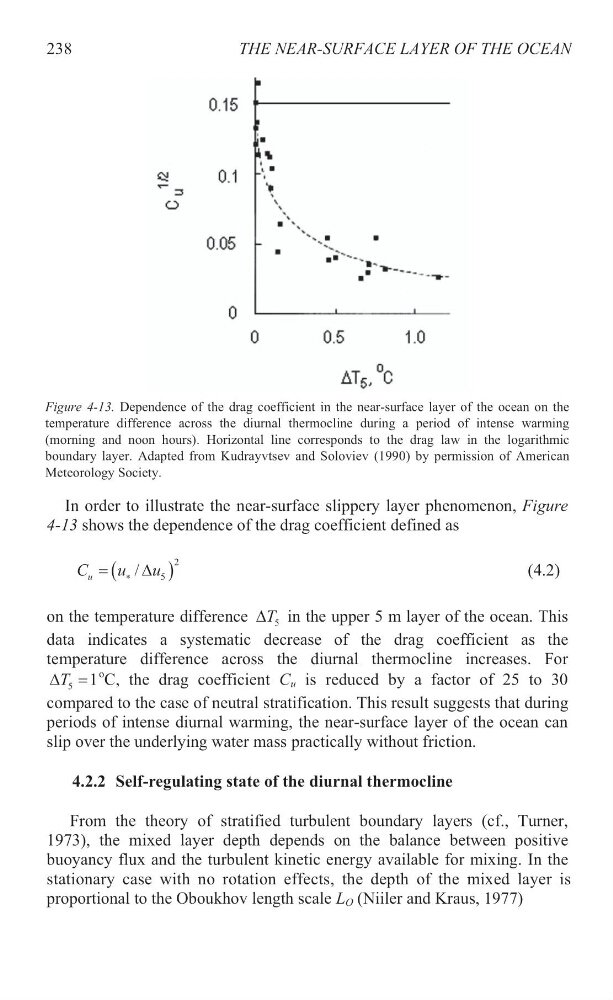
In order to illustrate the near-surface slippery layer phenomenon, X Figure
4-13 shows the dependence of the drag coefficient defined as
2
5
/
u
C
u
u
'
(4.2)
on the temperature difference
5
T
' in the upper 5 m layer of the ocean. This
data indicates a systematic decrease of the drag coefficient as the
temperature difference across the diurnal thermocline increases. For
5
1
T
'
P
o
PC,
the drag coefficient CB u B is reduced by a factor of 25 to 30
compared to the case of neutral stratification. This result suggests that during
periods of intense diurnal warming, the near-surface layer of the ocean can
slip over the underlying water mass practically without friction.
4.2.2 Self-regulating state of the diurnal thermocline
From the theory of stratified turbulent boundary layers (cf., Turner,
1973), the mixed layer depth depends on the balance between positive
buoyancy flux and the turbulent kinetic energy available for mixing. In the
stationary case with no rotation effects, the depth of the mixed layer is
proportional to the Oboukhov length scale LB O B (Niiler and Kraus, 1977)
238
Figure 4-13. Dependence of the drag coefficient in the near-surface layer of the ocean on the
temperature difference across the diurnal thermocline during a period of intense warming
(morning and noon hours). Horizontal line corresponds to the drag law in the logarithmic
boundary layer. Adapted from Kudrayvtsev and Soloviev (1990) by permission of American
Meteorology Society.
In order to illustrate the near-surface slippery layer phenomenon, X Figure
4-13 shows the dependence of the drag coefficient defined as
2
5
/
u
C
u
u
'
(4.2)
on the temperature difference
5
T
' in the upper 5 m layer of the ocean. This
data indicates a systematic decrease of the drag coefficient as the
temperature difference across the diurnal thermocline increases. For
5
1
T
'
P
o
PC,
the drag coefficient CB u B is reduced by a factor of 25 to 30
compared to the case of neutral stratification. This result suggests that during
periods of intense diurnal warming, the near-surface layer of the ocean can
slip over the underlying water mass practically without friction.
4.2.2 Self-regulating state of the diurnal thermocline
From the theory of stratified turbulent boundary layers (cf., Turner,
1973), the mixed layer depth depends on the balance between positive
buoyancy flux and the turbulent kinetic energy available for mixing. In the
stationary case with no rotation effects, the depth of the mixed layer is
proportional to the Oboukhov length scale LB O B (Niiler and Kraus, 1977)
238
Figure 4-13. Dependence of the drag coefficient in the near-surface layer of the ocean on the
temperature difference across the diurnal thermocline during a period of intense warming
(morning and noon hours). Horizontal line corresponds to the drag law in the logarithmic
boundary layer. Adapted from Kudrayvtsev and Soloviev (1990) by permission of American
Meteorology Society.