

Chapter 4: FINE STRUCTURE AND MICROSTRUCTURE
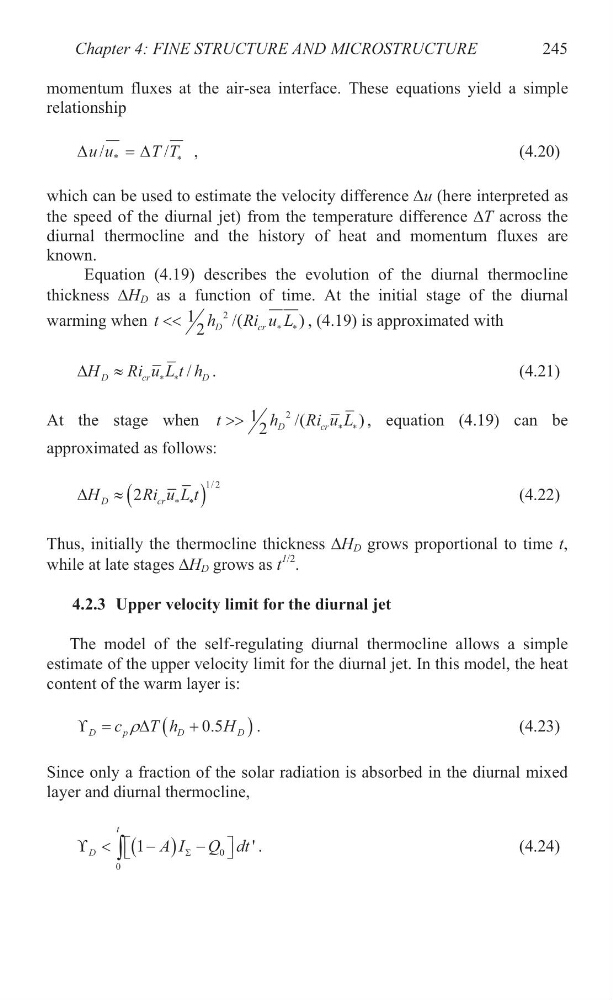
momentum fluxes at the air-sea interface. These equations yield a simple
relationship
*
/
/
u u
T T
'
'
,
(4.20)
which can be used to estimate the velocity difference 'u (here interpreted as
the speed of the diurnal jet) from the temperature difference 'T across the
diurnal thermocline and the history of heat and momentum fluxes are
known.
Equation X (4.19)X describes the evolution of the diurnal thermocline
thickness 'HB D B as a function of time. At the initial stage of the diurnal
warming when
2
1
/(
)
2 D
c r
t
h
Ri u L
, X (4.19)X is approximated with
/
D
c r
D
H
Ri u Lt h
'
|
.
(4.21)
At the stage when
2
1
/(
)
2 D
c r
t
h
Ri uL
!!
, equation X (4.19)X can be
approximated as follows:
1/ 2
2
D
c r
H
Ri u Lt
'
|
(4.22)
Thus, initially the thermocline thickness 'HB D B grows proportional to time t,
while at late stages 'HB D B grows as tP
1/2
P.
4.2.3 Upper velocity limit for the diurnal jet
The model of the self-regulating diurnal thermocline allows a simple
estimate of the upper velocity limit for the diurnal jet. In this model, the heat
content of the warm layer is:
0.5
D
p
D
D
c
T h
H
U
b
'
.
(4.23)
Since only a fraction of the solar radiation is absorbed in the diurnal mixed
layer and diurnal thermocline,
0
0
1
'
t
D
A I Q dt
6
b ª
º
¬
¼
³
.
(4.24)
245
momentum fluxes at the air-sea interface. These equations yield a simple
relationship
*
/
/
u u
T T
'
'
,
(4.20)
which can be used to estimate the velocity difference 'u (here interpreted as
the speed of the diurnal jet) from the temperature difference 'T across the
diurnal thermocline and the history of heat and momentum fluxes are
known.
Equation X (4.19)X describes the evolution of the diurnal thermocline
thickness 'HB D B as a function of time. At the initial stage of the diurnal
warming when
2
1
/(
)
2 D
c r
t
h
Ri u L
, X (4.19)X is approximated with
/
D
c r
D
H
Ri u Lt h
'
|
.
(4.21)
At the stage when
2
1
/(
)
2 D
c r
t
h
Ri uL
!!
, equation X (4.19)X can be
approximated as follows:
1/ 2
2
D
c r
H
Ri u Lt
'
|
(4.22)
Thus, initially the thermocline thickness 'HB D B grows proportional to time t,
while at late stages 'HB D B grows as tP
1/2
P.
4.2.3 Upper velocity limit for the diurnal jet
The model of the self-regulating diurnal thermocline allows a simple
estimate of the upper velocity limit for the diurnal jet. In this model, the heat
content of the warm layer is:
0.5
D
p
D
D
c
T h
H
U
b
'
.
(4.23)
Since only a fraction of the solar radiation is absorbed in the diurnal mixed
layer and diurnal thermocline,
0
0
1
'
t
D
A I Q dt
6
b ª
º
¬
¼
³
.
(4.24)
245