

THE NEAR-SURFACE LAYER OF THE OCEAN
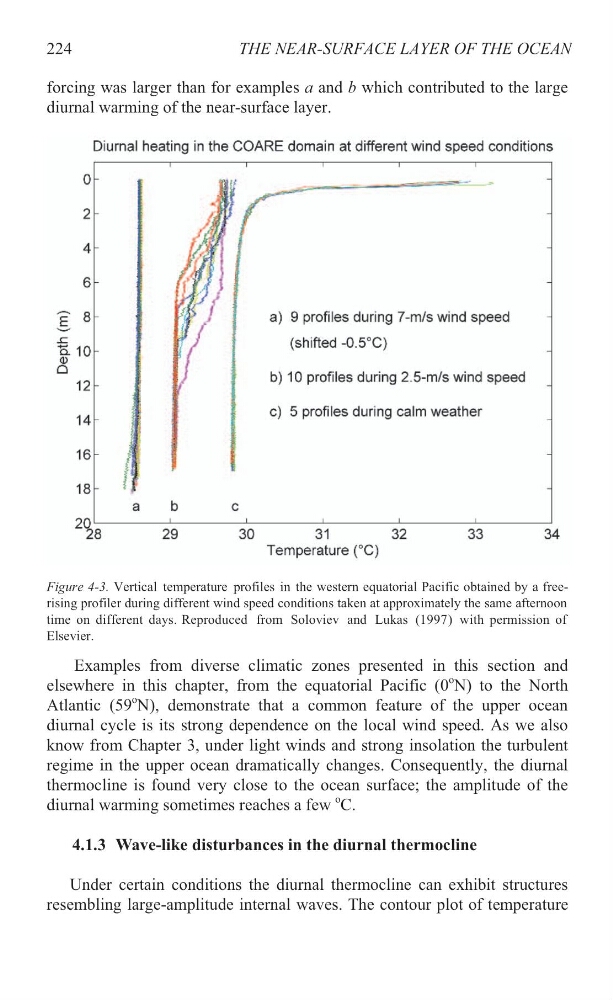
forcing was larger than for examples a and b which contributed to the large
diurnal warming of the near-surface layer.
Examples from diverse climatic zones presented in this section and
elsewhere in this chapter, from the equatorial Pacific (0P
o
PN)
to the North
Atlantic (59P
o
PN),
demonstrate that a common feature of the upper ocean
diurnal cycle is its strong dependence on the local wind speed. As we also
know from Chapter 3, under light winds and strong insolation the turbulent
regime in the upper ocean dramatically changes. Consequently, the diurnal
thermocline is found very close to the ocean surface; the amplitude of the
diurnal warming sometimes reaches a few P
o
PC.
4.1.3 Wave-like disturbances in the diurnal thermocline
Under certain conditions the diurnal thermocline can exhibit structures
resembling large-amplitude internal waves. The contour plot of temperature
224
Figure 4-3. Vertical temperature profiles in the western equatorial Pacific obtained by a freerising profiler during different wind speed conditions taken at approximately the same afternoon
time on different days. Reproduced from Soloviev and Lukas (1997) with permission of
Elsevier.
forcing was larger than for examples a and b which contributed to the large
diurnal warming of the near-surface layer.
Examples from diverse climatic zones presented in this section and
elsewhere in this chapter, from the equatorial Pacific (0P
o
PN)
to the North
Atlantic (59P
o
PN),
demonstrate that a common feature of the upper ocean
diurnal cycle is its strong dependence on the local wind speed. As we also
know from Chapter 3, under light winds and strong insolation the turbulent
regime in the upper ocean dramatically changes. Consequently, the diurnal
thermocline is found very close to the ocean surface; the amplitude of the
diurnal warming sometimes reaches a few P
o
PC.
4.1.3 Wave-like disturbances in the diurnal thermocline
Under certain conditions the diurnal thermocline can exhibit structures
resembling large-amplitude internal waves. The contour plot of temperature
224
Figure 4-3. Vertical temperature profiles in the western equatorial Pacific obtained by a freerising profiler during different wind speed conditions taken at approximately the same afternoon
time on different days. Reproduced from Soloviev and Lukas (1997) with permission of
Elsevier.