

0
0
/
/
T
p
S
E
gQ c
S gQ L
H
D
U E
U
,
(3.96)
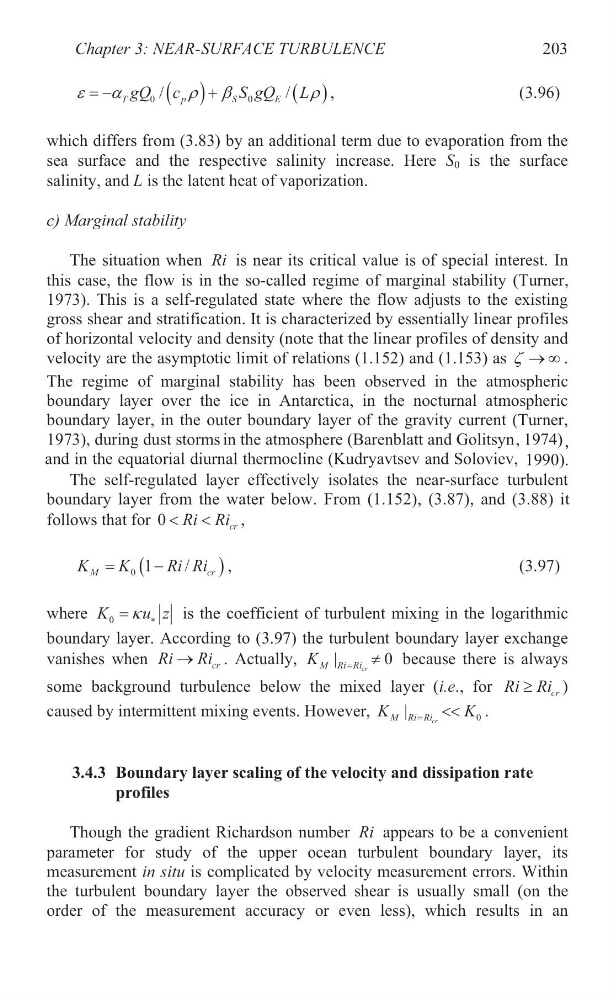
which differs from (3.83) by an additional term due to evaporation from the
sea surface and the respective salinity increase. Here S 0 is the surface
salinity, and L is the latent heat of vaporization.
c) Marginal stability
The situation when Ri is near its critical value is of special interest. In
this case, the flow is in the so-called regime of marginal stability (Turner,
1973). This is a self-regulated state where the flow adjusts to the existing
gross shear and stratification. It is characterized by essentially linear profiles
of horizontal velocity and density (note that the linear profiles of density and
The regime of marginal stability has been observed in the atmospheric
boundary layer over the ice in Antarctica, in the nocturnal atmospheric
boundary layer, in the outer boundary layer of the gravity current (Turner,
,
and in the equatorial diurnal thermocline (Kudryavtsev and Soloviev, 1990).
The self-regulated layer effectively isolates the near-surface turbulent
follows that for 0
cr
Ri Ri
,
0 1
/
M
c r
K
K
Ri Ri
,
(3.97)
where 0
K
u z
N
is the coefficient of turbulent mixing in the logarithmic
boundary layer. According to (3.97) the turbulent boundary layer exchange
vanishes when
cr
Ri Ri
o
. Actually,
|
0
cr
M Ri Ri
K
z because there is always
some background turbulence below the mixed layer (i.e., for
cr
Ri Ri
t
)
caused by intermittent mixing events. However,
0
|
cr
M Ri Ri
K
K
.
3.4.3 Boundary layer scaling of the velocity and dissipation rate
profiles
Though the gradient Richardson number Ri appears to be a convenient
parameter for study of the upper ocean turbulent boundary layer, its
measurement in situ is complicated by velocity measurement errors. Within
the turbulent boundary layer the observed shear is usually small (on the
order of the measurement accuracy or even less), which results in an
Chapter 3: NEAR-SURFACE TURBULENCE
203
velocity are the asymptotic limit of relations (1.152) and (1.153) as ] o f .
boundary layer from the water below. From (1.152), (3.87), and (3.88) it
1973), during dust storms in the atmosphere (Barenblatt and Golitsyn, 1974)
0
/
/
T
p
S
E
gQ c
S gQ L
H
D
U E
U
,
(3.96)
which differs from (3.83) by an additional term due to evaporation from the
sea surface and the respective salinity increase. Here S 0 is the surface
salinity, and L is the latent heat of vaporization.
c) Marginal stability
The situation when Ri is near its critical value is of special interest. In
this case, the flow is in the so-called regime of marginal stability (Turner,
1973). This is a self-regulated state where the flow adjusts to the existing
gross shear and stratification. It is characterized by essentially linear profiles
of horizontal velocity and density (note that the linear profiles of density and
The regime of marginal stability has been observed in the atmospheric
boundary layer over the ice in Antarctica, in the nocturnal atmospheric
boundary layer, in the outer boundary layer of the gravity current (Turner,
,
and in the equatorial diurnal thermocline (Kudryavtsev and Soloviev, 1990).
The self-regulated layer effectively isolates the near-surface turbulent
follows that for 0
cr
Ri Ri
,
0 1
/
M
c r
K
K
Ri Ri
,
(3.97)
where 0
K
u z
N
is the coefficient of turbulent mixing in the logarithmic
boundary layer. According to (3.97) the turbulent boundary layer exchange
vanishes when
cr
Ri Ri
o
. Actually,
|
0
cr
M Ri Ri
K
z because there is always
some background turbulence below the mixed layer (i.e., for
cr
Ri Ri
t
)
caused by intermittent mixing events. However,
0
|
cr
M Ri Ri
K
K
.
3.4.3 Boundary layer scaling of the velocity and dissipation rate
profiles
Though the gradient Richardson number Ri appears to be a convenient
parameter for study of the upper ocean turbulent boundary layer, its
measurement in situ is complicated by velocity measurement errors. Within
the turbulent boundary layer the observed shear is usually small (on the
order of the measurement accuracy or even less), which results in an
Chapter 3: NEAR-SURFACE TURBULENCE
203
velocity are the asymptotic limit of relations (1.152) and (1.153) as ] o f .
boundary layer from the water below. From (1.152), (3.87), and (3.88) it
1973), during dust storms in the atmosphere (Barenblatt and Golitsyn, 1974)